1871 G50C BG-912 (Regular Strike)
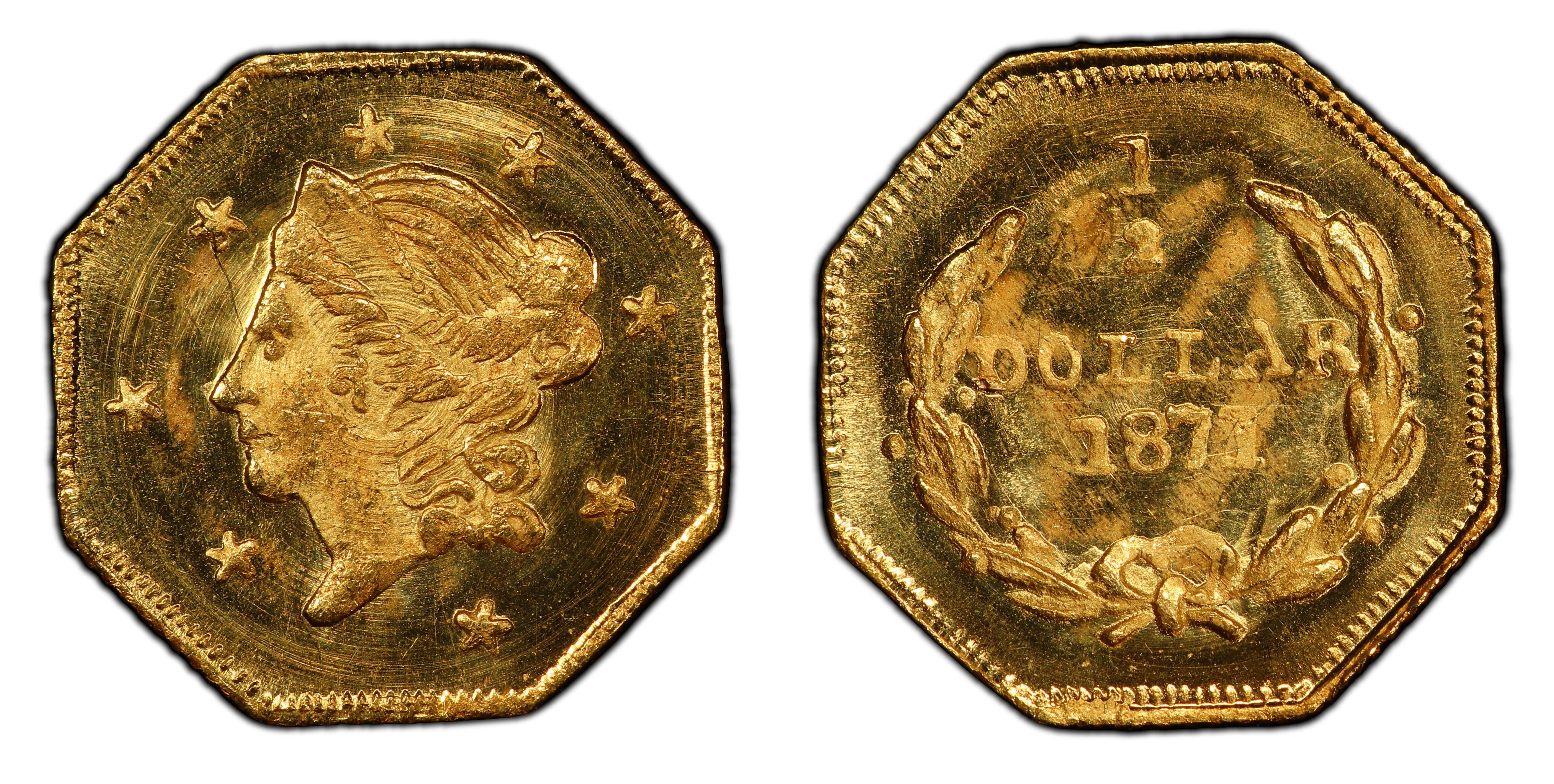
Obverse & Reverse
The 1871 Octagonal Liberty Head 50 Cents, cataloged as BG-912, is a product of the second great wave of private small-denomination gold coin production in California. Unlike the 'Period One' (1852-1857) issues, which were struck out of a genuine commercial need to alleviate a shortage of small change during the initial Gold Rush boom, the 'Period Two' (1859-1882) pieces were created primarily as souvenirs and keepsakes. By the 1870s, the United States Mint in San Francisco was in full operation, producing ample federal coinage for daily transactions. The romance and allure of the Gold Rush, however, had not faded. Jewelers and private minters like the firm of Frontier & Deviercy recognized a robust market for mementos of the 'Days of '49.' These tiny, intricate gold tokens were popular with tourists, locals, and East Coast residents fascinated by the Wild West. They were often incorporated into jewelry, such as stickpins, cufflinks, and watch fobs. The Coinage Act of 1864 had made the private minting of coinage illegal, but enforcement was lax, particularly for pieces that were clearly underweight and intended as novelties rather than circulating currency. The jewelers continued production, often backdating their pieces to pre-1864 dates to feign legality, though this 1871-dated piece was struck contemporaneously. The BG-912 variety is a quintessential example of these later 'jeweler's issues,' prized not for its intrinsic value—which was significantly less than its face value—but for its charm and historical association with one of America's most defining eras. Their continued production into the early 1880s was finally halted by more stringent enforcement by the Secret Service, bringing an end to the fascinating chapter of California Fractional Gold.
Associated EventPost-Gold Rush California Commerce
Reason For MintingPrimarily created to be sold as souvenirs and novelties capitalizing on the romanticism of the California Gold Rush.
Minter HistoryThe firm of Frontier & Deviercy was a prominent San Francisco jeweler and a prolific producer of Period Two California Fractional Gold. Pierre Frontier and Eugene Deviercy were active in the 1850s and 1860s, succeeding the earlier private minter Alexandre Dubois. The firm went through several partnership changes, becoming Frontier & Co. and later Frontier & Bellemere. They utilized common die punches across many of their issues, a characteristic that helps numismatists attribute their work. Their establishment was located on Pine Street in San Francisco, where they produced a wide variety of these popular gold tokens for the souvenir trade.
Historical SignificanceThe BG-912 represents the commercialization of the Gold Rush legacy. While not used in daily commerce, these Period Two tokens are historically significant as a tangible link to California's identity in the late 19th century and the enduring national fascination with the West. They are a distinct and collectible series that tells a story of numismatic souvenirs rather than emergency money.
K-N/A
Denomination50 Cents
Minting Period1871
Assayer/MinterFrontier & Deviercy (Successors)
Geographic OriginSan Francisco, California
Obverse DescriptionA head of Liberty facing left, her hair tied in a bun. She is surrounded by 13 six-pointed stars, seven to the left and six to the right. The date '1871' is below the bust truncation.
Obverse Inscription1871
Reverse DescriptionThe denomination '1/2' is centered within a wreath composed of two olive branches. The wreath is open at the top and tied with a bow at the bottom. The legend 'DOLLAR CAL' appears just inside the upper rim, above the wreath.
Reverse Inscription1/2 DOLLAR CAL
CompositionGold
Stated Fineness Actual FinenessVariable, typically lower than federal coinage, often around .500 to .750 fine.
Weight0.25 grams
Diameter10.00 mm
EdgePlain
Unknown
Survival Estimate200-300
Rarity ScaleR-3 (Scarce)
This coin is popular for its classic Liberty Head design, octagonal shape, and direct connection to the romantic era of post-Gold Rush San Francisco. As an R-3 variety, it is scarce but obtainable, making it a desirable piece for type collectors and specialists in the extensive California Fractional Gold series.
Key VarietiesThe primary distinction for this issue is its classification as a 'Period Two' (1859-1882) regular business strike, intended as a souvenir. No contemporary proofs are known. Collectors should differentiate it from 'Period One' (1852-1857) issues, which were intended for circulation and are generally rarer and more valuable. There are no known major die varieties for BG-912 itself, but the broader series includes hundreds of Breen-Gillio varieties with differences in dates, designs, and minters.
Authentication TipsGenuine examples of BG-912 exhibit sharp, well-defined details, particularly in Liberty's hair and the leaves of the wreath. The numerals in the date and letters in the legend should be of a consistent, professional style characteristic of Frontier & Deviercy's punches. Counterfeits are often crude, with mushy details, incorrect letter/numeral shapes, or a soapy, cast-like surface. Many fakes lack a denomination and instead say 'CAL GOLD CHARM,' a key diagnostic. Weight and size can be inconsistent on genuine pieces but should be within a reasonable tolerance of known examples. Third-party grading is highly recommended.
Shopping ConsiderationsA premium quality example for its grade will possess a sharp, full strike, as these were often weakly produced. Look for crispness on Liberty's coronet, the date, and the fine details of the wreath. Original, lustrous surfaces command a significant premium; many surviving examples have been cleaned, polished, or used in jewelry, showing evidence of soldering or harsh abrasions. Avoid pieces described as 'tooled' or having 'repaired damage.' Attractive, original reddish-gold or yellow-gold toning adds to the eye appeal and value. A coin certified by PCGS or NGC, especially with a CAC sticker, provides the best assurance of authenticity and quality.
A coin's grade is its condition, rated on a 1-70 scale. For rare coins, this is the most critical factor in determining value, as a tiny difference in preservation can mean a huge difference in price.
Relevant Grade TypesOriginal 1871 BG-912 issues were all business strikes intended for sale as souvenirs, not circulation. They are found in Circulated grades (AU-58 and below, typically from handling or jewelry use) and Mint State grades (MS, 60-70). No proofs were struck during the original period of issue. Any piece described as a 'Proof' would refer to modern replicas or fantasy pieces and should not be confused with these historic originals.
Mint State CharacteristicsUncirculated examples of BG-912 are defined by their luster, which is typically frosty and satiny rather than deeply prooflike. The strike can be inconsistent; a well-centered strike with full definition on the highest points (Liberty's hair bun and the bow of the wreath) is highly desirable. Small, scattered contact marks are common due to the softness of the gold and the way these pieces were handled in bulk by the jewelers who made them. Unmarked fields and strong luster are the hallmarks of a premium Mint State example.
Circulated Wear PatternsWear first appears on the highest points of the design. On the obverse, friction will dull the luster and flatten the details of Liberty's hair above the eye and ear, as well as the highest strands of the bun. On the reverse, the high points of the wreath's leaves and the knot of the bow will show the first signs of wear. In lower grades (VF and below), the stars and legends will begin to weaken and merge with the fields.
Key Factors For ValueThe primary driver of value is the certified grade. Beyond the number, surface quality is paramount; an example with original, undisturbed luster will always be worth more than a cleaned or polished coin of the same grade. Strike quality is a major factor, with sharply struck pieces commanding significant premiums. Eye appeal, enhanced by attractive original toning, also plays a crucial role. Finally, for high-grade examples, certification by a top-tier service (PCGS or NGC) is standard, and the addition of a CAC sticker for superior quality can add substantially to the coin's market value.
PCGS Price Guide
| Grade | Price | Population |
|---|---|---|
| 45 | $190.00 | 1 |
| 45+ | $195.00 | N/A |
| 50 | $200.00 | 2 |
| 50+ | $205.00 | N/A |
| 53 | $210.00 | N/A |
| 53+ | $215.00 | N/A |
| 55 | $220.00 | 5 |
| 55+ | $230.00 | N/A |
| 58 | $250.00 | 11 |
| 58+ | $265.00 | N/A |
| 60 | $285.00 | 2 |
| 61 | $300.00 | 9 |
| 62 | $325.00 | 48 |
| 62+ | $345.00 | N/A |
| 63 | $425.00 | 52 |
| 63+ | $475.00 | N/A |
| 64 | $550.00 | 37 |
| 64+ | $600.00 | N/A |
| 65 | $800.00 | 8 |
| 65+ | $1,000.00 | N/A |
| 66 | $1,450.00 | 1 |
| 66+ | $1,700.00 | N/A |
| 67 | $2,350.00 | 2 |