1874 G25C BG-875, PL (Regular Strike)
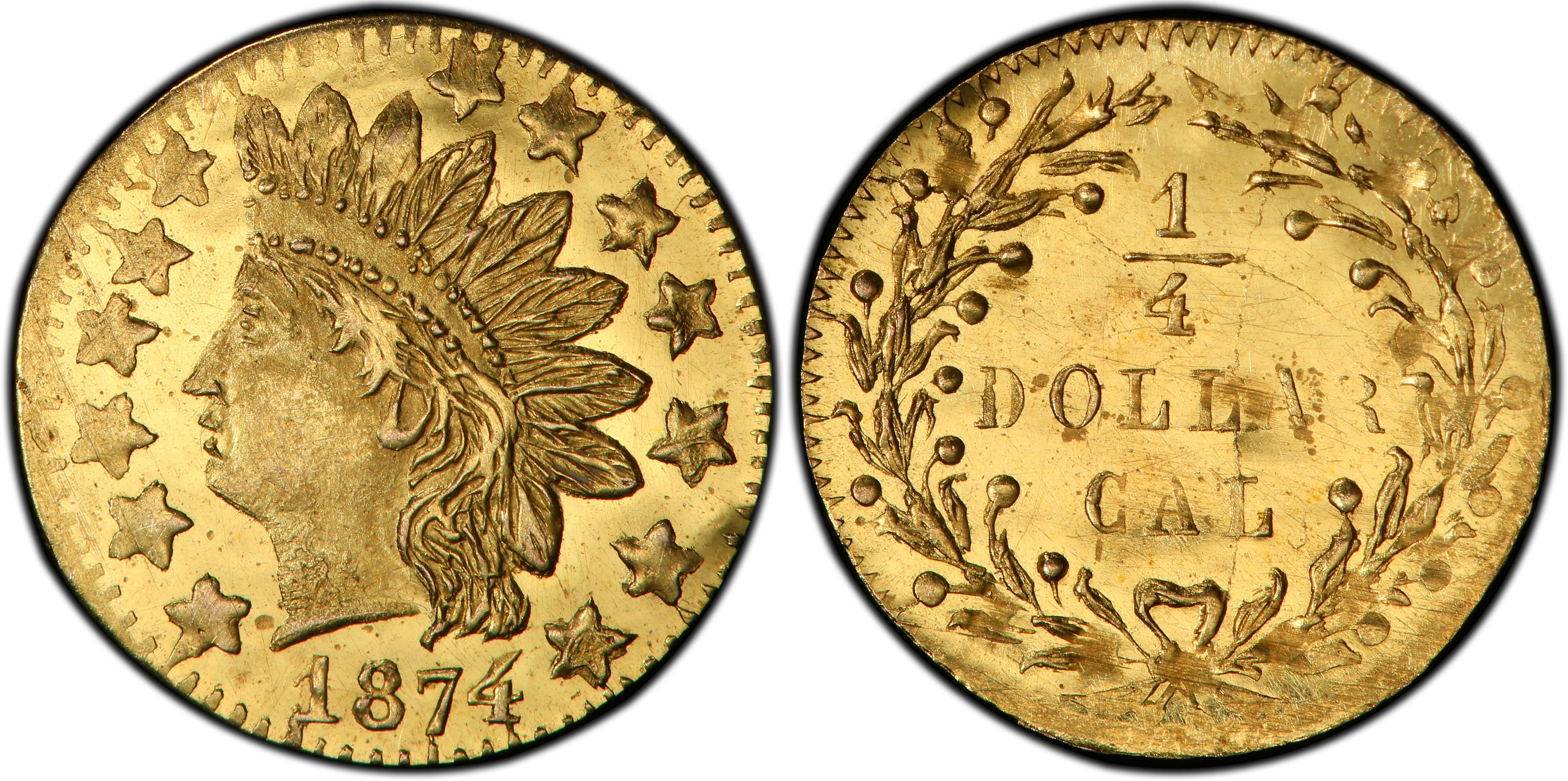
Obverse & Reverse
The 1874 BG-875 25 Cents is a quintessential example of a 'Period Two' California Fractional Gold piece. By the mid-1870s, the initial, desperate shortage of small change that characterized the Gold Rush (leading to the heavier, more substantial 'Period One' issues of 1852-1856) had largely subsided. The San Francisco Mint was in full operation, producing ample federal silver coinage. However, the allure of gold and the tradition of using small, privately-made gold pieces for transactions and as keepsakes persisted. This era saw a proliferation of so-called 'jeweler's issues,' which were manufactured by various, often anonymous, jewelers and artisans in San Francisco. These pieces were not strictly intended to fill a monetary void in the same way as their predecessors. Instead, they served a dual purpose: as a convenient, if often underweight, medium of exchange in local commerce, and increasingly as popular souvenirs for tourists and trinkets for locals. Unlike many earlier issues or those from specific makers like Robert B. Gray & Co. (who often marked his coins with a 'G'), the BG-875 is unattributed, a common feature for this period. Its production occurred after the Coinage Act of 1864, which prohibited private coinage, but enforcement was lax in California until the Secret Service finally cracked down in 1883. Thus, these pieces were made in a legally gray area, often with deliberately crude or simplified designs. The Indian Head motif was a popular design choice, likely emulating the design of the U.S. Indian Head cent and the larger gold dollars, lending it a familiar and somewhat official appearance that would have been comforting to users. Their diminutive size and actual gold content made them an affordable and tangible piece of the California dream for those who could not afford larger gold coins.
Associated EventPost-Gold Rush Economic Expansion
Reason For MintingTo serve a continued, localized need for small denomination currency and to be sold as popular souvenirs and jewelry items.
Minter HistoryThe BG-875 is not attributed to a specific, known minter. It is classified as a 'jeweler's issue' from the second period of fractional gold production (1859-1882). During this time, many San Francisco jewelers produced these small gold pieces, often anonymously and without distinctive maker's marks, to avoid potential legal repercussions following the Coinage Act of 1864.
Historical SignificanceThis coin represents the transition of fractional gold from a necessary form of currency to a more commercially-driven souvenir and novelty item. It is a tangible artifact from the later, more settled period of San Francisco's 19th-century development, reflecting a persistent local attachment to gold long after the federal government had established official coinage in the region.
N/A
Denomination25 Cents
Minting Period1874
Assayer/MinterUnknown Jeweler
Geographic OriginSan Francisco, California
Obverse DescriptionA stylized Indian Head facing left, surrounded by thirteen stars. The date '1874' appears below the bust. The portrait is typically rendered with simple, somewhat crude details, characteristic of many later-period jeweler's issues.
Obverse Inscription1874
Reverse DescriptionThe denomination '1/4 DOLLAR' is enclosed within a wreath of leaves and berries. The wreath is open at the top.
Reverse Inscription1/4 DOLLAR
CompositionGold
Stated Fineness Actual FinenessVariable, but typically lower than official U.S. coinage of the era, ranging from .500 to .800 fine.
Weight0.25 grams
Diameter10.00 mm
EdgePlain
Unknown
Survival Estimate75-125
Rarity ScaleR-4+
The BG-875 is popular among collectors for its classic Indian Head design, affordability relative to rarer Period One issues, and its status as a representative 'jeweler's issue' from a fascinating period of private currency production. Its high R-4+ rarity ensures it is challenging to find but not prohibitively rare.
Key VarietiesThe primary variety is the regular business strike. No original proofs were intentionally struck. However, some examples were struck on highly polished planchets with fresh dies, resulting in mirrored fields and frosty devices. These are designated as 'Prooflike' (PL) or 'Deep Prooflike' (DPL) by third-party grading services and command a significant premium. These are not a separate issue but rather a desirable quality of certain regular strikes. There are no known major die varieties or restrikes for BG-875.
Authentication TipsGenuine pieces often exhibit a somewhat crude, soft strike, particularly on the high points of the Indian's hair and the details of the wreath. The lettering and numerals can be unevenly spaced or weakly defined. Be wary of modern replicas, which are often brassy in color, have a soapy or cast-like texture, and may feature incorrect design details (such as a bear on the reverse, which is not found on genuine denominated pieces of this type). Genuine examples have a distinct gold color, though it can vary from yellow to a reddish hue depending on the alloy. Weight and diameter should be close to the specified norms.
Shopping ConsiderationsA premium quality example for its grade will exhibit a sharp strike for the issue, with clear details on the headdress feathers and the bow of the wreath. Luster is a key value determinant; seek out coins with original, vibrant luster rather than those that have been cleaned or polished. Prooflike (PL) examples are highly desirable and carry a substantial premium; look for deep, clear reflectivity in the fields. Common problems include weak strikes (especially on the date), minor planchet flaws, and evidence of having been previously mounted in jewelry, so inspect the edges and rims carefully for damage or solder marks.
A coin's grade is its condition, rated on a 1-70 scale. For rare coins, this is the most critical factor in determining value, as a tiny difference in preservation can mean a huge difference in price.
Relevant Grade TypesAll original 1874 BG-875 coins were produced as business strikes, intended for circulation or sale as souvenirs. They are found in Circulated grades (1-58) and, more commonly for this later period, in Mint State (MS, 60-70). No true Proofs were struck during the original period of issue. The 'PL' in the original query refers to 'Prooflike,' a desirable surface characteristic of a business strike coin, not a separate method of manufacture. These Prooflike examples were created by striking the coins with freshly polished dies on polished planchets and are highly prized by collectors.
Mint State CharacteristicsAn uncirculated (MS) BG-875 typically displays a soft, satiny luster. The strike is often somewhat weak in the center, so a coin with sharp central details (Indian's cheek, wreath bow) is considered superior. Due to the softness of the gold alloy and minimal handling, even high-grade examples can show small, scattered contact marks or 'ticks.' A Prooflike (PL) specimen will have noticeable mirrored fields, which should be free of excessive marks or hairlines to command the highest premiums.
Circulated Wear PatternsWear first appears on the highest points of the design: the cheek and the feathers of the Indian's headdress on the obverse. On the reverse, the high points of the wreath leaves and the bow will show initial friction and flattening. In lower grades (VF and below), the date and stars will begin to merge with the fields, and the finer details of the wreath will be completely worn away.
Key Factors For ValueFor the BG-875, value is primarily driven by three factors: 1) The numerical grade (condition). 2) Surface quality, with a massive premium for original, lustrous surfaces over cleaned or damaged examples. 3) The presence of Prooflike fields. An MS-64 PL example is significantly more valuable than a standard MS-64. Eye appeal is also critical; coins with a pleasing, original reddish-gold toning and a sharp strike for the issue will always be in high demand. A CAC sticker will add a further premium, confirming the quality for the assigned grade.
PCGS Price Guide
| Grade | Price | Population |
|---|---|---|
| 64 | N/A | N/A |
| 65 | $1,350.00 | 4 |
| 67 | N/A | N/A |