1869 G50C BG-919 (Regular Strike)
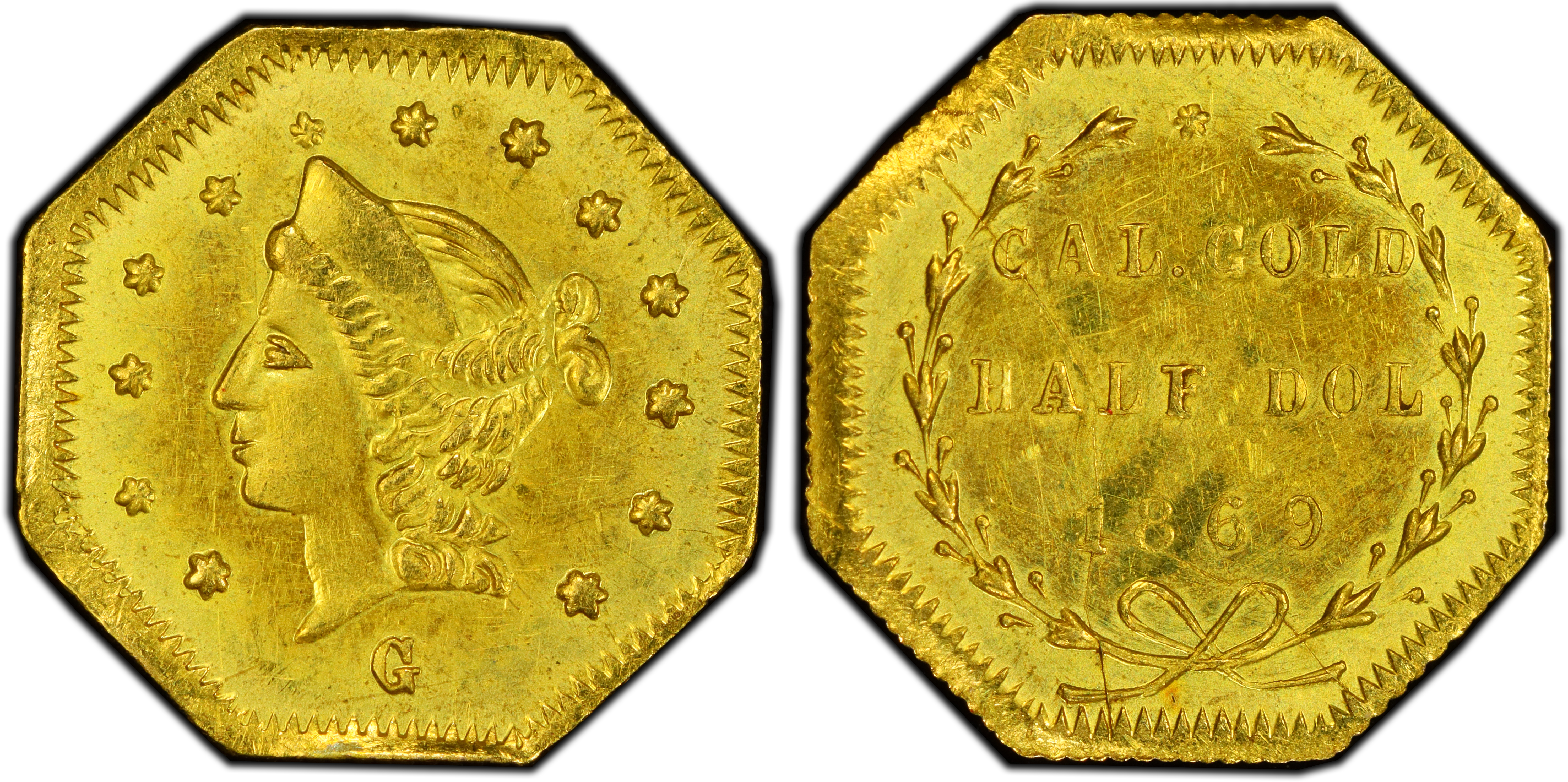
Obverse & Reverse
The 1869 G50C BG-919 is a quintessential example of 'Period Two' California Fractional Gold, a series born from the unique economic conditions of the American West. Following the initial California Gold Rush, a chronic shortage of small-denomination coinage plagued the rapidly growing population. While the U.S. Mint in San Francisco began operations in 1854, its output was initially focused on larger denominations, leaving a void for everyday transactions. Private jewelers and metalworkers stepped in, producing fractional gold pieces beginning in 1852. These 'Period One' issues were generally intended to contain their face value in gold and served a genuine commercial need. However, the landscape shifted dramatically with the Coinage Act of April 22, 1864, which explicitly outlawed private coinage. This act, combined with the increasing availability of federal coinage, rendered the original purpose of fractional gold obsolete. Yet, demand did not cease; instead, it transformed. The coins had become popular as souvenirs and keepsakes—tiny, affordable mementos of the romanticized Gold Rush. This gave rise to the 'Period Two' or 'Jeweler's Issues' (1859-1882), of which the BG-919 is a prime example. These later pieces were struck by manufacturing jewelers, not for circulation, but primarily for sale to tourists and the public as novelties. Legally suppressed, their production was clandestine. To circumvent the law, minters often used back-dates, though this 1869-dated piece was struck contemporaneously. The 'G' mintmark on the obverse identifies the maker as Robert B. Gray & Co., a prominent San Francisco jeweler who had acquired the equipment of an earlier French minter, Antoine Louis Nouizillet. Gray's pieces are noted for being of generally higher weight and quality than many other Period Two issues. The BG-919, with its crude but charming execution, represents a fascinating intersection of economic necessity, legal prohibition, and the burgeoning tourist trade that defined post-Gold Rush California.
Associated EventCalifornia Gold Rush Aftermath
Reason For MintingPrimarily created as a souvenir and collectible item for the tourist trade after the federal prohibition of private coinage.
Minter HistoryRobert B. Gray & Co. was a San Francisco-based jewelry firm active from approximately 1858 to 1871. In the late 1850s, Gray purchased the dies, hubs, and equipment of Antoine Louis Nouizillet, one of the prolific 'Period One' French jewelers who produced fractional gold. Gray continued to use some of Nouizillet's old dies before creating new ones bearing his own hallmark, a distinctive 'G' on the obverse. His workshop was located at 616 Merchant Street in San Francisco. Gray's issues are generally considered to be of better quality and higher gold content than many of his Period Two contemporaries. In 1871, he sold his interests to the California Jewelry Co., marking the end of his fractional gold production.
Historical SignificanceThe BG-919 is significant not as a circulating coin, but as a numismatic artifact representing the transition of fractional gold from utilitarian currency to a souvenir commodity. It demonstrates the ingenuity of private minters in adapting to new laws and markets, preserving a tangible link to the California Gold Rush era for a national audience fascinated by the West. Its maker-marked nature provides a direct link to a specific San Francisco jeweler of the period.
N/A
Denomination50 Cents
Minting Period1869
Assayer/MinterRobert B. Gray & Co.
Geographic OriginSan Francisco, California
Obverse DescriptionAn octagonal planchet featuring a crudely rendered bust of Liberty facing left, her hair tied in a bun. The portrait is surrounded by 13 stars. Below the bust is the date, 1869, and a small but distinct letter 'G' is located in the field, typically below the chin and to the right of the date.
Obverse Inscription1869
Reverse DescriptionThe denomination '1/2' appears in the center, encircled by a wreath of two olive branches tied with a bow at the bottom. The legend 'CALIFORNIA GOLD' is inscribed within the octagonal border, outside the wreath.
Reverse InscriptionCALIFORNIA GOLD 1/2
CompositionGold
Stated Fineness Actual FinenessVariable, typical for Period Two issues, generally ranging from .500 to .800 fine (12-19 Karat). Robert B. Gray's issues are reputed to be of higher fineness than many contemporaries.
Weight0.25 grams
Diameter10.00 mm
EdgePlain
Unknown
Survival EstimateFewer than 150; PCGS Population Report data suggests a total survival of approximately 145 pieces in all grades.
Rarity ScaleR-4 / R-5 (scarce to rare)
This variety is highly sought after as a maker-marked piece from a known San Francisco jeweler. Its octagonal shape and clear connection to the post-Gold Rush era make it a classic and relatively affordable entry point into the complex world of California Fractional Gold.
Key VarietiesThe BG-919 is a specific die marriage and considered a single variety. There are no major sub-varieties or special collector restrikes known from the period. Collectors should be aware of the numerous other BG-numbered varieties of 1869-dated 50 Cent pieces by other makers, as well as modern replicas, which are typically gold-plated and worthless.
Authentication TipsGenuine BG-919s are struck in solid gold, not plated. They often exhibit a somewhat crude, uneven strike, particularly on the date and stars. The 'G' mintmark is a key diagnostic and should match the style known for Robert B. Gray. Counterfeits are common and often appear too perfect, with sharp, uniform details and fields that may be unnaturally smooth or reflective. Genuine pieces frequently show die polishing lines and have a soft, lustrous character to the gold.
Shopping ConsiderationsA 'premium quality' example for this issue is defined less by absolute grade and more by the strength of the strike and originality of the surfaces. Buyers should prioritize pieces with a bold, legible date and a clear 'G' mintmark, as these features are often weak. Look for pleasing, original luster, which can range from satiny to semi-prooflike. Avoid examples that have been harshly cleaned, polished, or mounted in jewelry, as this is common and drastically reduces value. A softly struck but original and attractive coin is often more desirable to specialists than a higher-grade but cleaned or weakly detailed specimen.
A coin's grade is its condition, rated on a 1-70 scale. For rare coins, this is the most critical factor in determining value, as a tiny difference in preservation can mean a huge difference in price.
Relevant Grade TypesOriginal period issues were business strikes, although they were not intended for widespread circulation. They are found in Circulated (1-58) and, more commonly, Mint State (MS, 60-70) grades due to their status as souvenirs. No true Proofs were struck during the original period. The 'PL' (Prooflike) designation may be assigned by grading services to examples with reflective surfaces, but these are a product of die preparation for regular strikes, not special collector strikings.
Mint State CharacteristicsUncirculated examples of BG-919 are characterized by a soft, satiny luster. The strike is a critical factor; they are frequently weakly struck, particularly on the date, the stars, and the high points of Liberty's hair. Excessively polished dies can also lead to washed-out details, a trait noted on this variety. Due to the softness of the gold and rudimentary handling at the 'mint,' even high-grade MS examples can show small planchet flaws or minor contact marks.
Circulated Wear PatternsWear first appears on the high points of Liberty's hair, particularly the strands above her ear and the bun. On the reverse, the highest points of the wreath's leaves and the numerals of the fraction '1/2' will show the first signs of friction. In lower grades (VF and below), the date and stars begin to merge with the fields, and the wreath becomes increasingly faint.
Key Factors For ValueFor the BG-919, value is driven by three main factors: 1) Strike: A sharply struck example with a full date and clear details commands a significant premium. 2) Surface Preservation: Coins with original, uncleaned surfaces and attractive luster are highly prized. 3) Eye Appeal: Evenly toned pieces with a pleasing golden hue are favored over those with distracting spots or discoloration. A CAC sticker for this issue indicates premium quality for the grade and will often result in a higher market value.
PCGS Price Guide
| Grade | Price | Population |
|---|---|---|
| 45 | $225.00 | 1 |
| 45+ | $230.00 | N/A |
| 50 | $240.00 | 4 |
| 50+ | $245.00 | N/A |
| 53 | $250.00 | 2 |
| 53+ | $255.00 | N/A |
| 55 | $260.00 | 16 |
| 55+ | $265.00 | N/A |
| 58 | $270.00 | 15 |
| 58+ | $280.00 | N/A |
| 60 | $300.00 | 9 |
| 61 | $325.00 | 13 |
| 62 | $400.00 | 28 |
| 62+ | $475.00 | N/A |
| 63 | $650.00 | 13 |
| 63+ | $750.00 | N/A |
| 64 | $1,000.00 | 2 |