1859 G50C BG-902 (Regular Strike)
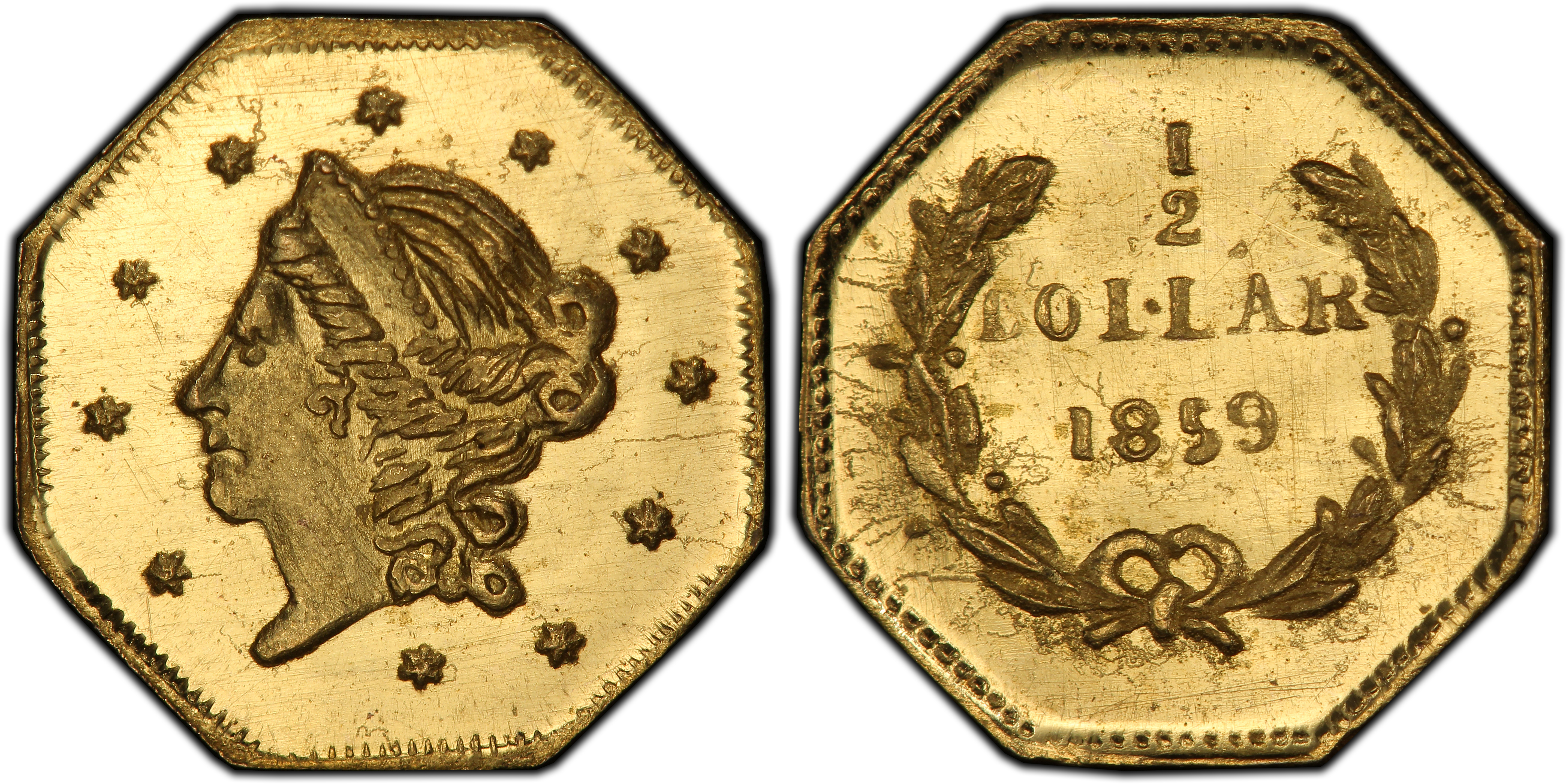
Obverse & Reverse
The California Gold Rush, initiated by the discovery of gold at Sutter's Mill in 1848, triggered a massive influx of over 300,000 people to the territory, creating an unprecedented demand for goods and services. This explosive economic growth was severely hampered by a chronic shortage of small-denomination coinage for daily transactions. Federal coins were scarce on the West Coast, and foreign silver coins were confusing and often undervalued. To fill this critical monetary gap, private minters, predominantly jewelers in San Francisco with experience in working with precious metals, began producing their own small-denomination gold coins in 1852. These pieces, now known as 'California Fractional Gold,' served as a vital, albeit unofficial, medium of exchange. The BG-902 50 Cents piece emerged during the second period of this coinage (1859-1882), often termed the 'Jeweler's Issues.' Unlike the earlier Period One issues that more closely resembled federal coinage in weight and design, these later pieces were typically lighter than their face value would suggest and exhibited more diverse designs. This specific variety, an octagonal 50-cent piece dated 1859, is attributed to the workshop of Antoine Louis Nouizillet, a prominent French jeweler in San Francisco. These coins were crudely manufactured, most often by the 'hammer method,' where a top die was struck with a sledgehammer onto a planchet resting on a bottom die, resulting in inconsistent strike quality. While they facilitated commerce, their underweight nature made them essentially tokens, and their legality was tenuous. By 1864, the U.S. government passed the Coinage Act, making the private issuance of coinage illegal, effectively ending the legitimate production of these fascinating pieces. In later years, particularly into the 1880s, some pieces were produced as souvenirs for the burgeoning tourism industry. Today, California Fractional Gold coins like the BG-902 are prized by numismatists as tangible artifacts of the chaotic and industrious spirit of the Gold Rush, representing a grassroots solution to a fundamental economic problem in the developing American West.
Associated EventCalifornia Gold Rush
Reason For MintingTo alleviate a severe shortage of small-denomination coinage for everyday commercial transactions in Gold Rush-era California.
Minter HistoryAntoine Louis Nouizillet was a French jeweler and one of the most prolific producers of California Fractional Gold. He was active in San Francisco during the Gold Rush and is believed to have been involved in several partnerships, as indicated by various initials found on the coins, such as 'D.N.' (Deriberpe and Nouizillet) and 'N.R.' (Nouizillet and Routhier). Like many minters of the era, he was a skilled craftsman who applied his jewelry-making expertise to the creation of these small, intricate gold pieces. His issues are characteristic of the 'Jeweler's Issues' of Period Two, which were essential for commerce but also popular as keepsakes.
Historical SignificanceThe BG-902, like other California Fractional Gold, represents a fascinating chapter in American monetary history where private enterprise filled a void left by the federal government. These pieces were the currency of the 'everyman' in the West, used for basic daily purchases rather than large transactions. They are a direct link to the Gold Rush economy and the innovative, sometimes legally ambiguous, methods pioneers used to create a functioning society far from established eastern institutions.
N/A
DenominationG50C (Gold 50 Cents)
Minting Period1859
Assayer/MinterUnknown, attributed to Antoine Louis Nouizillet
Geographic OriginSan Francisco, California
Obverse DescriptionA Liberty Head, facing left, with 13 stars surrounding the portrait. The design is a miniature version of the motif used on contemporary federal gold coinage.
Obverse InscriptionNo inscription. The design consists of the Liberty Head portrait and 13 stars.
Reverse DescriptionThe denomination '50 CENTS' is enclosed within a wreath. The date '1859' appears below the wreath.
Reverse Inscription50 CENTS 1859
CompositionGold
Stated Fineness Actual FinenessVaries, typically ranging from 14 to 22 karats.
EdgePlain
Unknown
Survival Estimate75-125
Rarity ScaleR-4 (Low R-4)
This coin is highly sought after for its direct connection to the California Gold Rush, its unusual octagonal shape, and its status as a privately-minted pioneer gold issue. It is a popular type coin for collectors building sets of California Fractional Gold.
Key VarietiesThe primary variety is the regular business strike. No known proof restrikes or special collector issues are associated with BG-902 from the original minting period. Collectors focus on die states, with some examples showing evidence of heavy die clashing, resulting in a rough or distorted appearance on the planchet.
Authentication TipsAuthentic examples often have a crude, hand-made appearance due to hammer striking. Look for a correct style of Liberty Head and wreath for Nouizillet's work. Counterfeits often have incorrect details, a soapy or cast-like texture, or are made of brass. Weight and specific gravity tests can be inconclusive due to the variable fineness of originals. Comparison with certified examples is the best authentication method.
Shopping ConsiderationsA premium quality example for its grade will possess a sharp strike, especially on the stars, Liberty's hair details, and the numbers in the date and denomination. Original, uncleaned surfaces with some remaining mint luster are highly desirable. Look for attractive, original reddish-gold toning. Common problems include weak strikes from the hammer-striking process, planchet flaws, and evidence of harsh cleaning or polishing. Be wary of coins that appear too perfect or have an unusual surface texture, as they may be counterfeit.
A coin's grade is its condition, rated on a 1-70 scale. For rare coins, this is the most critical factor in determining value, as a tiny difference in preservation can mean a huge difference in price.
Relevant Grade TypesOriginal period issues were business strikes intended for circulation, and are found in Circulated (1-58) and Mint State (MS, 60-70) grades. No Proof (PR/PF) examples of BG-902 were struck during the original minting period, as these were utilitarian pieces, not special collector issues. Any piece described as a 'Proof' would be a modern creation or a misattribution.
Mint State CharacteristicsUncirculated examples are scarce. A typical Mint State BG-902 often exhibits a weak or uneven strike, a common trait of hammer-struck coinage. Luster is typically satiny rather than deeply frosty. Due to the softness of the gold and crude production methods, even uncirculated examples can have planchet flaws, laminations, or minor adjustment marks made before striking. Heavy die clashing is also seen on this variety, giving the fields a rough texture.
Circulated Wear PatternsWear first appears on the high points of Liberty's hair, cheek, and the leaves of the wreath. On the reverse, the numbers '50' and the date will show initial flatness. In lower grades (VG and below), the stars will become faint and merge with the rim, and the central details of the wreath will be worn smooth.
Key Factors For ValueFor the BG-902, sharpness of strike is a primary value driver; a well-struck example commands a significant premium over a weakly struck one of the same grade. Surface preservation is critical – coins with original, uncleaned 'skin' and attractive eye appeal are prized. The absence of distracting marks, planchet flaws, or evidence of cleaning significantly increases value. A CAC sticker for this issue is highly valued as it confirms both the grade and the quality of the surfaces for that grade.
PCGS Price Guide
| Grade | Price | Population |
|---|---|---|
| 45 | $180.00 | 1 |
| 45+ | $182.00 | N/A |
| 50 | $185.00 | 1 |
| 50+ | $187.00 | N/A |
| 53 | $190.00 | 1 |
| 53+ | $195.00 | N/A |
| 55 | $200.00 | 3 |
| 55+ | $205.00 | N/A |
| 58 | $210.00 | 12 |
| 58+ | $225.00 | N/A |
| 60 | $250.00 | 2 |
| 61 | $275.00 | 4 |
| 62 | $350.00 | 35 |
| 62+ | $380.00 | N/A |
| 63 | $500.00 | 33 |
| 63+ | $535.00 | N/A |
| 64 | $625.00 | 23 |
| 64+ | $750.00 | N/A |
| 65 | $1,250.00 | 12 |
| 65+ | $1,350.00 | N/A |
| 66 | $1,650.00 | 3 |
| 66+ | $1,750.00 | N/A |
| 67 | $1,850.00 | 1 |