1872/1 G50C BG-937 (Regular Strike)
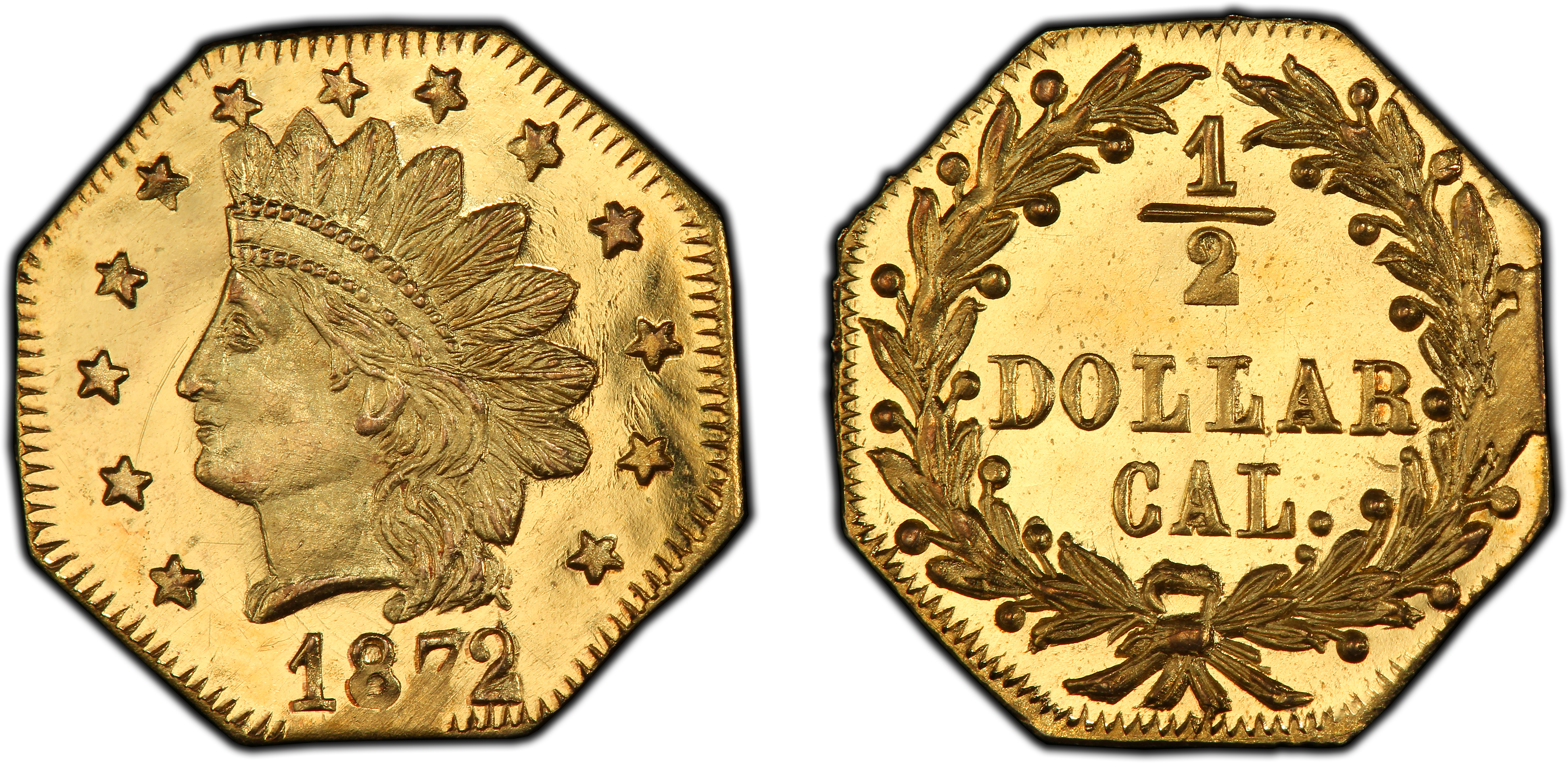
Obverse & Reverse
The 1872/1 G50C BG-937 is a quintessential example from the second period of California Fractional Gold production (1859-1882), a fascinating and complex chapter in American numismatics. Following the initial California Gold Rush boom, the state's explosive population growth created a chronic shortage of small denomination coinage for daily transactions. While the first period (1852-1856) saw private minters strike pieces that more closely resembled federal coinage in weight and design, the landscape had shifted by the 1870s. The Coinage Act of 1864 had explicitly outlawed private coinage, but enforcement in the West was inconsistent. This legal ambiguity, combined with the persistent need for small change, allowed a new generation of producers—primarily jewelers and merchants in San Francisco—to continue striking fractional gold pieces. These 'Period Two' issues, often called 'jeweler's issues,' were different. They were not intended to be full-weight coins but rather functioned as tokens or convenient substitutes for federal currency, their gold content being intrinsically worth less than their face value. The makers were often anonymous, fearing potential legal repercussions, and their work is characterized by artistic flair and immense variety, yet also by crude manufacturing techniques like the hammer press. The BG-937 variety, dated 1872 with a clear 2 over 1 overdate, reflects this era perfectly. It was produced to facilitate minor commerce in a bustling San Francisco, long after the peak of the gold fever but still a major economic hub. These tiny, octagonal pieces would have been used to buy a drink, a newspaper, or other small necessities, serving a vital economic role that federal coinage had yet to adequately fill on the West Coast. The overdate itself suggests the re-purposing of an 1871-dated die, a common practice among these private minters to economize on the expensive and time-consuming process of die sinking. As federal coins became more plentiful in the late 1870s and early 1880s, and as enforcement of the 1864 Act tightened, the production of these charming fractional pieces ceased, marking the end of a uniquely Western solution to a national currency problem.
Associated EventCalifornia Gold Rush (Later Period)
Reason For MintingTo alleviate a persistent shortage of small-denomination coinage for everyday commercial transactions in post-Gold Rush California.
Minter HistoryThe minter of BG-937, like most 'Period Two' California Fractional Gold producers, is unknown. The era was dominated by San Francisco jewelers who typically did not sign their work, likely to avoid prosecution under the Private Coinage Act of 1864. These artisans created a wide array of designs, often with more creative liberty than technical precision, using hand-operated presses. Their identities are largely lost to history, with their legacy being the varied and intricate coinage they left behind.
Historical SignificanceThis coin is significant as a tangible artifact of the post-Gold Rush economy in California, representing the 'jeweler's issue' period of private minting. It illustrates how private enterprise continued to fill a circulating currency void long after federal laws were enacted to stop it, showcasing the unique economic conditions of the American West. The overdate provides insight into the pragmatic and cost-saving methods of these anonymous minters.
N/A
Denomination50 Cents
Minting Period1872
Assayer/MinterUnknown
Geographic OriginSan Francisco, California
Obverse DescriptionAn Indian Head portrait, facing left, wearing a feathered headdress. The portrait is surrounded by thirteen stars, representing the original colonies.
Obverse Inscription[None]
Reverse DescriptionThe denomination '1/2' is enclosed within a wreath of leaves and berries. The date '1872' is positioned below the wreath, with the '2' clearly struck over a '1'. A small 'G' mintmark, for Gold, is sometimes noted on these issues, though its presence and location can vary.
Reverse Inscription1/2
CompositionGold
Stated Fineness Actual FinenessVariable, typically between .500 and .750 fine.
Weight0.25 grams
Diameter10.00 mm
EdgePlain
Unknown
Survival Estimate76-200 coins estimated to exist.
Rarity ScaleHigh R-4
The BG-937 is highly sought after for its distinctive octagonal shape, clear 1872/1 overdate, and its status as a representative of the mysterious 'jeweler's issue' period. Its small size and intricate design make it a fascinating miniature work of art from the Old West. The challenge of acquiring a well-struck, high-grade example adds to its appeal for specialists.
Key VarietiesThe primary variety is the 1872/1 overdate. Within the BG-937 designation, different die states are known to exist. Of particular note is 'Die State II,' which is characterized by a prominent die break, or cud, appearing on the reverse near the 3 o'clock position. Examples with deeply mirrored, prooflike (DMPL or PL) surfaces are known and command significant premiums.
Authentication TipsAuthenticity is paramount with California Fractional Gold. Genuine BG-937 pieces will exhibit a specific die signature. The numerals of the date and the details of the wreath should match known examples cataloged in Breen-Gillio. Be wary of pieces with a soapy or cast-like appearance. Many modern replicas exist, often with incorrect details, mushy strikes, or improper metallic composition. A common red flag for fakes is the presence of a bear on the design, which was not used on genuine circulating issues. Authentication by a major third-party grading service (PCGS or NGC) is highly recommended.
Shopping ConsiderationsWhen acquiring a BG-937, strike quality is a critical factor. Many examples are softly struck, particularly on the denomination, the base of the date, and some of the stars. A premium quality example will exhibit unusual sharpness in these areas. Look for clean, original surfaces with some remaining luster. Deeply mirrored, prooflike (PL) examples are the most desirable and valuable. Avoid coins that have been harshly cleaned, which strips the original patina and imparts a dull or hairlined appearance. Also inspect for evidence of having been mounted in jewelry, such as solder marks or rim damage, which is a common issue for this series.
A coin's grade is its condition, rated on a 1-70 scale. For rare coins, this is the most critical factor in determining value, as a tiny difference in preservation can mean a huge difference in price.
Relevant Grade TypesOriginal period issues of BG-937 were business strikes intended for circulation, and are found in Circulated (1-58) and, more commonly for this variety, Mint State (MS, 60-70) grades. No true Proofs were struck during the original period of issue. However, some pieces were struck on highly polished planchets with polished dies, resulting in Deep Mirror Prooflike (DMPL) or Prooflike (PL) surfaces, which are designated as such on the grading label and are highly prized.
Mint State CharacteristicsAn uncirculated BG-937 is defined by the quality of its luster and the presence, or lack, of marks. Luster can range from satiny to deeply reflective (prooflike). Strike weakness is common; look for sharpness on the highest points of the Indian's headdress and the details within the wreath. Softness on the denomination '1/2' and the lower part of the date is typical even on high-grade examples. Due to their small size and handling in bulk, even Mint State coins often exhibit tiny contact marks, but premium pieces will have clean, attractive fields.
Circulated Wear PatternsWear first appears on the high points of the design: the cheek and feathers of the Indian Head on the obverse, and the highest leaves and bow of the wreath on the reverse. On moderately worn examples, the stars will begin to lose their definition and merge with the fields. In lower grades (VF and below), the date and denomination will show significant flattening.
Key Factors For ValueFor the BG-937, value is driven by several key factors. Firstly, the numerical grade (e.g., MS-64 vs MS-65) is paramount. Secondly, surface quality is crucial; an example with original, undisturbed luster and minimal marks will always be worth more than a cleaned or heavily marked coin of the same grade. Thirdly, sharpness of strike is a major value-driver, with well-struck examples commanding strong premiums. Finally, any special designation, particularly a Prooflike (PL) or Deep Mirror Prooflike (DMPL) attribution, can dramatically increase a coin's value. A CAC sticker, indicating premium quality for the grade, also adds a significant premium.
PCGS Price Guide
| Grade | Price | Population |
|---|---|---|
| 55 | $250.00 | 2 |
| 55+ | $260.00 | N/A |
| 58 | $275.00 | 1 |
| 58+ | $290.00 | N/A |
| 60 | $400.00 | 1 |
| 61 | $425.00 | N/A |
| 62 | $450.00 | 10 |
| 62+ | $465.00 | N/A |
| 63 | $490.00 | 15 |
| 63+ | $525.00 | N/A |
| 64 | $600.00 | 23 |
| 64+ | $650.00 | N/A |
| 65 | $975.00 | 3 |
| 65+ | $1,250.00 | 1 |
| 66 | $2,500.00 | 3 |