1870 G25C BG-835A (Regular Strike)
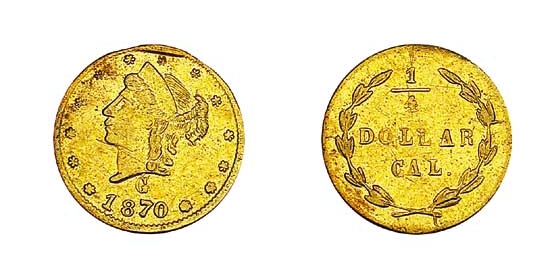
Obverse & Reverse
The 1870 BG-835A 25 Cent piece is a fascinating artifact from the second period of California's private gold coinage, a time when the purpose of these miniature issues had shifted dramatically from necessity to novelty. The first period (1852-1857) was born from a genuine crisis: a severe shortage of small-denomination coinage in the gold fields, forcing transactions to be made with cumbersome gold dust. Private minters, many of them jewelers, filled this void with fractional gold coins intended for circulation. However, by 1858, the new San Francisco Mint was producing sufficient quantities of federal silver and gold coinage, rendering the private issues obsolete for commerce. Instead of disappearing, the practice evolved. A new generation of 'Period Two' (1858-1882) pieces emerged, catering to a burgeoning tourist trade and a national fascination with the California Gold Rush. These later issues, often termed 'jeweler's pieces,' were not meant to circulate but were sold as souvenirs, keepsakes, and charms. The BG-835A, struck in 1870, is a prime example of this phenomenon. It was produced by Antoine Louis Nouizillet, a French jeweler and one of the most prolific makers of fractional gold, who had been active since the first period. By 1870, Nouizillet's business had been sold to Robert B. Gray & Co., but evidence suggests Gray continued to use Nouizillet's old dies alongside his own. These Period Two coins were often underweight and made of debased gold, as their value was in their novelty, not their intrinsic content. Despite the Coinage Act of 1864 making private coinage illegal, the law was not strictly enforced against these souvenir tokens until 1883, allowing San Francisco jewelers a long and profitable window to market these miniature symbols of the Golden State. The extreme rarity of the BG-835A today, with a survival estimate of only seven known examples, suggests it was produced in very small quantities, even for a souvenir issue, making it one of the most elusive and desirable varieties for specialists.
Associated EventPost-Gold Rush California Tourism
Reason For MintingPrimarily struck as a souvenir or charm for the tourist trade, not for monetary circulation.
Minter HistoryAntoine Louis Nouizillet was a French jeweler who operated in San Francisco and was a significant, prolific producer of California fractional gold during both Period One (1852-57) and Period Two (1858-82). His early issues were intended to alleviate the shortage of small change. His later work, and dies used by his successors like Robert B. Gray & Co., focused on the souvenir market. His designs, particularly the distinct Liberty Head motifs, are characteristic of the 'jeweler's issues' of the era.
Historical SignificanceThe BG-835A represents the evolution of private gold coinage from a utilitarian response to a coin shortage into a commercial enterprise catering to tourism and nostalgia. It is a tangible link to the romanticized image of the Gold Rush that captivated the nation in the decades following the initial strikes and is a testament to the creative entrepreneurship of San Francisco's jewelers.
N/A
Denomination25 Cents
Minting Period1870
Assayer/MinterAntoine Louis Nouizillet
Geographic OriginSan Francisco, California
Obverse DescriptionA small, round planchet featuring a left-facing bust of Liberty. Her hair is tied in a bun, and she wears a coronet. The field is typically surrounded by thirteen stars, representing the original colonies.
Obverse InscriptionNo inscription, only the Liberty Head portrait and stars.
Reverse DescriptionA simple wreath surrounds the denomination '25 CENTS' and the date '1870'.
Reverse Inscription25 CENTS 1870
CompositionGold
Stated Fineness Actual FinenessPeriod Two issues are known to be of inconsistent and often lower fineness than Period One issues, sometimes as low as 14 karat, but the specific fineness for this variety is not documented.
EdgePlain
Extremely low; likely less than 100.
Survival Estimate7 known specimens.
Rarity ScaleR-7
This coin's appeal lies in its extreme rarity and its connection to the well-documented 'jeweler's issue' period of fractional gold. As an R-7 variety, it is a significant prize for advanced specialists seeking to complete a collection by Breen-Gillio (BG) number.
Key VarietiesThe BG-835A is itself a key variety. No major sub-varieties from the original minting period are known due to its rarity. No later-date Proof restrikes or special collector issues are known to exist for this specific BG number; it is known only as a business strike intended for the souvenir market.
Authentication TipsAuthentic Period Two fractionals must bear a denomination (e.g., 'CENTS' or 'DOLLAR'). Replicas often have a bear on the reverse, which is a definitive sign of a fantasy piece. Genuine examples are typically very thin and can exhibit weak or uneven strikes due to the crude hammer-striking process. Look for the correct die markers for the BG-835A if high-resolution images of known genuine examples can be located. Given its high rarity and value, authentication by a top-tier grading service (PCGS or NGC) is essential.
Shopping ConsiderationsFor a 'premium quality' BG-835A, look for a sharp strike on the central devices, particularly on Liberty's hair details and the numerals of the date and denomination. Original, undisturbed surfaces with some remaining mint luster are highly desirable. Since these were souvenirs, some may have been mounted as jewelry; carefully check the rims and surfaces for evidence of mounting, tooling, or harsh cleaning, which would significantly impair the value. Given the extreme rarity, any example, even one with minor impairments, would be considered a significant acquisition. A CAC sticker would provide strong confirmation of quality for the assigned grade.
A coin's grade is its condition, rated on a 1-70 scale. For rare coins, this is the most critical factor in determining value, as a tiny difference in preservation can mean a huge difference in price.
Relevant Grade TypesOriginal period issues were business strikes intended for the souvenir market and are found in Circulated (1-58) and Mint State (MS, 60-70) grades. Despite their souvenir purpose, some saw minor handling that would result in a circulated grade. No Proof (PR/PF) examples were struck during the original period of issue, and no later-date Proof restrikes are known.
Mint State CharacteristicsAn uncirculated BG-835A would be expected to have a soft, satiny luster. The strike is often somewhat weak or uneven, a characteristic of the hammer-striking process used by private jewelers, so a fully-struck gem is almost unknown. The high points of the design, like Liberty's cheek and the wreath on the reverse, are susceptible to contact marks from handling. A premium MS example would display minimal marks, a strong strike for the issue, and attractive original golden toning.
Circulated Wear PatternsWear first appears on the highest points of the design. On the obverse, this includes Liberty's cheek, the hair above the ear, and the coronet. On the reverse, the high points of the wreath and the numerals of the denomination will show the first signs of friction. In lower grades (VF and below), the stars on the obverse and the lettering on the reverse will begin to lose their sharpness and merge towards the fields.
Key Factors For ValueFor the BG-835A, the primary value driver is its absolute rarity. After that, grade and surface quality are paramount. An example with original, uncleaned surfaces commands a massive premium over one that has been cleaned, polished, or removed from jewelry. Strike quality is also critical; a coin with a sharper-than-average strike on the portrait and legends is highly prized. Finally, given its status as a collector's item from the time of issue, eye appeal—a pleasing color and lack of distracting marks—plays a significant role in its ultimate market value. A CAC sticker on a certified holder confirms that the coin is a premium-quality example for its designated grade.
PCGS Price Guide
| Grade | Price | Population |
|---|---|---|
| 50 | $1,200.00 | N/A |
| 50+ | $1,275.00 | N/A |
| 53 | $1,400.00 | 1 |
| 53+ | $1,450.00 | N/A |
| 55 | $1,600.00 | N/A |
| 55+ | $1,650.00 | N/A |
| 58 | $1,900.00 | 1 |
| 58+ | $2,050.00 | N/A |
| 60 | $2,250.00 | N/A |
| 61 | $3,250.00 | N/A |
| 62 | $5,000.00 | 3 |