1880 G50C BG-954, PL (Regular Strike)
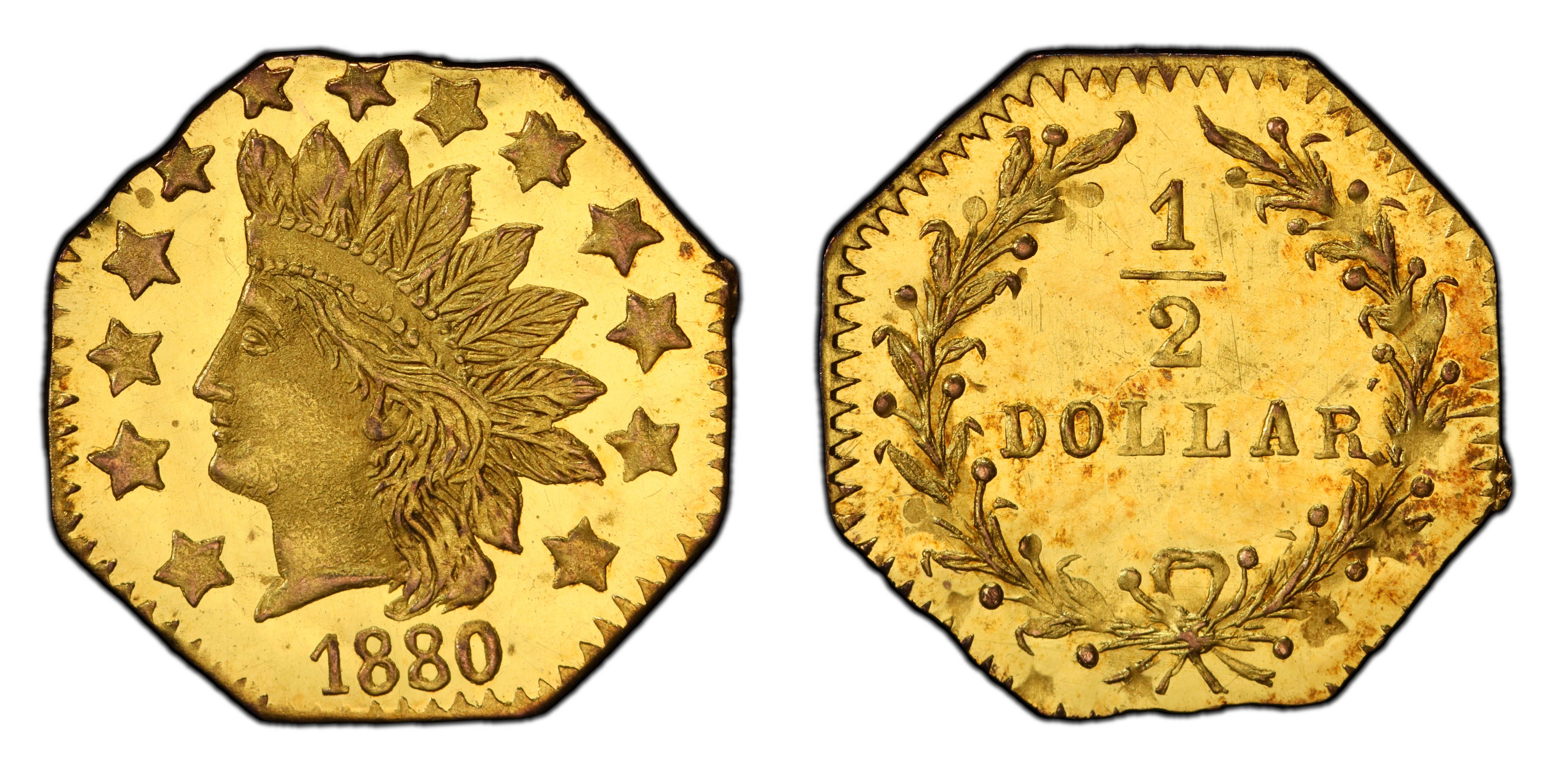
Obverse & Reverse
The 1880 G50C BG-954 is a quintessential example of a 'Period Two' California Fractional Gold piece. By 1880, the acute shortage of small change that had plagued California during the initial Gold Rush had long been resolved by the output of the San Francisco Mint. The purpose of these tiny, privately-issued gold pieces had shifted dramatically from utilitarian currency to charming souvenirs. Local jewelers, primarily in San Francisco, found a lucrative market selling these miniature gold 'coins' to tourists and easterners as mementos of the romanticized 'Wild West.' Herman J. Brand, a German immigrant jeweler and sculptor who operated his own shop in San Francisco from the early 1870s, is the man credited with producing this issue. Brand, like his contemporaries, operated in a legal gray area. The Coinage Act of 1864 had made the private minting of currency illegal, but the law was not aggressively enforced by the Secret Service against these small 'tokens' until the early 1880s. These 'jeweler's issues' were intentionally produced with a gold value significantly below their face value, rendering them profitable novelties rather than true coinage. The BG-954 was struck on highly polished planchets, giving many surviving examples a Prooflike (PL) or semi-Prooflike appearance, a deliberate choice to enhance their aesthetic appeal to buyers. Their production ceased around 1883 when federal authorities finally cracked down on all private issues bearing a denomination, forcing makers to switch to non-denominated 'charms' or cease production altogether. Today, the BG-954 is a tangible link to this final, fascinating chapter of private minting in California, representing a transition from necessity-driven coinage to commercial memorabilia.
Associated EventPost-Gold Rush California Tourism
Reason For MintingTo be sold as a souvenir or collectible item to tourists and the public, rather than to alleviate a shortage of circulating coinage.
Minter HistoryHerman Jacob Brand (1837–1914) was a German immigrant jeweler, engraver, and sculptor who became a notable producer of Period Two California Fractional Gold. He arrived in San Francisco around 1867 and worked with other established jewelers like R.B. Gray & Co. before opening his own business in 1872. Brand was a skilled artisan, also known for creating medals and a well-regarded plaster statuette of Emperor Norton I. His fractional gold pieces, including the BG-954, were produced in the late 1870s and early 1880s. He eventually ran afoul of the U.S. Secret Service for producing denominated tokens that resembled coinage, which led to the cessation of such activities by 1883. Brand remained a prominent San Francisco jeweler for many years, his work serving as a prime example of the 'jeweler's issues' of the era.
Historical SignificanceThis coin represents the final phase of private gold issues in California, when their function had shifted entirely from commerce to souvenirs. It is a product of the post-Gold Rush romanticism of the West and the legal ambiguity surrounding private coinage prior to strict federal enforcement in 1883.
BG-954
Denomination50 Cents
Minting Period1880
Assayer/MinterHerman J. Brand
Geographic OriginSan Francisco, California
Obverse DescriptionA stylized head of a Native American (Indian Head) facing left, wearing a feathered headdress. The portrait is surrounded by 13 five-pointed stars. The date, 1880, is below the bust.
Obverse Inscription1880
Reverse DescriptionThe denomination '1/2' is centered within a wreath composed of two branches tied together by a ribbon at the bottom. The legend 'CALIFORNIA GOLD' encircles the wreath along the upper periphery, and the word 'DOL.' is at the bottom, below the ribbon.
Reverse InscriptionCALIFORNIA GOLD 1/2 DOL.
CompositionGold
Stated Fineness Actual FinenessPeriod Two issues are known for having a lower gold content than earlier issues, often in the range of 9 to 14 Karat gold, but the specific fineness for BG-954 is not consistently documented.
Weight0.25 grams
Diameter10.50 mm
EdgePlain
Unknown, but very small, likely in the hundreds.
Survival Estimate31-75 (per R-5 rating)
Rarity ScaleR-5
The BG-954 is sought after for its attractive Octagonal Indian Head design, its status as a late-date souvenir issue, and the frequent availability of high-grade, Prooflike specimens that offer excellent eye appeal. Its connection to a known jeweler, Herman J. Brand, adds to its historical allure.
Key VarietiesThe primary variety is the regular strike (BG-954) itself. There are no known major die varieties, patterns, trial pieces, or official later-date restrikes associated with this specific Breen-Gillio number. The main distinction for collectors is the quality of the strike and the degree to which a specimen displays Prooflike (PL) surfaces.
Authentication TipsGenuine BG-954 pieces are very thinly struck. Replicas are often thicker and have a 'soapy' or cast appearance, lacking the sharp detail of a true strike. Look for a faint die crack that can sometimes be seen on the reverse, linking the '1' and '2' of the denomination back to the 'AR' in 'DOLLAR,' a characteristic of an early die state. The style of the numerals and letters should match known examples precisely. Any piece featuring a bear on the reverse is a modern fantasy piece.
Shopping ConsiderationsA premium quality example for its grade will possess sharply struck details, particularly in the fine lines of the headdress feathers and the leaves of the reverse wreath. For PL-designated coins, look for deeply mirrored fields that contrast with frosted devices. Avoid examples that have been harshly cleaned, which destroys the delicate original surfaces and imparts a hazy, unattractive look. Small, as-struck planchet flaws or grease strikes (as noted in auction records for this variety) are generally acceptable and part of the coin's character, but significant scratches, rim bumps, or evidence of having been mounted in jewelry should be cause for a significant reduction in price.
A coin's grade is its condition, rated on a 1-70 scale. For rare coins, this is the most critical factor in determining value, as a tiny difference in preservation can mean a huge difference in price.
Relevant Grade TypesOriginal period issues were business strikes intended for sale as souvenirs, not circulation. They are found in both Circulated (1-58) and, more commonly, Mint State (MS, 60-70) grades. No true Proofs were struck during the original period. The Prooflike (PL) designation is a modifier applied to business strikes that exhibit mirror-like surfaces from being struck with highly polished dies, a common and intentional feature of these jeweler's issues. These are distinct from true Proof coins and are valued for their exceptional eye appeal.
Mint State CharacteristicsUncirculated examples of BG-954 are characterized by their typically sharp strikes and satiny to deeply reflective luster. Due to the manufacturing process, specimens often exhibit a semi-Prooflike or full Prooflike (PL) surface. Because the gold is soft and the coins are small, even high-grade MS examples may show minor handling marks or tiny planchet imperfections. The overall 'flash' and reflectivity of the fields are key determinants of quality for PL coins.
Circulated Wear PatternsAlthough most did not circulate, on those that show wear, friction first appears on the highest points: the cheek and brow of the Indian Head, the feathers of the headdress, and the leaves and ribbon bow on the reverse wreath. In lower grades (VF and below), the date and the finer details of the stars will begin to soften and merge with the fields.
Key Factors For ValueThe primary drivers of value for a BG-954 are grade and surface quality. A high Mint State grade (e.g., MS-64 or higher) commands a significant premium. The presence of a Prooflike (PL) or Deep Prooflike (DMPL) designation will substantially increase value. Eye appeal is paramount; coins with clean, reflective fields and attractive original gold toning are highly prized. Conversely, specimens that are cleaned, spotted, or have distracting marks will trade at a steep discount. A CAC sticker confirming quality for the grade adds a further premium.
PCGS Price Guide
| Grade | Price | Population |
|---|---|---|
| 62 | $400.00 | 1 |
| 62+ | $425.00 | N/A |
| 63 | $475.00 | 1 |
| 63+ | $550.00 | N/A |
| 64 | $700.00 | 2 |
| 64+ | $825.00 | N/A |
| 65 | $1,250.00 | N/A |
| 65+ | $1,500.00 | N/A |
| 66 | $2,350.00 | 1 |
| 66+ | $2,600.00 | N/A |
| 67 | $3,000.00 | N/A |