1870 G50C BG-909 (Regular Strike)
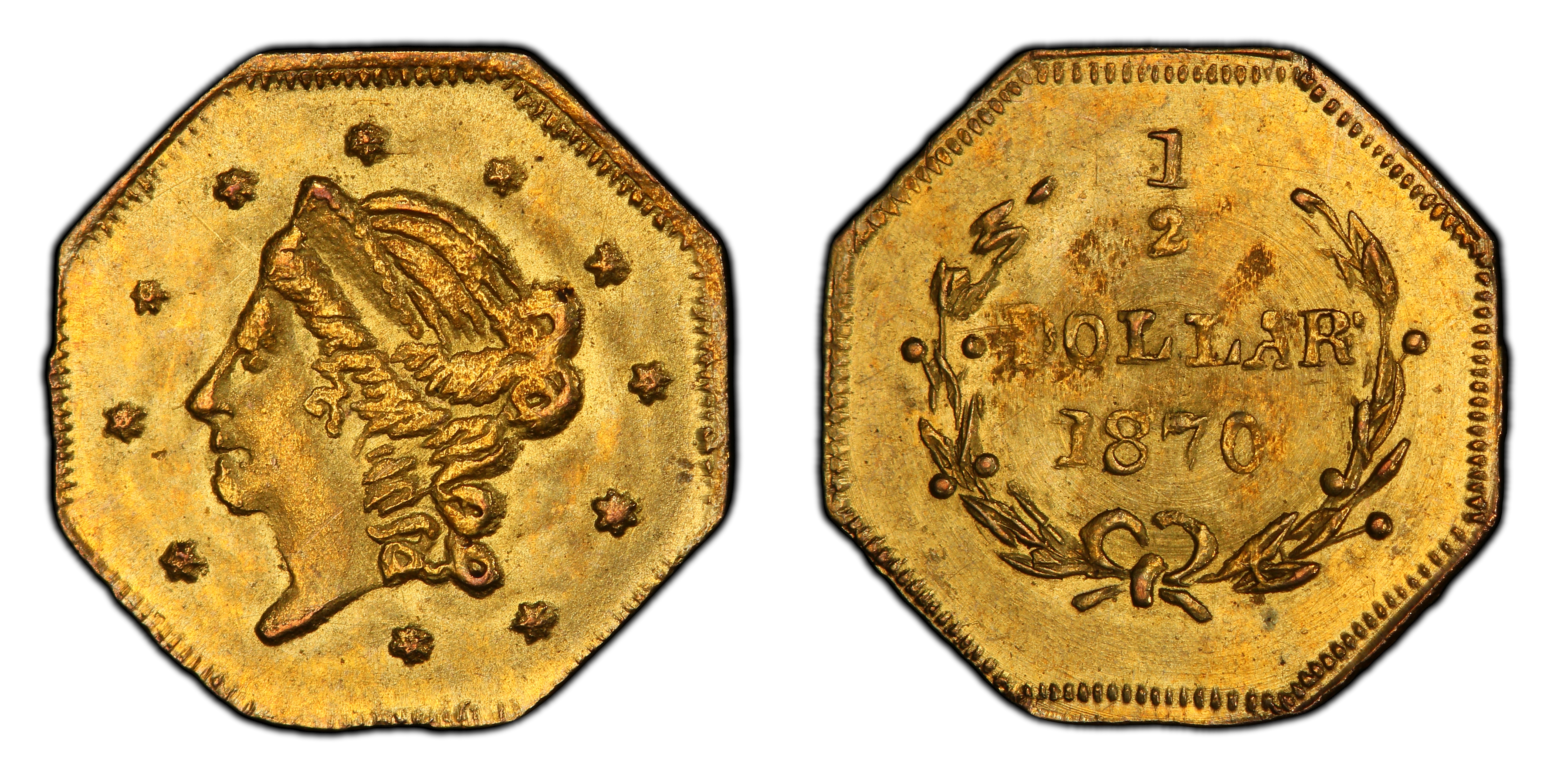
Obverse & Reverse
The 1870 BG-909 50 Cent piece is a quintessential example of a 'Period Two' California Fractional Gold coin. The initial period of these fascinating small-denomination gold pieces, from 1852 to roughly 1857, was born of true necessity. The massive influx of population during the Gold Rush created a vibrant economy, but the United States Mint in San Francisco, which opened in 1854, could not keep up with the overwhelming demand for small change. Gold dust was impractical for minor daily transactions, leading private jewelers to strike their own quarter, half, and one-dollar coins. These 'Period One' issues circulated widely. However, by the late 1850s, the initial coin shortage had eased. The nature of fractional gold production shifted dramatically, entering 'Period Two' (1858-1882). These later issues, including the BG-909, were no longer primarily intended to facilitate commerce. Instead, they became popular souvenirs and keepsakes. For people back East or in Europe, California was a land of adventure and opportunity, and these tiny, tangible pieces of 'California Gold' were an affordable novelty. They were often underweight for their stated value and struck by various, often anonymous, jewelers in San Francisco. The Coinage Act of 1864 officially prohibited private coinage, but federal enforcement was lax in the West. This lack of oversight allowed production of denominated pieces to flourish throughout the 1870s, a testament to their popularity as souvenirs. It wasn't until 1883 that a crackdown by the Secret Service finally halted the manufacture of these denominated 'jeweler's issues,' ending a unique chapter in American numismatics. The BG-909, struck in this later period, embodies this transition from utilitarian coin to cherished memento of the Golden State.
Associated EventPost-Gold Rush California Economy
Reason For MintingPrimarily struck as a popular souvenir or novelty item for the tourist and mail-order trade, not for general circulation.
Minter HistoryThe specific minter for the BG-909 variety is not definitively known, a common trait for many Period Two issues. These pieces were produced by various manufacturing jewelers in San Francisco who saw a commercial opportunity in the souvenir market. Firms like Robert B. Gray & Co. were prominent producers of similar octagonal pieces during this era, though a direct attribution for BG-909 is not established. These jewelers often used shared punches and dies, making precise attribution difficult for modern numismatists.
Historical SignificanceThe BG-909 represents the evolution of California Fractional Gold from a necessary circulating medium to a popular souvenir. Its existence demonstrates the continued romantic allure of the Gold Rush long after its peak and showcases the entrepreneurial spirit of California jewelers who operated in a gray area of minting legality for decades.
N/A
Denomination50 Cents
Minting Period1870
Assayer/MinterUnknown San Francisco Jeweler
Geographic OriginSan Francisco, California
Obverse DescriptionA fairly crude depiction of a Liberty Head facing left, modeled after contemporary federal gold coinage. She is surrounded by thirteen stars, which are often weakly struck and unevenly spaced. The portrait details are typically soft, a result of the primitive 'hammer method' of striking.
Obverse Inscription[None]
Reverse DescriptionThe reverse is dominated by a wreath composed of two branches tied by a bow at the bottom. Within the wreath is the denomination '1/2'. The date '1870' is centered below the bow, and the legend 'DOLLAR' appears above the wreath, following the octagonal border. A beaded circle encloses the central wreath design.
Reverse Inscription1/2 DOLLAR 1870
CompositionGold
Stated Fineness Actual FinenessVariable, but generally lower than the .900 fineness of federal coinage, as was typical for Period Two issues.
EdgePlain
Unknown
Survival Estimate13-30 coins known.
Rarity ScaleR-6
This variety appeals to collectors specializing in the extensive and complex California Fractional Gold series. Its octagonal shape, clear date, and defined rarity of R-6 make it a desirable and challenging piece to acquire. It serves as a perfect example of a 'jeweler's issue' from the height of their production in the 1870s.
Key VarietiesThe primary catalog attribution is Breen-Gillio 909 (BG-909). There are no major varieties, patterns, or restrikes known for this specific issue. The series of Period Two fractionals is vast, with hundreds of minor die varieties cataloged by Breen and Gillio, but BG-909 is a distinct variety.
Authentication TipsAuthentic Period Two fractionals like the BG-909 must bear a denomination (e.g., 'DOLLAR' or 'CENTS'). Souvenir tokens made after 1883 typically omit the denomination to comply with federal law. Look for the characteristic softness of a hammer strike; modern replicas often appear too sharp or have a 'cast' texture. The style of the Liberty head and wreath should be compared to known genuine examples. Fakes may also be made of brass or low-karat gold, so weight and specific gravity tests can be revealing.
Shopping ConsiderationsA premium quality BG-909 will exhibit a bold strike for the issue, though some softness is expected. Specifically, the 'D' in DOLLAR is noted in auction records as being characteristically soft, as it is located opposite the high relief of Liberty's hair on the obverse. Look for original, uncleaned surfaces, which may display attractive 'apricot-gold' or 'sea-green' toning from decades of storage. Avoid examples that are holed, bent, or have been harshly cleaned or polished, as this drastically reduces value. Full details in the wreath and a clear, complete date are highly desirable.
A coin's grade is its condition, rated on a 1-70 scale. For rare coins, this is the most critical factor in determining value, as a tiny difference in preservation can mean a huge difference in price.
Relevant Grade TypesAll original 1870 BG-909 pieces are considered business strikes, though their intended purpose was for sale as souvenirs rather than circulation. They are found in Circulated grades (AU-58 and lower) and, more commonly, in Mint State grades (MS-60 to 70). No proofs were struck during the original period of issue, and no later-date restrikes are known to exist.
Mint State CharacteristicsUncirculated examples are defined by the presence of original mint luster, which is often bright and satiny. Due to the primitive manufacturing process, even high-grade Mint State specimens will show imperfections. The strike is often uneven, with softness on the highest points of the design. Small planchet flaws or faint die polish lines are common and not necessarily considered defects. Contact marks, while present, should be minimal and not distracting on a choice specimen.
Circulated Wear PatternsOn circulated examples, wear first appears on the highest points of the design. For the obverse, this includes Liberty's cheek, hair details above the ear, and the coronet. On the reverse, the high points of the wreath's leaves and the bow will show the first signs of friction and flattening. In lower circulated grades, the stars on the obverse and the individual letters in the legends will begin to lose their sharpness and merge with the fields.
Key Factors For ValueFor the BG-909, value is driven by several key factors. Grade is paramount, with a significant price jump between circulated and Mint State examples, and further premiums for gem grades (MS-65 and above). The second factor is surface quality; a coin with original, lustrous surfaces and attractive toning will command a strong premium over a cleaned, scratched, or otherwise damaged piece. Finally, sharpness of the strike is crucial. A well-struck example with full details, especially a bold date and denomination, is far more desirable than a typically soft or weakly struck piece. A CAC sticker will add a further premium, signifying that the coin is of high quality for its assigned grade.
PCGS Price Guide
| Grade | Price | Population |
|---|---|---|
| 53 | N/A | N/A |
| 55 | $385.00 | 1 |
| 55+ | $395.00 | N/A |
| 58 | $410.00 | N/A |
| 58+ | $425.00 | N/A |
| 60 | $475.00 | N/A |
| 61 | $500.00 | N/A |
| 62 | $545.00 | 5 |
| 62+ | $575.00 | N/A |
| 63 | $700.00 | 4 |
| 63+ | $800.00 | N/A |
| 64 | $1,200.00 | 5 |
| 64+ | $1,300.00 | N/A |
| 65 | $1,650.00 | 4 |