1868 G50C BG-960, PL (Regular Strike)
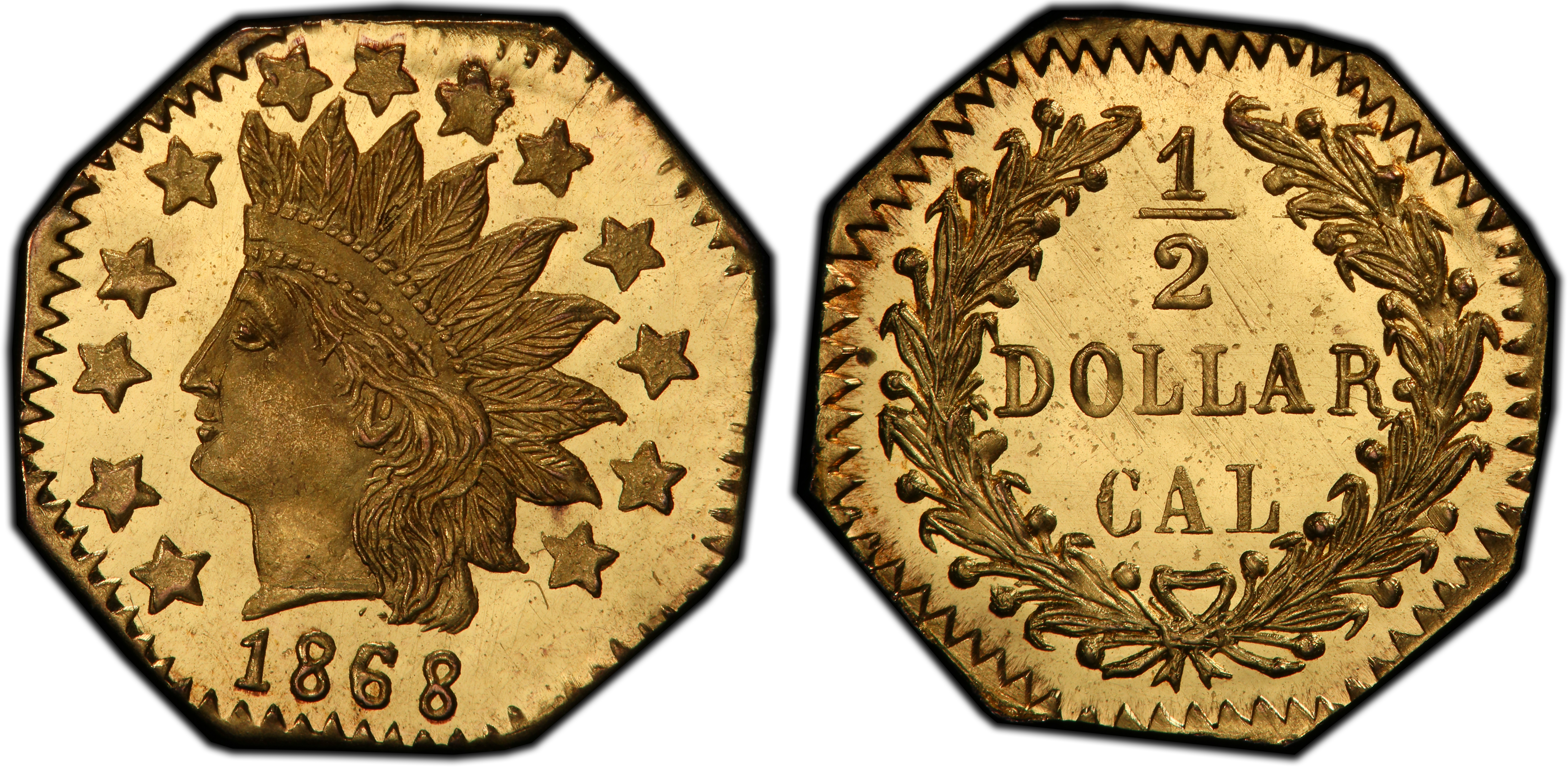
Obverse & Reverse
The 1868 BG-960 fifty-cent piece emerges from the second major phase of California Fractional Gold production, a period numismatically distinct from the initial, necessity-driven issues of the early Gold Rush. By the late 1860s, the acute shortage of small denomination coinage that had plagued California a decade and a half earlier had been largely resolved by the output of the United States Mint in San Francisco, which began operations in 1854. The raison d'être for private coinage had shifted dramatically from commerce to curiosity. These later 'Period Two' (1858-1882) issues, as defined by Walter Breen and Ronald J. Gillio, were primarily struck by jewelers not to facilitate trade, but to sell as souvenirs and keepsakes. The allure of the 'Golden State' and the romance of the Gold Rush created a robust market for these tiny, intricate gold tokens among tourists, merchants, and those back East. The Coinage Act of 1864 had explicitly forbidden private coinage, but enforcement in the West was inconsistent, allowing this souvenir trade to flourish until a Secret Service crackdown in the early 1880s. The BG-960 was struck in this environment. Its production was likely a small-scale, hand-operated affair within a San Francisco jeweler's shop. Unlike their Period One predecessors, which often contained gold close to their face value, Period Two pieces were notoriously underweight and sometimes made of debased gold, reinforcing their nature as novelties rather than legitimate currency. The Indian Head motif, popular in American coinage of the era, was adopted to enhance their appeal. The existence of prooflike (PL) examples, like the one specified in the user request, underscores their non-circulating intent; they were meant to be admired for their shiny, reflective surfaces, a quality that would be instantly lost in circulation.
Associated EventPost-Gold Rush California Economic Expansion
Reason For MintingPrimarily created to be sold as a souvenir or collectible charm reflecting the romanticism of the California Gold Rush.
Minter HistoryThe specific minter of BG-960 is not definitively known, a common trait for many Period Two issues where dies were often made anonymously. However, the dominant producer of fractional gold in San Francisco during this era was Robert B. Gray & Co. Gray had purchased the business of prominent Period One minter Antoine Louis Nouizillet around 1859 and continued striking pieces with both old and new dies. While many of Gray's pieces are hallmarked with a 'G', not all are, and his workshop's style is considered a likely candidate for many anonymous Indian Head issues of the late 1860s. These jewelers operated in a legally grey area, producing items that were technically illegal but tolerated as long as they didn't seriously disrupt commerce.
Historical SignificanceThe BG-960 is a tangible artifact of the commercialization of the Gold Rush myth. It represents a shift from private coinage as a monetary necessity to its production as a purely commemorative and decorative item, highlighting the evolving economy and identity of California in the decades following the initial rush.
K-N/A
Denomination50 Cents
Minting Period1868
Assayer/MinterUnknown Jeweler (Possibly Robert B. Gray & Co.)
Geographic OriginSan Francisco, California
Obverse DescriptionFeatures a stylized Indian Head facing left, adorned with a feathered headdress. The portrait is surrounded by thirteen six-pointed stars, often unevenly spaced and of crude execution. The date '1868' appears below the bust truncation.
Obverse Inscription1868
Reverse DescriptionA wreath composed of two branches, typically with numerous berries, tied together at the bottom with a bow. Inside the wreath, the denomination '1/2' is centrally located. The legend 'CALIFORNIA GOLD' encircles the wreath, though on some specimens, parts of the legend, especially 'CAL', can be weak or effaced due to die state.
Reverse InscriptionCALIFORNIA GOLD 1/2
CompositionGold
Stated Fineness Actual FinenessVariable, typically lower than circulating coinage of the era, often ranging from .500 to .800 fine.
Weight0.25 grams
Diameter10.00 mm
EdgePlain
Extremely low; exact figures are unknown as minter records do not exist.
Survival EstimateFewer than 20 believed to exist.
Rarity ScaleR-6 (Very Rare)
The BG-960 is sought for its extreme rarity and its classic 'Old West' Indian Head design on an octagonal planchet. As a Period Two issue, high-grade and prooflike examples are more attainable than for circulating Period One coins, appealing to collectors who prize aesthetic quality and preservation.
Key VarietiesThe primary known variety is the BG-960A, which is struck from the same die pair but in a later die state where the letters 'CAL' on the reverse are almost completely effaced. The designation 'PL' (Prooflike) is not a variety but a manufacturing characteristic of certain strikes, highly prized by collectors. No later-date restrikes are known.
Authentication TipsGenuine examples exhibit characteristic die polish lines and a specific pattern of softness in the strike, particularly on the highest points of the feathers and the reverse wreath. Counterfeits are common and often have a soapy, cast-like appearance or incorrect weight. They may also lack the denomination, instead having the word 'CHARM', which is a key diagnostic of a modern replica. Any piece with a bear on the reverse is not a genuine fractional gold coin from this period.
Shopping ConsiderationsA premium quality BG-960 is defined by a sharp strike, particularly on the stars, date, and the details of the headdress. For a prooflike example, the fields should be deeply mirrored and largely free of distracting hairlines. A weak strike on the central reverse is common for the issue and not necessarily a detriment. Look for original, uncleaned surfaces with a pleasant luster. Avoid examples that have been mounted in jewelry, as evidenced by solder marks, tooling, or harsh cleaning which drastically reduce value.
A coin's grade is its condition, rated on a 1-70 scale. For rare coins, this is the most critical factor in determining value, as a tiny difference in preservation can mean a huge difference in price.
Relevant Grade TypesOriginal period issues were business strikes, but as they were intended as souvenirs, they rarely circulated. They are found in both Circulated (1-58) and, more commonly, Mint State (MS, 60-70) grades. The 'PL' (Prooflike) designator is often applied to high-grade examples with mirrored fields, reflecting their special production. True Proofs (PR/PF) were not struck during the original period of issue.
Mint State CharacteristicsIn Mint State, the BG-960 often displays a soft, satiny luster, though prooflike examples with deeply reflective fields are most coveted. The strike is a key differentiator; many are softly struck, especially on the stars near the rim and the center of the reverse wreath. A well-struck example with sharp details throughout is a significant condition rarity. Minor planchet flaws or die polish lines are common and generally accepted for the issue.
Circulated Wear PatternsOn the rare occasion a circulated example is found, wear first appears on the high points of the Indian's cheek, the brow, and the feathers of the headdress. On the reverse, the highest points of the wreath's leaves and the numerals of the fraction '1/2' will show the first signs of friction and flattening.
Key Factors For ValueFor the BG-960, value is driven primarily by rarity and grade. Surface quality is paramount; an example with original, undisturbed luster and minimal contact marks will command a substantial premium over one that has been cleaned or polished. The strength and evenness of the strike are critical, with sharp details on the portrait and wreath being highly desirable. The presence of a 'PL' designation from a major grading service significantly enhances value and eye appeal. A CAC sticker confirms premium quality for the grade and adds another layer of desirability.
PCGS Price Guide
| Grade | Price | Population |
|---|---|---|
| 66 | $3,750.00 | 1 |
| 67 | N/A | N/A |