1871 G25C BG-859 (Regular Strike)
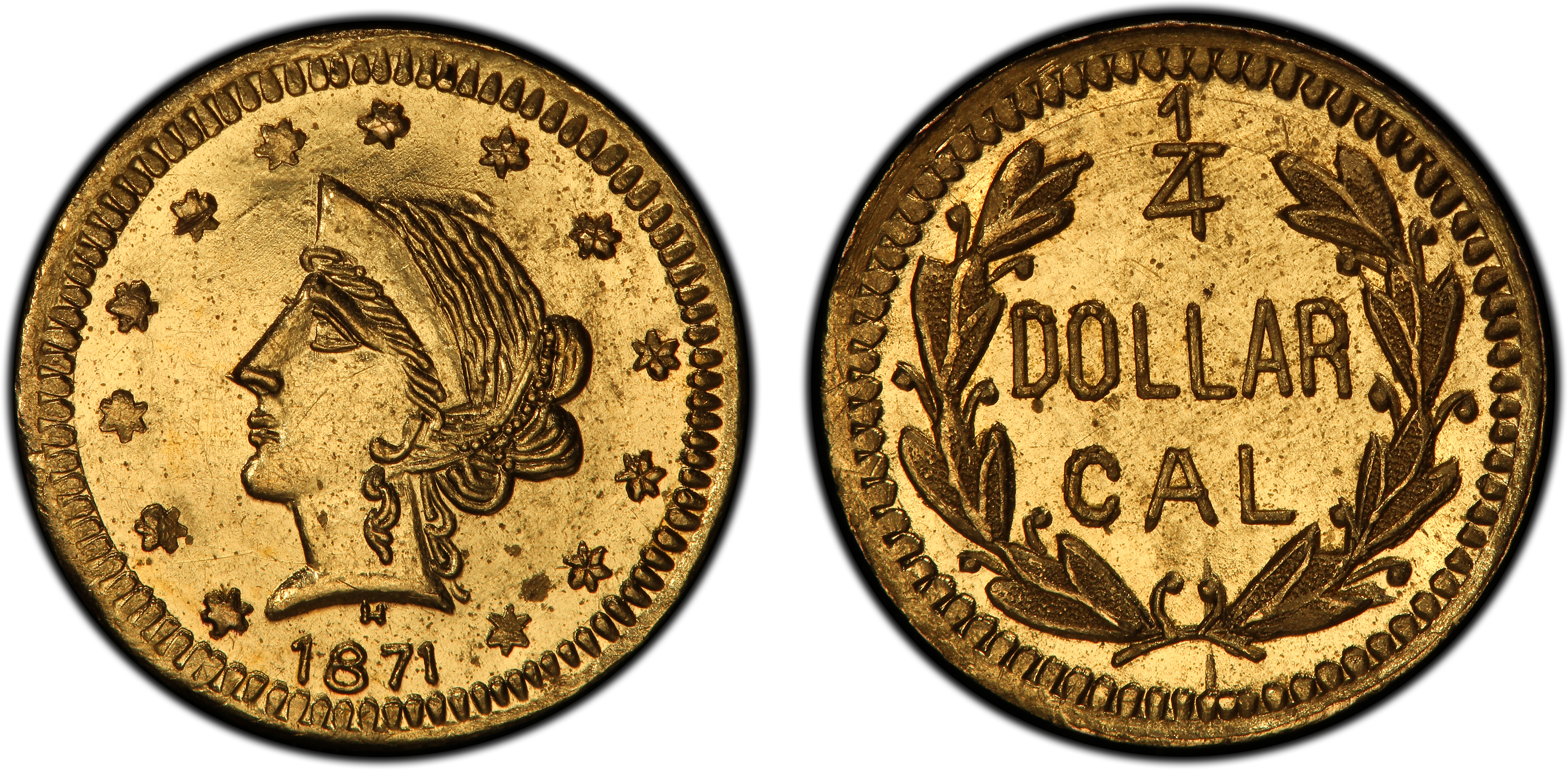
Obverse & Reverse
The 1871 BG-859 25 Cents falls into the 'Period Two' (1859-1882) of California Fractional Gold production, a fascinating and complex era of private coinage in American history. Born from the initial chaos of the California Gold Rush, the earliest fractional gold pieces of 1852-1858 were a genuine, albeit short-lived, response to a severe shortage of small denomination federal coinage for daily commerce. Miners and merchants were forced to transact with inconvenient gold dust or large denomination coins. By the 1870s, the economic landscape had shifted. The United States Mint in San Francisco was in full operation, and the acute need for circulating private coinage had subsided. However, the tiny gold coins had found a new and enduring purpose as popular souvenirs, keepsakes, and jewelry items. Entrepreneurs, many of whom were jewelers by trade, continued to strike these miniature gold pieces to satisfy this robust tourist and novelty market. The BG-859 is a product of this later period, often referred to as 'jeweler's issues.' Unlike the earlier issues which were intended to have intrinsic value close to their face value, these later pieces were known to be underweight, containing less gold than their denomination would imply. They were struck by hand, using a hammer to impress the design from steel dies onto a small gold planchet. This method resulted in significant variations in strike quality, from sharply detailed specimens to those with considerable weakness. The federal government viewed these private issues with growing disdain, considering them an infringement on the government's sole authority to coin money. The Secret Service began to crack down on producers in the 1870s and 1880s, leading many minters to cease production of denominated pieces. The BG-859, proudly bearing its '25 CENTS' denomination, represents one of the last waves of such denominated private issues before legal pressures forced remaining manufacturers to produce only non-denominated tokens. Today, these pieces are not just historical curiosities but are collected as a distinct and challenging numismatic series, with each Breen-Gillio variety representing a unique combination of dies made by an often-anonymous craftsman.
Associated EventCalifornia Gold Rush aftermath and westward expansion tourism.
Reason For MintingPrimarily produced as souvenirs and for use in jewelry, capitalizing on the romantic appeal of the Gold Rush, rather than to alleviate a coin shortage.
Minter HistoryThe specific minter of BG-859 is unknown, which is characteristic of the 'jeweler's issues' from this period. Unlike the more famous assayers of the early Gold Rush (e.g., Moffat & Co., Kellogg & Co.), the producers of Period Two fractionals were often small-scale jewelers who operated with a degree of anonymity, likely to avoid scrutiny from federal authorities. Their primary business was not minting but creating novelty items, and these gold 'coins' were a popular product line.
Historical SignificanceThe BG-859 is significant as an artifact of the commercialization of the Gold Rush legend. It represents the transition of California fractional gold from a necessary medium of exchange to a popular souvenir item, reflecting a maturing California economy and the burgeoning American tourism industry. Its existence highlights the blurry line between private currency and tokens in the late 19th century and the eventual assertion of federal control over coinage.
BG-859
Denomination25 Cents
Minting Period1871
Assayer/MinterUnknown private minter, likely a San Francisco jeweler.
Geographic OriginSan Francisco, California
Obverse DescriptionA head of Liberty facing left, with 'LIBERTY' inscribed on her coronet. The portrait is surrounded by thirteen six-pointed stars, representing the original colonies.
Obverse InscriptionLIBERTY
Reverse DescriptionThe denomination '25 CENTS' is enclosed within a wreath of two olive branches tied with a ribbon at the bottom. The date '1871' is positioned below the wreath.
Reverse Inscription25 CENTS 1871
CompositionGold
Stated Fineness Actual FinenessVariable, but generally lower than official U.S. coinage of the era.
Diameter9.50 mm
EdgePlain
Unknown, but very low.
Survival Estimate20-30 coins
Rarity ScaleR-6 (Low)
The BG-859 is sought after for its high rarity (R-6), classic Liberty Head design, and its status as a denominated piece from the later period of issue. Collectors of the extensive California Fractional Gold series pursue each Breen-Gillio number as a distinct collectible, and high-grade, well-struck examples of scarcer varieties like this are always in demand.
Key VarietiesThe BG-859 itself is a specific die marriage variety. Within the broader California Fractional series, there are no official later-date restrikes or patterns associated with BG-859. The primary variations for collectors are differences in planchet thickness, strike quality, and any minor die states (such as small cracks) that may have developed during its brief production.
Authentication TipsAuthentic pieces should exhibit the correct die characteristics for BG-859. The style of the lettering and the portrait should match known genuine examples. Be wary of modern replicas, which often have a soapy, cast-like appearance and incorrect details. A common red flag for fake California fractionals is the presence of a bear on the reverse, which was not a design used on genuine denominated pieces of this period. Genuine examples often have a slightly crude, hand-struck feel, whereas forgeries may appear too perfect or possess a modern, machine-struck look.
Shopping ConsiderationsFor a premium quality example, a potential buyer should seek out a specimen with a sharp, well-centered strike, particularly on the high points of Liberty's hair and the details of the wreath. Luster is a key factor; some BG-859 examples are found with reflective, semi-prooflike fields, and these command a significant premium. Check for originality of the surfaces, avoiding coins that have been harshly cleaned, polished, or used in jewelry (evidenced by solder marks or excessive rim damage). Tiny, unobtrusive planchet flaws are common and generally accepted, but large, distracting marks will detract from the value. Given the coin's small size, magnification is essential to properly assess its quality.
A coin's grade is its condition, rated on a 1-70 scale. For rare coins, this is the most critical factor in determining value, as a tiny difference in preservation can mean a huge difference in price.
Relevant Grade TypesOriginal issues of BG-859 were business strikes intended for sale, not circulation in the traditional sense, but they are graded on the same scale. They are found in Circulated grades (AU-50 to AU-58 are most common for pieces that saw handling) and Mint State (MS, 60-70). No true Proofs were struck during the original period of issue. The term 'prooflike' (PL) is sometimes used to describe Mint State examples with unusually reflective, mirror-like surfaces, which are highly desirable.
Mint State CharacteristicsAn uncirculated BG-859 is defined by the presence of original mint luster. Quality is determined by the strength of the strike; many are weakly struck in the center, so sharp details on Liberty's coronet and the wreath are prized. Luster is typically bright and satiny, though some are semi-prooflike. Due to the hand-striking process and the softness of the gold, even high-grade specimens will often display tiny planchet flaws or contact marks from handling and storage with other pieces.
Circulated Wear PatternsWear first appears on the highest points of the design. On the obverse, this includes Liberty's cheek, the hair above her eye, and the coronet. On the reverse, the highest points of the wreath's leaves and the bow of the ribbon will show the first signs of friction. In lower grades (e.g., AU-50), the majority of the design remains sharp, but the luster will be gone from these high points.
Key Factors For ValueThe primary drivers of value are rarity and grade. A high-grade (MS-63 or finer) BG-859 is significantly more valuable than a circulated one. Surface quality is paramount: an example with original, undisturbed luster and minimal marks will always be worth more than a cleaned or damaged coin of the same grade. Strike sharpness is a major consideration, with collectors paying a premium for fully struck specimens. Finally, eye appeal, which includes factors like attractive original gold toning and the presence of any prooflike contrast, can add a substantial premium.
PCGS Price Guide
| Grade | Price | Population |
|---|---|---|
| 50 | $250.00 | 1 |
| 50+ | $260.00 | N/A |
| 53 | $275.00 | N/A |
| 53+ | $285.00 | N/A |
| 55 | $300.00 | N/A |
| 55+ | $310.00 | N/A |
| 58 | $325.00 | 5 |
| 58+ | $330.00 | N/A |
| 60 | $450.00 | N/A |
| 61 | $500.00 | 6 |
| 62 | $550.00 | 8 |
| 62+ | $600.00 | N/A |
| 63 | $675.00 | 9 |
| 63+ | $850.00 | N/A |
| 64 | $1,250.00 | 8 |