1875/4 G50C BG-931 (Regular Strike)
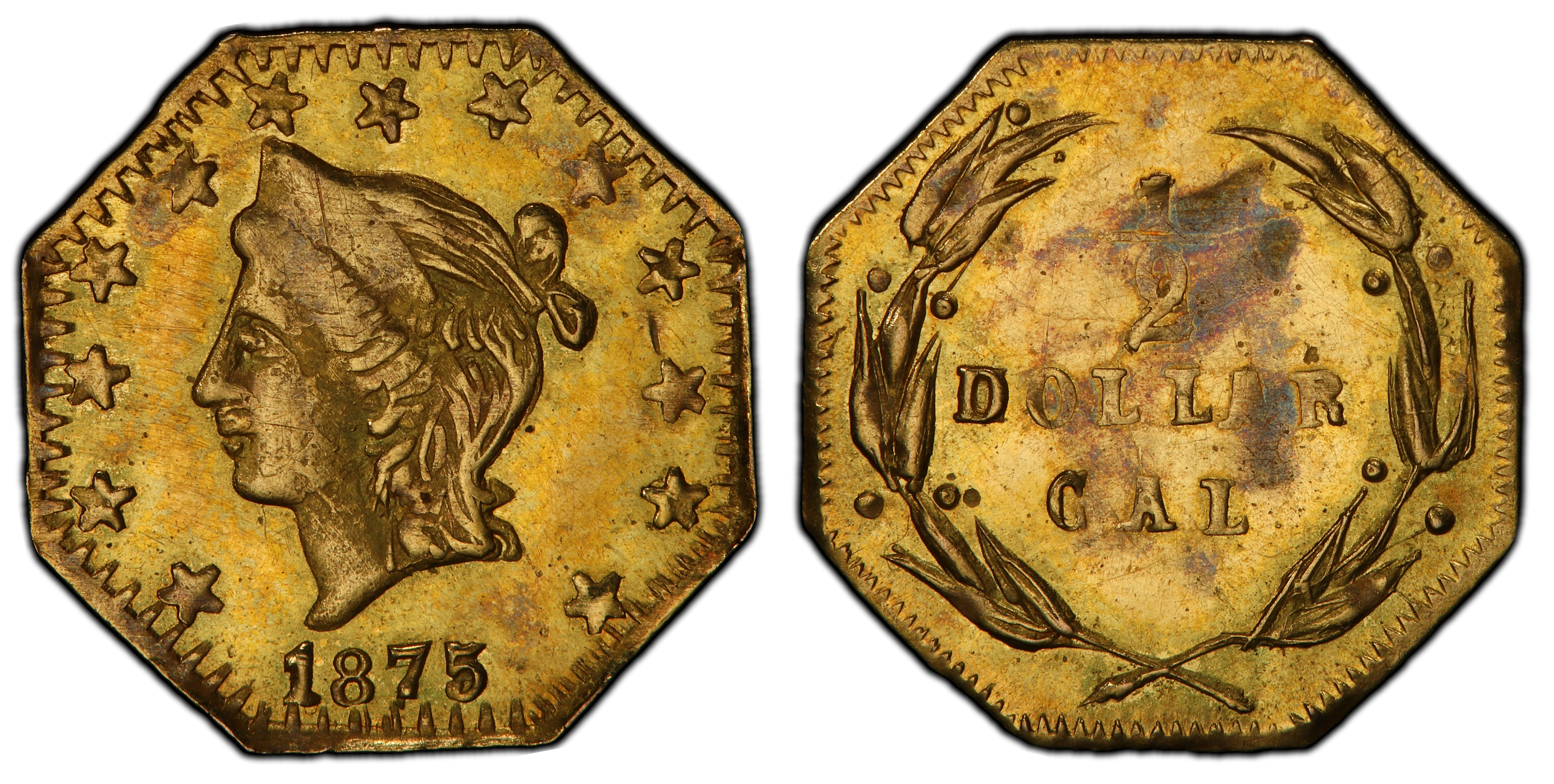
Obverse & Reverse
The 1875/4 BG-931 50 Cents is a fascinating artifact from the second major phase of California Fractional Gold production, often termed 'Period Two' or the 'Suppressed Jewelers' Issues' (1859-1882). Unlike the earlier 'Period One' issues (1852-1857), which were struck to genuinely alleviate a shortage of small-denomination coinage during the initial chaos of the Gold Rush, these later pieces served a different purpose. By the 1870s, the San Francisco Mint was in full operation, producing ample federal coinage for commerce. The acute need for private fractional gold had vanished. Instead, these miniature gold pieces had become popular as souvenirs, keepsakes, and jewelry items. Tourists and residents alike sought them as mementos of the romanticized Gold Rush era. Production was carried out by various jewelers, often anonymously, who capitalized on this demand. The Coinage Act of 1864 had made all private minting illegal, but the law was not aggressively enforced against these small, low-value souvenir tokens until the early 1880s. The makers of BG-931 and its contemporaries operated in this legally grey area, creating a wide variety of designs that mimicked federal coinage but were often lighter in weight and lower in fineness than their stated value would imply. The 1875/4 overdate is a classic example of the practicalities of this cottage industry; rather than create an entirely new die for 1875, a jeweler simply punched the new digit over a leftover 1874 die. These pieces never truly circulated as money but were traded and sold as novelties, a tangible link to California's golden identity long after the frontier chaos had subsided. Their modern numismatic significance lies in their vast variety, their connection to the jeweler's trade of the era, and their status as some of the last privately issued 'coins' in American history.
Associated EventPost-Gold Rush California Economic Expansion
Reason For MintingTo serve the robust souvenir and jewelry market that romanticized the earlier California Gold Rush.
Minter HistoryThe specific minter of BG-931 is unknown, a common trait for Period Two fractional gold. The work is attributed to the many skilled but anonymous jewelers operating in San Francisco during the 1870s. These craftsmen used primitive coining techniques, such as the hammer press, and often re-used or re-punched dies to save on costs, resulting in the numerous overdates and die varieties beloved by collectors today. Their primary business was jewelry and watchmaking, with fractional gold production being a profitable sideline.
Historical SignificanceThe BG-931 represents the evolution of California Fractional Gold from a necessary medium of exchange to a commercial souvenir. It highlights a period when the memory and allure of the Gold Rush were powerful marketing tools. As a 'suppressed issue,' it is a product of a legally ambiguous period and is one of the last examples of private entities striking coin-like objects for public distribution in the United States before federal law was fully enforced in 1883.
BG-931
Denomination50 Cents
Minting Period1875
Assayer/MinterUnknown Private Jeweler
Geographic OriginSan Francisco, California
Obverse DescriptionAn octagonal planchet featuring a left-facing Liberty Head, stylistically similar to contemporary U.S. gold coinage but often more crudely executed. The portrait shows hair tied in a bun at the back. The field is surrounded by 13 five-pointed stars, representing the original colonies. The date, '1875', is positioned below the bust truncation. On this variety, evidence of a '4' is visible beneath the final digit '5' of the date, indicating the use of an altered prior-year die.
Obverse Inscription1875
Reverse DescriptionA central inscription of the denomination '50 CENTS' is enclosed within a wreath. The wreath is typically composed of two branches tied together by a bow at the bottom. The design is characteristic of the jewelers' issues of the period, often featuring simpler, more open wreaths compared to federal coinage.
Reverse Inscription50 CENTS
CompositionGold
Stated Fineness Actual FinenessVariable, typically between .500 and .800 fine gold, often alloyed with silver and copper.
Weight0.25 grams
Diameter10.50 mm
EdgePlain
Unknown, but presumed to be very small.
Survival EstimateFewer than 20 known examples.
Rarity ScaleR-7- (or Low R.7)
The 1875/4 BG-931 is highly sought after for its extreme rarity, its status as a dramatic overdate, and its octagonal shape. It appeals to specialists in California Fractional Gold, overdate collectors, and numismatists who appreciate the artistry and scarcity of Period Two jewelers' issues. Its low survival rate makes any appearance on the market a significant event.
Key VarietiesThe primary variety is the 1875/4 overdate itself. No major die states or other significant varieties are widely recognized for BG-931, likely due to its extremely small original mintage. No special collector issues, patterns, or restrikes are known to exist for this specific die pair.
Authentication TipsAuthentication requires careful examination. A genuine BG-931 will exhibit a clear but often subtle remnant of the underlying '4' beneath the '5' in the date. The overall strike will be somewhat soft in areas, characteristic of hammer striking. The surfaces may show fine, parallel die polishing lines. Look for crude, irregular lettering and stars, unlike the sharp, uniform devices of modern replicas. Counterfeits are often the wrong weight, have a soapy or cast-like texture, incorrect letter fonts, or feature a bear on the reverse—a motif never used on genuine fractional gold of this period.
Shopping ConsiderationsA premium quality example for this issue is defined primarily by its state of preservation and clarity of the overdate. Look for a specimen with minimal marks, no evidence of having been mounted in jewelry (a common fate for these pieces), and a bold strike. Pay close attention to the high points of Liberty's hair and the leaves in the wreath for originality. Surfaces should ideally possess some remnant of original luster, though this is rare. Avoid examples that have been harshly cleaned, polished, or show evidence of tooling or repairs. Given its rarity, even a problem-free, lower-grade example is a significant acquisition. A clear, easily discernible overdate adds a substantial premium.
A coin's grade is its condition, rated on a 1-70 scale. For rare coins, this is the most critical factor in determining value, as a tiny difference in preservation can mean a huge difference in price.
Relevant Grade TypesOriginal period issues were business strikes, although intended as souvenirs rather than for circulation. They are found in Circulated grades (AU-58 and lower, though rarely seen heavily worn) and, more commonly, in Mint State (MS, 60-70) grades. No Proofs were struck during the original period. There are no known later-date Proof restrikes or special collector strikings associated with the BG-931 dies.
Mint State CharacteristicsUncirculated examples of BG-931 often exhibit a soft, satiny luster rather than a hard, frosty one. The strike is almost never perfectly sharp across the entire coin due to the hammer-striking process; expect some weakness in the centers or on the peripheral stars. Planchet quality can be irregular, and small, mint-made adjustment marks or striking flaws are not uncommon and should not be confused with post-mint damage. Contact marks can be prominent due to the softness of the low-karat gold.
Circulated Wear PatternsWear first appears on the highest points of the design. On the obverse, this includes Liberty's cheek, the hair above the ear, and the bun. On the reverse, the highest points of the leaves and the bow of the wreath will show initial friction. In lower grades (VF and below), the finer details of the hair and leaves will merge, and the sharpness of the octagonal edges may become slightly rounded.
Key Factors For ValueFor BG-931, rarity is paramount. Beyond that, value is driven by surface quality and the strength of the overdate. An example with clean, original surfaces free of distracting marks or cleaning will command a significant premium. The boldness and clarity of the 1875/4 overdate is a key value driver; a clear and unmistakable '4' is more desirable than a faint or ambiguous one. Eye appeal, meaning an attractive, original golden toning and a relatively sharp strike, is highly prized. A CAC sticker for this issue would be a strong endorsement of quality and originality, adding a substantial premium.
PCGS Price Guide
| Grade | Price | Population |
|---|---|---|
| 62 | $3,750.00 | 5 |
| 62+ | $4,000.00 | N/A |
| 63 | $4,500.00 | 3 |
| 63+ | $5,000.00 | N/A |
| 64 | $5,500.00 | 2 |
| 64+ | $6,000.00 | N/A |
| 65 | $6,750.00 | 1 |