1865 25C BG-803 (Regular Strike)
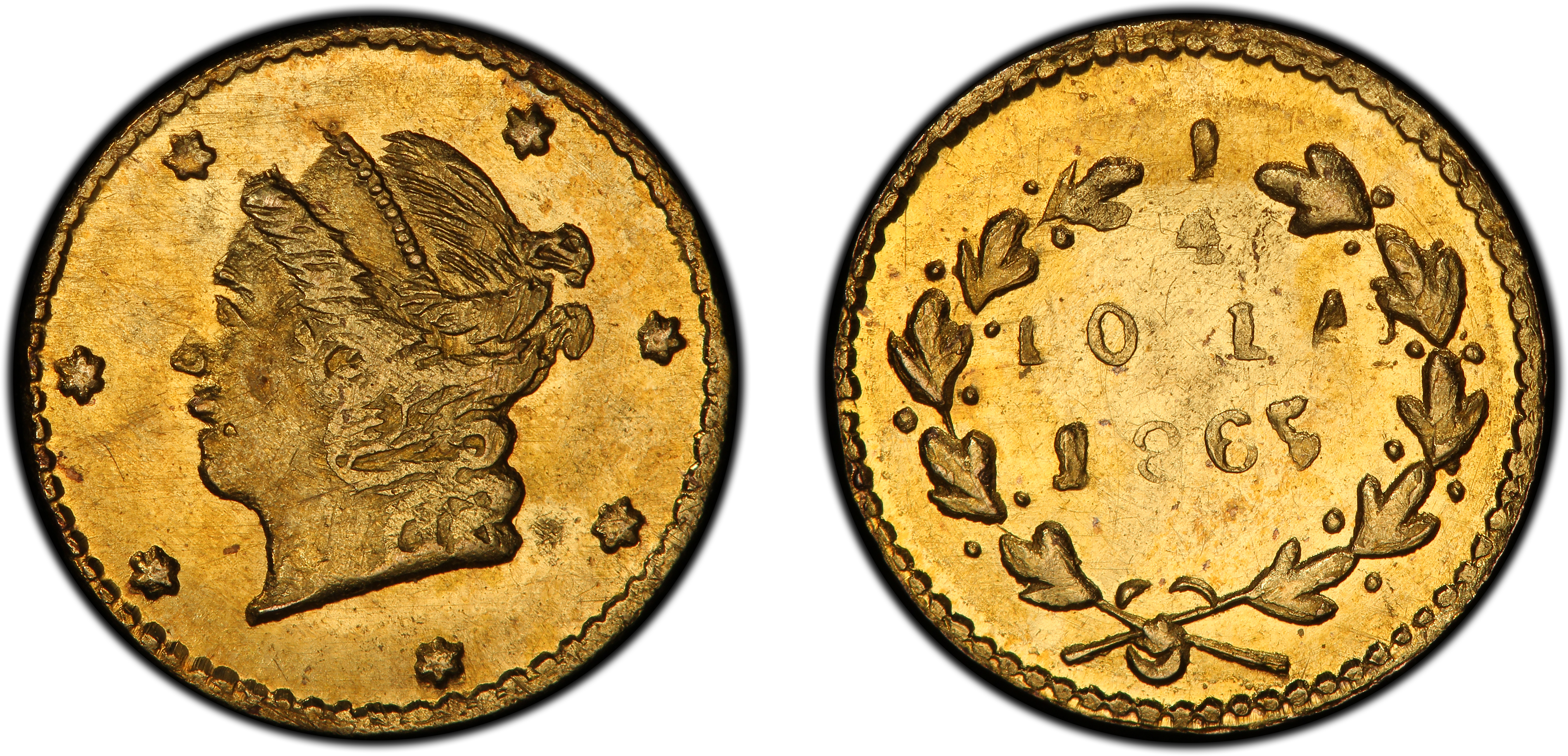
Obverse & Reverse
The 1865 25C Liberty Head, cataloged as Breen-Gillio 803, is a fascinating artifact from the second period of California's private gold coinage. This era, spanning from 1859 to 1882, is distinct from the earlier 'Period One' issues which arose out of a genuine and severe shortage of circulating small change during the initial Gold Rush boom. By 1865, the United States Mint in San Francisco was in full operation, and the acute need for fractional currency had subsided. The context for BG-803's creation is therefore one of transition and legal ambiguity. The Coinage Act of April 22, 1864, had explicitly outlawed the private issuance of coinage. However, enforcement in the still-remote West was lax, and the Secret Service did not fully crack down on these operations until 1883. This legal gray area allowed a number of San Francisco jewelers to continue striking these miniature gold pieces. Unlike their Period One predecessors, these 'jeweler's issues' were not primarily intended to facilitate commerce but were instead produced as souvenirs, keepsakes for tourists, and novelty items for a public still captivated by the allure of gold. Struck in the year the Civil War ended, the BG-803 represents a continuation of a uniquely Californian tradition, defying federal law to satisfy a local market for gold tokens. The manufacturing process for these pieces was often crude, employing hand-cut dies and manual screw presses or even hammer striking, resulting in inconsistent quality. Many Period Two issues were intentionally underweight for their face value, profiting the producers. The BG-803, with its amateurish die work, is a testament to this cottage industry. Its existence speaks to the persistent cultural significance of gold in California long after the initial frenzy of the Gold Rush had passed, serving as a tangible link to the state's identity and economic origins.
Associated EventCalifornia Gold Rush Aftermath
Reason For MintingPrimarily struck as a souvenir or novelty item for local sale after the acute shortage of small change had ended and despite a federal ban on private coinage.
Minter HistoryThe specific minter or jeweler who produced the BG-803 variety is unknown. Research by specialists like Walter Breen, Ronald J. Gillio, and Robert D. Leonard Jr. has attributed many fractional gold varieties to specific makers, but BG-803 remains anonymous. It was likely produced in a small, back-room operation by one of the many jewelers active in San Francisco during the mid-1860s who capitalized on the continued demand for gold souvenirs.
Historical SignificanceThe BG-803 is significant as a 'Period Two' issue, struck after the 1864 Coinage Act. It demonstrates the limited reach of federal authority in the West and the continuation of private minting practices for the souvenir market, illustrating the enduring romanticism of gold in California's post-Gold Rush economy.
N/A
Denomination$0.25
Minting Period1865
Assayer/MinterUnknown Jeweler
Geographic OriginSan Francisco, California
Obverse DescriptionA Liberty Head facing left, modeled after the contemporary federal gold coinage of James B. Longacre. The portrait is surrounded by thirteen six-pointed stars. The engraving is often described as somewhat amateurish.
Obverse Inscription[None]
Reverse DescriptionThe denomination '1/4 DOLLAR' and the date '1865' are enclosed within a beaded circle, which is itself surrounded by the inscription 'CALIFORNIA GOLD'.
Reverse InscriptionCALIFORNIA GOLD 1/4 DOLLAR 1865
CompositionGold
Stated Fineness Actual Fineness EdgePlain
Unknown
Survival EstimateFewer than 30
Rarity ScaleR-6
This variety is highly sought after due to its R-6 rarity. As a 'Period Two' issue struck after the federal ban, it holds special historical interest. The crude yet charming engraving and the challenge of finding a well-struck example add to its numismatic appeal.
Key VarietiesNo major varieties, patterns, or official restrikes are known for BG-803. The primary variation among surviving examples lies in the strike quality and die state. No special collector issues are recorded.
Authentication TipsGenuine examples must have a stated denomination (e.g., 'DOLLAR'); replicas often omit this or use terms like 'CAL GOLD CHARM'. Period Two pieces are typically very thin. Look for the characteristic crude engraving style; Heritage Auctions notes the 'amateurish die cutting' on this variety. The reverse lettering, particularly 'DOLLAR', and the date are often weak. Be wary of modern replicas which are often gold-plated brass and may feature a bear on the reverse, a design not found on genuine Period One or Two issues.
Shopping ConsiderationsA premium quality example for this issue would be one that overcomes the variety's typical production flaws. Look for a specimen with a sharper-than-usual strike, particularly on the date and the word 'DOLLAR' on the reverse. On the obverse, seek an example with minimal effects from the excessive die polishing noted in auction catalogs, which can obliterate details on Liberty's nose and diadem. Original, uncleaned surfaces with some remaining luster are paramount and command a significant premium. Avoid examples that have been mounted for jewelry, cleaned, bent, or exhibit scratches, as these problems are common and severely impact value.
A coin's grade is its condition, rated on a 1-70 scale. For rare coins, this is the most critical factor in determining value, as a tiny difference in preservation can mean a huge difference in price.
Relevant Grade TypesOriginal period issues were business strikes intended for local sale, not circulation in the traditional sense, and are found in both Circulated (1-58) and Mint State (MS, 60-70) grades. Due to their nature as souvenirs, high-grade examples are more common than for circulating Period One issues. No Proof (PR/PF) examples of BG-803 were struck during the original period of issue, and no later-date Proof restrikes are known to exist.
Mint State CharacteristicsUncirculated examples of BG-803 are defined by their luster, but the strike is a key differentiator. A typical piece is weakly struck, particularly on the date and the word 'DOLLAR'. The obverse is often plagued by heavy die polishing lines and a lack of detail on the high points of Liberty's portrait. A superior Mint State specimen would display a bold strike, minimal die polishing effects, and vibrant, frosty luster. Small planchet flaws or adjustment marks made prior to striking are common for this type of private issue and may not detract significantly from the grade if they are not distracting.
Circulated Wear PatternsOn this issue, wear first appears on the highest points: Liberty's cheek, hair details above the eye, and the coronet. On the reverse, the fraction '1/4' and the letters in 'DOLLAR' will show initial friction and begin to flatten. In lower grades (VF and below), the stars on the obverse and the letters in 'CALIFORNIA GOLD' will lose their sharpness and start merging with the fields.
Key Factors For ValueFor the BG-803, value is driven by three main factors beyond the numerical grade. First is the sharpness of the strike; a well-defined date and 'DOLLAR' can add a massive premium. Second is surface quality; an example with original, lustrous surfaces free of cleaning, tooling, or jewelry mounting is extremely desirable. Third is eye appeal; coins with a pleasing, original reddish-gold toning are prized over dull or spotted specimens. A CAC sticker for this issue is highly significant, as it confirms both the grade and the superior quality for that grade, and such coins will command a strong premium in the market.
PCGS Price Guide
| Grade | Price | Population |
|---|---|---|
| 40 | $200.00 | 1 |
| 45 | $210.00 | N/A |
| 45+ | $215.00 | N/A |
| 50 | $225.00 | 1 |
| 50+ | $240.00 | N/A |
| 53 | $265.00 | N/A |
| 53+ | $275.00 | N/A |
| 55 | $290.00 | 3 |
| 55+ | $295.00 | N/A |
| 58 | $310.00 | 2 |
| 58+ | $315.00 | N/A |
| 60 | $345.00 | 2 |
| 61 | $365.00 | 2 |
| 62 | $400.00 | 6 |
| 62+ | $475.00 | N/A |
| 63 | $725.00 | 9 |
| 63+ | $800.00 | N/A |
| 64 | $950.00 | 5 |
| 64+ | $1,150.00 | N/A |
| 65 | $1,750.00 | 1 |