1876 G25C BG-879, PL (Regular Strike)
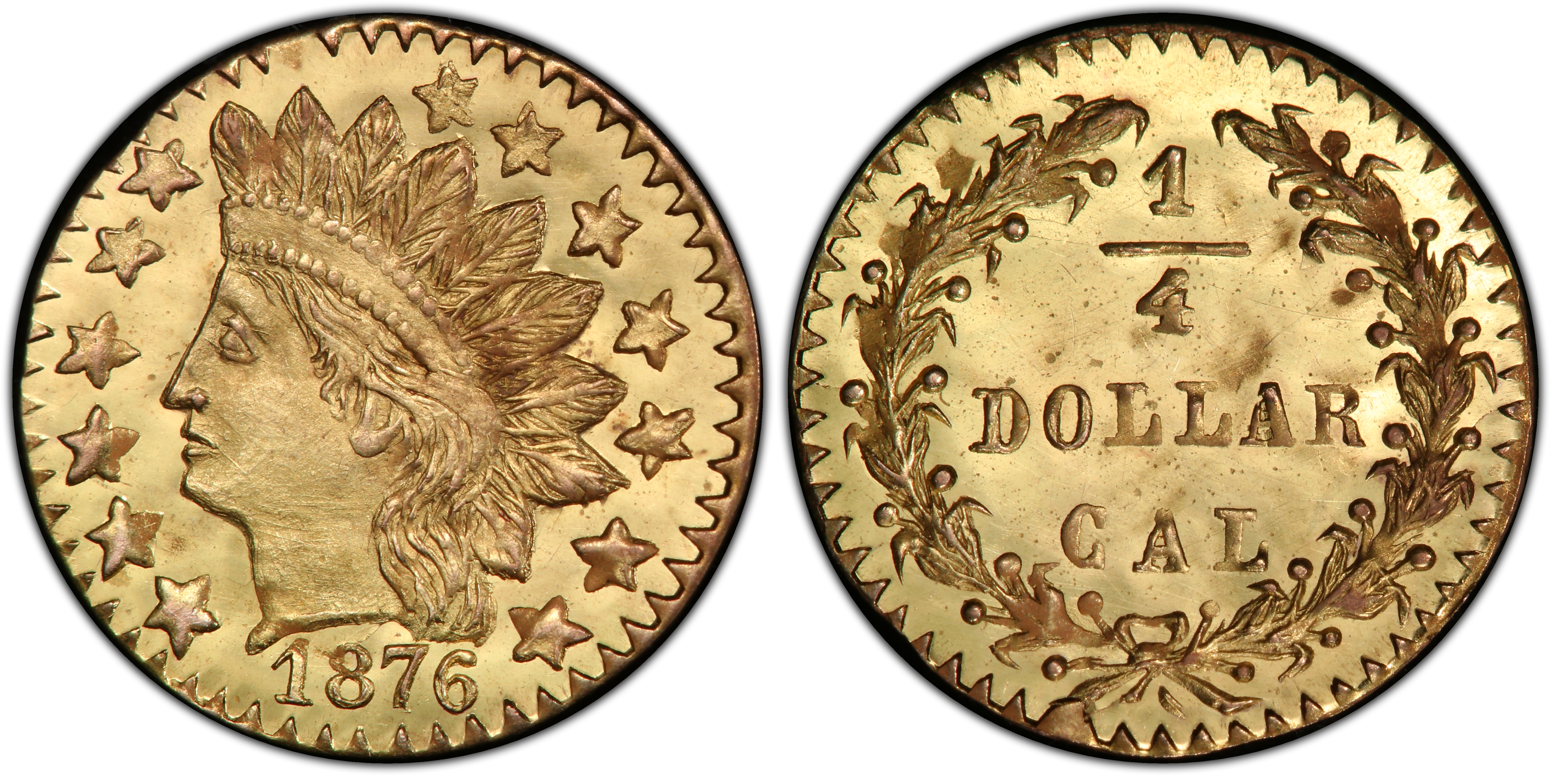
Obverse & Reverse
The 1876 BG-879 25 Cents is a quintessential example of a 'Period Two' California Fractional Gold piece. The history of this fascinating series is rooted in the utter chaos and economic necessity of the California Gold Rush. When gold was discovered in 1848, the subsequent flood of prospectors created a vibrant but chaotic economy desperately short of circulating small-denomination coinage. Gold dust and nuggets were impractical for daily transactions, and the supply of federal silver coins from the East was woefully inadequate. From 1852 to 1857 ('Period One'), various jewelers and assayers stepped in to fill this void, producing small gold quarter-dollar, half-dollar, and dollar coins that genuinely circulated and facilitated commerce. However, by the late 1850s, the San Francisco Mint was in full operation, producing enough federal coinage to alleviate the shortage. This marked the beginning of 'Period Two' (1858-1882), during which the nature of fractional gold production shifted dramatically. No longer essential for circulation, these tiny gold pieces evolved into souvenirs and novelty items, catering to tourists, collectors, and those wishing to send a tangible piece of the 'Golden State' back home. The Coinage Act of 1864 had officially prohibited private coinage, but the law was not rigorously enforced by the Secret Service until 1883. This legal gray area allowed dozens of jewelers, many of French origin in San Francisco, to continue minting these denominated tokens. The BG-879, dated 1876—the year of the nation's Centennial—was struck squarely in this souvenir era. Its production was not driven by a shortage of change, but by a commercial demand for keepsakes. These pieces were often underweight and of a slightly lower fineness compared to their Period One predecessors, as their value was more in their novelty than their intrinsic worth. Despite being souvenirs, their historic connection to the Gold Rush and their intricate, miniature artistry make them highly significant numismatic artifacts today.
Associated EventPost-Gold Rush California / American Centennial
Reason For MintingPrimarily struck as a souvenir or keepsake of California, capitalizing on the legacy of the Gold Rush, rather than for monetary circulation.
Minter HistoryThe specific minter of the BG-879 variety, like many 'Period Two' fractionals, is unknown. The reference work 'California Pioneer Fractional Gold' by Walter Breen and Ronald J. Gillio (expanded by Robert D. Leonard Jr.) attributes these issues to a number of San Francisco-based jewelers and manufacturing firms who operated during this period. These craftsmen often created their own dies and struck pieces on demand. Unlike the more prominent assayers of Period One (e.g., Moffat & Co., Wass, Molitor & Co.), the makers of these later souvenir pieces were typically smaller, more anonymous operations whose primary business was jewelry and engraving, not large-scale minting.
Historical SignificanceThe BG-879 represents the transition of California fractional gold from a necessary circulating medium to a commercial souvenir. It is a tangible link to the romanticism of the Gold Rush era as it was perceived in the 1870s and serves as an important artifact of private minting during a period of lax federal enforcement. Its existence highlights a unique and colorful chapter in American numismatics, distinct from official federal coinage.
BG-879
Denomination25 Cents
Minting Period1876
Assayer/MinterUnknown Private Minter / Jeweler
Geographic OriginSan Francisco, California
Obverse DescriptionThe obverse features a stylized head of a Native American chief facing left, wearing a feathered headdress. The portrait is surrounded by 13 five-pointed stars, representing the original colonies. The date '1876' is positioned below the bust.
Obverse Inscription1876
Reverse DescriptionThe reverse features the denomination '1/4' and the word 'DOLLAR' enclosed within a continuous wreath composed of two leafy branches tied together at the bottom with a bow.
Reverse Inscription1/4 DOLLAR
CompositionGold
Stated Fineness Actual FinenessTypically around .500 to .800 fine, though varies by maker.
EdgePlain
Unknown
Survival Estimate75-125
Rarity ScaleR-4
The 1876 BG-879 is popular due to its classic Indian Head design, affordability relative to rarer varieties, and its connection to the U.S. Centennial year. It serves as an excellent and representative example of a 'Period Two' round fractional gold piece for type collectors.
Key VarietiesThe BG-879 itself is a specific die marriage. Within the broader series, no major varieties, patterns, or official restrikes are recorded for this specific BG number. The primary variations in the series are between different BG numbers, representing different dies and minters. Collectors should be aware of the vast number of contemporary counterfeits and modern replicas, which often feature a bear on the reverse and lack a proper denomination like 'DOLLAR' or 'CENTS'.
Authentication TipsGenuine BG-879 specimens are struck on thin planchets and often exhibit a slightly weak or uneven strike, a characteristic of the private minting process. A key diagnostic mentioned in auction records is a relative sharpness on most design elements, but with specific weakness at the top of the 'A' in DOLLAR. Fakes are often thicker, have a soapy or cast-like appearance, and may have different design details (e.g., star placement relative to the portrait). The presence of a proper denomination ('DOLLAR') is a primary indicator of an authentic Period Two piece, as later non-denominated tokens were made to evade anti-counterfeiting laws.
Shopping ConsiderationsA premium quality example of BG-879 will exhibit a sharp strike for the issue, with clear details in the headdress feathers and wreath leaves. Many genuine examples are found with semi-prooflike or prooflike surfaces, and these command a significant premium. Look for coins with clean, original surfaces that have not been harshly cleaned or polished, as this is a common issue. Eye appeal is paramount; seek out examples with attractive, original reddish or orange-gold toning. Avoid pieces that are bent, holed, or show evidence of being mounted in jewelry, as this drastically reduces their numismatic value.
A coin's grade is its condition, rated on a 1-70 scale. For rare coins, this is the most critical factor in determining value, as a tiny difference in preservation can mean a huge difference in price.
Relevant Grade TypesOriginal 1876 BG-879 issues were business strikes, although produced for souvenir purposes rather than circulation. They are found in both Circulated (AU-58 and below) and, more commonly, Mint State (MS, 60-70) grades due to their nature as keepsakes. No true Proofs were struck during the original period of issue. The 'PL' (Prooflike) or 'DMPL' (Deep Mirror Prooflike) designations are sometimes applied to business strikes with highly reflective fields and are highly desirable.
Mint State CharacteristicsUncirculated examples of BG-879 often possess a bright, satiny luster. High-end specimens frequently display semi-prooflike or fully prooflike fields, which contrast with frosted devices. The strike is typically decent for the series but often shows characteristic softness on the highest points, particularly the top of the 'A' in 'DOLLAR'. Due to the softness of the gold and their small size, even high-grade examples can show minor handling marks or hairlines that may affect the grade.
Circulated Wear PatternsOn this specific design, wear first appears on the highest points of the obverse: the cheek of the Indian chief and the feathers at the very top of the headdress. On the reverse, the high points of the wreath leaves and the edges of the numerals and letters will show the first signs of friction. In lower grades (VF and below), the finer details of the feathers will merge and the legends will begin to soften.
Key Factors For ValueFor the BG-879, the primary value drivers are grade and surface quality. A Mint State coin will be worth significantly more than a circulated one. Within Mint State grades, the presence of a Prooflike (PL) or Deep Mirror Prooflike (DMPL) designation dramatically increases value. Original, uncleaned surfaces with attractive toning command strong premiums. Strike sharpness is also key; a well-struck example showing full detail will be favored over a weakly struck one of the same grade. Certification by a top-tier service (PCGS or NGC) is essential for market acceptance, and a CAC sticker indicates premium quality for the assigned grade and will further enhance its value.
PCGS Price Guide
| Grade | Price | Population |
|---|---|---|
| 64 | $800.00 | 2 |
| 64+ | $975.00 | N/A |
| 65 | $1,350.00 | 2 |
| 66 | N/A | 1 |