1871 G50C BG-1026 (Regular Strike)
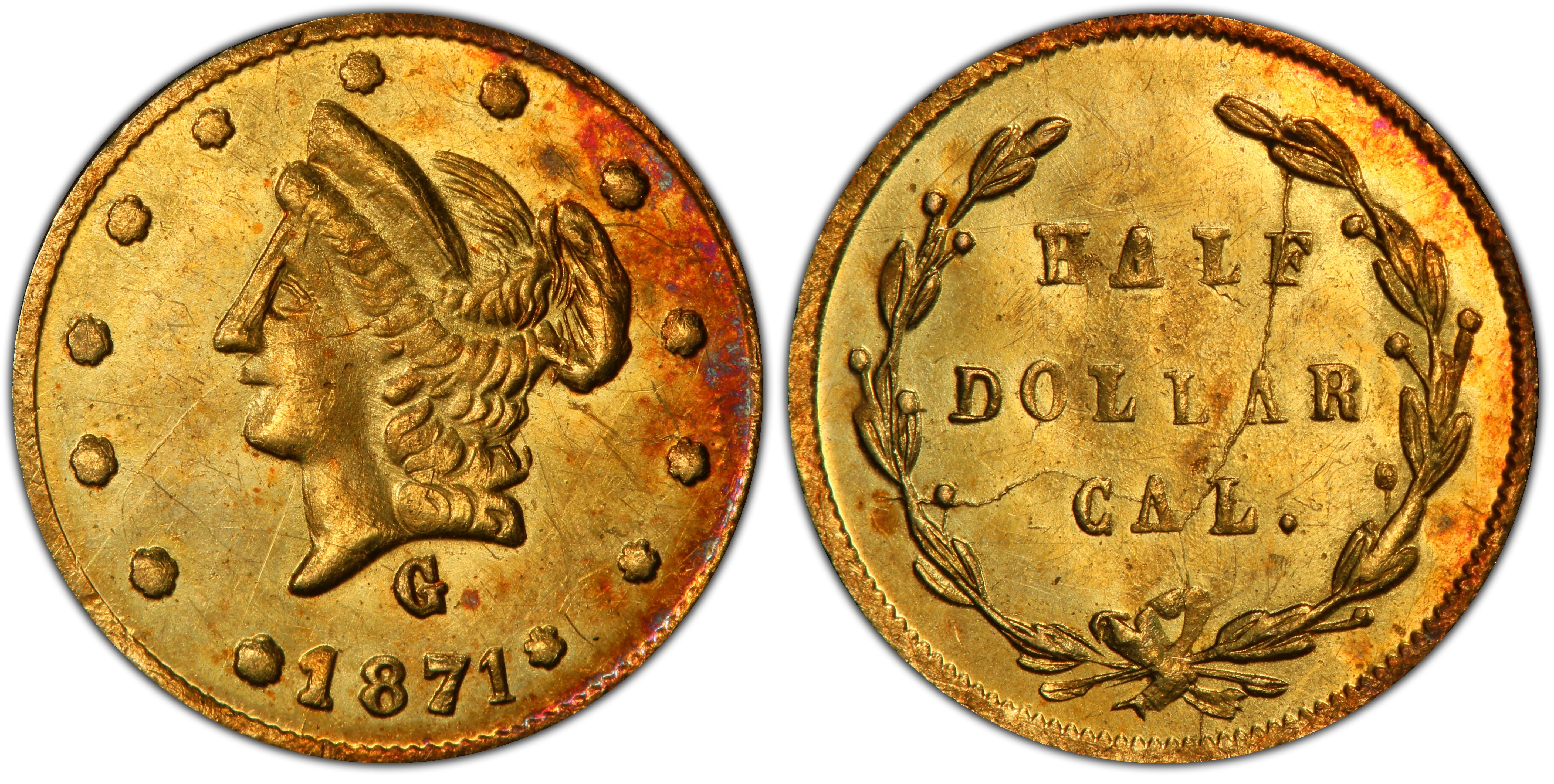
Obverse & Reverse
The 1871 G50C BG-1026 is a product of the second period (1858-1882) of California Fractional Gold production, a fascinating and complex series born from necessity and sustained by commercial opportunism. The initial California Gold Rush created a chaotic economic environment where vast amounts of gold dust and large-denomination coins overwhelmed a severe shortage of small change for daily transactions. To fill this void, private jewelers and metallurgists began striking their own small-denomination gold coins in 1852. These early 'Period One' issues were generally intended to circulate and contained a relatively high gold content for their size. However, by the late 1850s, the dynamic had shifted. The United States government began to crack down on private coinage, and the initial desperate need for small change had eased with the output of the San Francisco Mint. The 'Period Two' issues, including this 1871 piece, were thus produced in a legally gray area and served a dual purpose. While some may have entered circulation, their primary market was as souvenirs, keepsakes, and jewelry items for locals and tourists captivated by the romance of the Gold Rush. This variety, BG-1026, is particularly noteworthy for its distinct manufacturing characteristics. The dies used for its striking were subjected to an exceptionally vigorous polishing, a maintenance technique to remove clash marks or rust. This process was so aggressive that it effaced a key part of the design—Liberty's lower lip—creating a unique and identifiable feature for numismatists. These pieces were likely struck using the 'hammer method,' where a planchet was placed on an anvil die and struck with a hand-held punch die and a sledgehammer, a process that often resulted in coins of variable strike quality. The passage of the Act of April 22, 1864, made private coinage illegal, but enforcement was lax until 1883, allowing these later 'jeweler's issues' to be produced for nearly two more decades before federal authorities finally halted their manufacture.
Associated EventPost-Gold Rush Economic Expansion
Reason For MintingTo provide small denomination coinage for commerce, though by this period, they were primarily made for sale as souvenirs and jewelry.
Minter HistoryThe specific minter for the BG-1026 variety is not definitively known, a common trait for many Period Two California Fractional Gold issues. Production was often clandestine or unmarked due to the questionable legal status of private minting after 1864. San Francisco jewelers like Robert B. Gray & Co. were known to be active producers of fractional gold in 1871, but a direct attribution for this specific die pair has not been established in numismatic literature.
Historical SignificanceThe BG-1026, like other Period Two fractional gold, represents the commercial evolution of private coinage from a practical necessity to a souvenir trade. It serves as a tangible link to the enduring legacy of the California Gold Rush and the unique economic conditions of the American West. The distinct die state also offers a glimpse into the production methods and challenges faced by these private minters.
BG-1026
Denomination50 Cents
Minting Period1871
Assayer/Minter Geographic OriginSan Francisco, California
Obverse DescriptionA head of Liberty facing left, her hair tied in a bun with a coronet inscribed LIBERTY. She is surrounded by 13 six-pointed stars. A key diagnostic for this variety is that the dies were so heavily polished that Liberty's lower lip is completely missing, giving her the appearance of biting her lip.
Obverse InscriptionLIBERTY
Reverse DescriptionThe denomination '50 CENTS' is enclosed within a wreath of two olive branches tied with a bow at the bottom. The legend 'CALIFORNIA GOLD' appears above the wreath along the upper periphery, separated by a central rosette.
Reverse InscriptionCALIFORNIA GOLD 50 CENTS
CompositionGold
Stated Fineness Actual FinenessVaries, but typically lower than official U.S. Mint issues of the period.
Weight0.25 grams
Diameter10.00 mm
EdgePlain
Unknown
Survival Estimate75-200
Rarity ScaleR-4 to R-5
BG-1026 is highly sought after by specialists for its dramatic and easily identifiable die characteristic—the missing lower lip of Liberty. This feature makes it a fascinating variety and provides a clear diagnostic for attribution. The potential for sharply struck, prooflike examples adds to its appeal.
Key VarietiesThe primary characteristic of the BG-1026 is the heavily polished die state resulting in the missing lower lip. There are no other major, distinct varieties, patterns, or restrikes specifically cataloged for BG-1026. The variety itself is the key collectible issue.
Authentication TipsThe most critical diagnostic is the missing lower lip on the obverse, a result of extreme die polishing. Genuine examples often exhibit prooflike or semi-prooflike fields. Be wary of pieces with a soft, mushy strike and incorrect weight or dimensions. Replicas and modern fakes often have incorrect design details, wrong luster, and may have a coppery core visible on the edge or in areas of wear. Genuine pieces, even those made for jewelers, were struck, not cast.
Shopping ConsiderationsA premium quality example of BG-1026 will have a sharp strike, especially on the stars and wreath details. Look for coins with bright, reflective prooflike surfaces, which command a significant premium. Given the manufacturing process, some inherent weakness in strike is acceptable, but a strong overall impression is desirable. Avoid examples that have been harshly cleaned, which will show hairline scratches and impaired luster. Also, avoid pieces that have been mounted as jewelry, looking carefully for evidence of removed solder or tooling on the rims. The visibility of the 'missing lip' diagnostic should be clear and not obscured by wear or damage.
A coin's grade is its condition, rated on a 1-70 scale. For rare coins, this is the most critical factor in determining value, as a tiny difference in preservation can mean a huge difference in price.
Relevant Grade TypesOriginal period issues were business strikes, although many were sold as souvenirs and never circulated. They are found in Circulated (AU-58 and below) and Mint State (MS, 60-70) grades. No true Proofs were struck during the original period of issue. The term 'Prooflike' (PL) is a designation added to Mint State business strikes that exhibit highly reflective, mirror-like surfaces, and these are especially prized for this variety.
Mint State CharacteristicsUncirculated examples of BG-1026 are prized for their luster. The best specimens exhibit deep, flashy prooflike (PL) or deep mirror prooflike (DMPL) fields as a result of the polished dies. The strike can be uneven; some areas may be fully struck while others show some softness, which is characteristic of the hammer-striking process. Typical mint-made imperfections can include minor planchet flaws or a slightly uneven surface texture.
Circulated Wear PatternsWear first appears on the highest points: Liberty's cheek, hair above the ear, and the coronet. On the reverse, the high points of the wreath's leaves and the bow will show the first signs of friction. On lower-grade examples, the stars will begin to lose their definition and the fine details of the wreath will merge.
Key Factors For ValueSurface quality is paramount. An example with original, undisturbed prooflike luster will be worth many times more than a cleaned or circulated piece. The sharpness of the strike is also critical. Finally, overall eye appeal, meaning the combination of luster, strike, and absence of distracting marks or spots, heavily influences value. For this issue, a CAC sticker confirming quality for the grade would add a significant premium, as it provides third-party verification of superior surface preservation and strike.
PCGS Price Guide
| Grade | Price | Population |
|---|---|---|
| 40 | $190.00 | 1 |
| 45 | $195.00 | 1 |
| 45+ | $197.00 | N/A |
| 50 | $200.00 | 4 |
| 50+ | $205.00 | N/A |
| 53 | $210.00 | 3 |
| 53+ | $215.00 | N/A |
| 55 | $225.00 | 20 |
| 55+ | $250.00 | N/A |
| 58 | $275.00 | 31 |
| 58+ | $300.00 | N/A |
| 60 | $350.00 | 1 |
| 61 | $400.00 | 12 |
| 62 | $575.00 | 27 |
| 62+ | $650.00 | N/A |
| 63 | $875.00 | 7 |
| 63+ | $1,000.00 | N/A |
| 64 | $1,350.00 | 1 |