1876/6876 G50C BG-935 (Regular Strike)
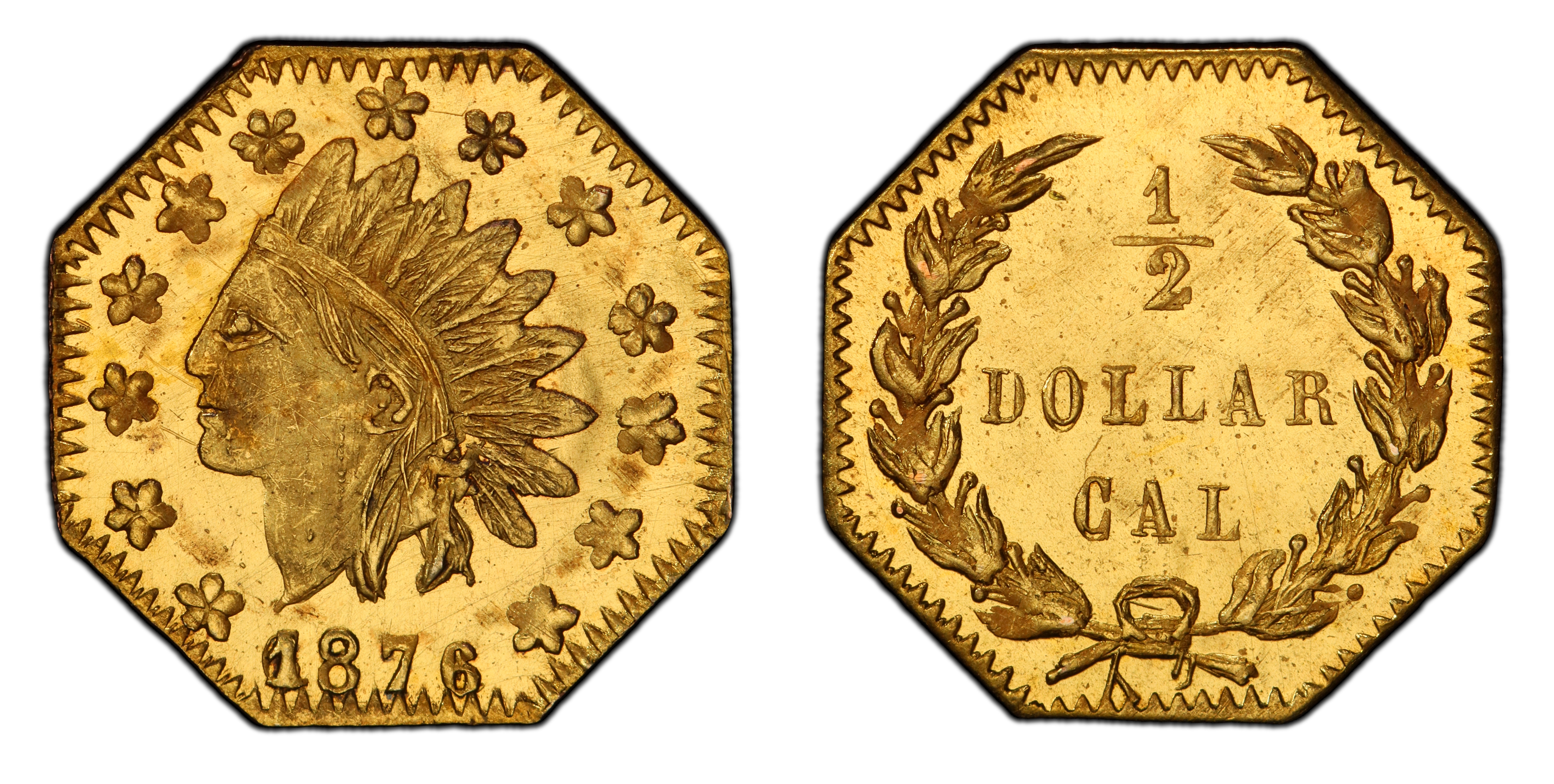
Obverse & Reverse
The 1876/6876 BG-935 50 Cents represents the second great phase of California Fractional Gold production, a period numismatists categorize as 'Period Two' (1859-1882). Unlike the earlier 'Period One' issues, which were struck out of genuine commercial necessity to alleviate the chronic shortage of small change during the Gold Rush, these later pieces served a more ambiguous role. By 1876, the San Francisco Mint was in full operation, supplying ample quantities of federal silver coinage and mitigating the acute need for private issues. Consequently, the production of fractional gold transitioned from a utilitarian enterprise to one driven by jewelers and merchants creating souvenirs, keepsakes, and items for the jewelry trade. These 'jeweler's issues' were often deliberately underweight and of lower fineness compared to their stated value, a fact that was likely an open secret among the populace. The specific minter of BG-935 remains anonymous, a common characteristic for many Period Two varieties. These pieces were produced by numerous small-scale craftsmen and jewelers in San Francisco, who often operated without leaving a clear maker's mark. The most distinctive feature of BG-935 is its dramatic and clear '1876/6876' overdate. This was not an error in the traditional sense, but rather a deliberate act of die modification. The die was almost certainly hubbed with a logotype punch for the date, and the craftsman made a significant error in positioning, punching '6876' initially before correcting it by punching '1876' over it. This prominent feature makes the coin a fascinating study in 19th-century die-sinking practices. These coins likely circulated to a limited extent in local commerce, particularly in areas where small federal coinage was still inconvenient to obtain, but their primary market was tourists and locals seeking a tangible, glittering memento of California's gold legacy. Their existence was finally curtailed in 1883 when the U.S. Secret Service, led by the zealous James J. Brooks, cracked down on all private coinage, effectively ending a unique and colorful chapter in American monetary history.
Associated EventPost-Gold Rush California Economy / Centennial Exposition Year
Reason For MintingPrimarily created as souvenirs and for the jewelry trade by private jewelers, though they may have seen limited local circulation.
Minter HistoryThe minter of BG-935 is unknown, which is typical for the 'jeweler's issues' of Period Two. Unlike Period One minters who sometimes marked their work (e.g., Deriberpe, Nouizillet), many later producers were anonymous craftsmen in San Francisco's vibrant metalsmithing trade, creating these pieces for a souvenir-driven market rather than as a primary commercial enterprise.
Historical SignificanceThis coin is a prime example of a 'Period Two' California Fractional Gold piece, significant not as a monetary necessity but as a cultural artifact. It showcases the evolution of private gold from essential circulating currency to a commercial souvenir product, reflecting California's transition from a frontier society to a tourist destination. The prominent overdate offers a direct link to the hand-crafting and die preparation methods of the era.
BG-935
Denomination50 Cents
Minting Period1876
Assayer/MinterUnknown Private Minter
Geographic OriginSan Francisco, California
Obverse DescriptionFeatures a stylized head of an Indian princess facing left, adorned with a feathered headdress. The portrait is surrounded by thirteen stars, representing the original colonies. The prominent overdate '1876/6876' is located below the bust.
Obverse Inscription1876/6876
Reverse DescriptionA wreath composed of two branches tied with a ribbon at the bottom encircles the denomination. Within the wreath, the value is expressed as '1/2' and 'DOLLAR'. A small letter 'C' for California is positioned below the fraction.
Reverse Inscription1/2 DOLLAR C
CompositionGold
Stated Fineness Actual FinenessVariable, often lower than federal standards for the era.
Weight0.25 grams
Diameter10.00 mm
EdgePlain
Unknown
Survival Estimate19-24 known specimens
Rarity ScaleR-6
The BG-935 is highly sought after due to its status as a dramatic and easily visible overdate, its high rarity (R-6), and its octagonal shape, which is emblematic of the pioneer gold series. It appeals to specialists in California gold, error collectors, and those who appreciate tangible links to 19th-century minting processes.
Key VarietiesThe primary variety is the regular strike described here, defined by the BG-935 attribution. No official patterns, proofs, or restrikes from the period of issue are known to exist. All known examples are considered business strikes, though they often exhibit prooflike characteristics due to the striking process on polished planchets.
Authentication TipsAuthentic examples must exhibit the precise die characteristics of BG-935, including the specific placement and details of the 1876/6876 overdate. Genuine Period Two fractionals will always have a denomination (e.g., 'DOLLAR'). Be wary of pieces with a bear on the reverse, as these are modern fantasy tokens. Genuine pieces are often weakly struck in areas, particularly on the high points of the hair and feathers, whereas modern fakes are often sharply and uniformly struck. The gold should have the characteristic color of unrefined California gold, often with a slightly brassy or reddish hue.
Shopping ConsiderationsA premium quality example of BG-935 will display a bold, clear overdate with all digits visible. Look for specimens with prooflike or semi-prooflike fields, which are highly desirable and frequently encountered on this variety. Surfaces should be as free as possible of the distracting abrasions and cleaning hairlines that plague these tiny, soft gold coins. Luster is paramount. Avoid examples that have been used as jewelry, evidenced by solder marks, retooling on the rims, or excessive, localized wear. Given the R-6 rarity, any certified example is significant, but one with strong eye appeal, original surfaces, and a sharp strike on the central devices will command a substantial premium.
A coin's grade is its condition, rated on a 1-70 scale. For rare coins, this is the most critical factor in determining value, as a tiny difference in preservation can mean a huge difference in price.
Relevant Grade TypesAll original examples of BG-935 are business strikes intended for souvenir sales and limited commerce, and are found in Circulated (1-58) and Mint State (MS, 60-70) grades. No true Proofs were struck during the original period of issue. However, many Mint State survivors were struck on polished planchets and exhibit deeply mirrored, prooflike (PL) or deep prooflike (DPL) surfaces; this is a key quality distinction and not a separate striking method.
Mint State CharacteristicsUncirculated examples are defined by their luster, which is often flashy and reflective rather than satiny. The strike is a key variable; many are softly struck on the highest points of the Indian's hair and the leaves in the wreath. A well-struck piece with full detail is rare and desirable. Due to the rudimentary production methods, even high-grade Mint State examples can show minor planchet flaws or adjustment marks made prior to striking. Small, scattered contact marks are common and must be assessed carefully.
Circulated Wear PatternsWear first appears on the high points of the Indian's cheek, hair, and the feathers of the headdress. On the reverse, the highest points of the wreath's leaves and the numerals of the fraction will show the first signs of friction. In lower grades (VF and below), the overdate details may begin to merge, and the stars and legends will lose their sharpness.
Key Factors For ValueThe primary value driver for BG-935 is its rarity. Beyond that, the quality of the surface preservation is critical; an example with original, undisturbed prooflike fields is far more valuable than a cleaned or abraded one of the same numerical grade. The clarity and boldness of the 1876/6876 overdate is a major factor in eye appeal and desirability. Thirdly, the sharpness of the strike, especially on the central portrait, separates average from premium examples. A CAC sticker on this issue provides a significant premium, confirming both authenticity and superior quality for the grade.
PCGS Price Guide
| Grade | Price | Population |
|---|---|---|
| 40 | $230.00 | 1 |
| 45 | $250.00 | N/A |
| 45+ | $255.00 | N/A |
| 50 | $270.00 | 2 |
| 50+ | $275.00 | N/A |
| 53 | $285.00 | N/A |
| 53+ | $290.00 | N/A |
| 55 | $305.00 | 1 |
| 55+ | $310.00 | N/A |
| 58 | $320.00 | 1 |
| 58+ | $335.00 | N/A |
| 60 | $400.00 | 1 |
| 61 | $475.00 | 3 |
| 62 | $525.00 | 11 |
| 62+ | $575.00 | N/A |
| 63 | $625.00 | 12 |
| 63+ | $800.00 | N/A |
| 64 | $1,250.00 | 7 |
| 64+ | $1,750.00 | N/A |
| 65 | $2,850.00 | 4 |