1871 G50C BG-1011 (Regular Strike)
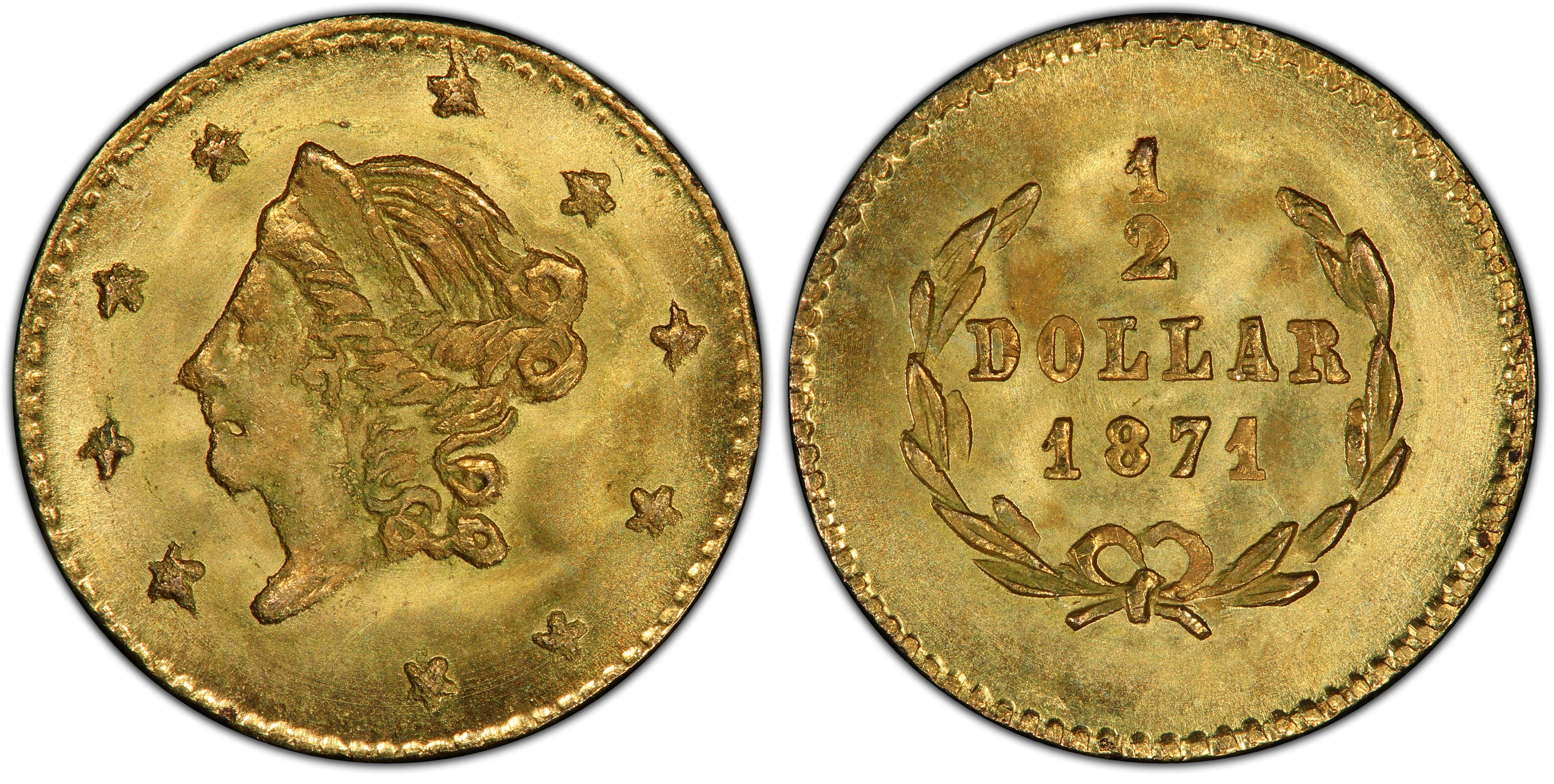
Obverse & Reverse
The 1871 BG-1011 50 Cents represents a fascinating and complex chapter in American monetary history, born from the lingering economic realities of the California Gold Rush. By the 1870s, the initial frenzy of the Gold Rush had subsided, but California's economy remained distinct from the rest of the nation. The official United States Mint in San Francisco produced substantial quantities of larger denomination gold coins, but a chronic shortage of small-denomination circulating coinage persisted. This scarcity was a legacy of the region's hard-money preference, where gold dust and nuggets had been the primary medium of exchange. Federal silver and copper coins were often rejected, hoarded, or quickly shipped east, creating a vacuum in daily commerce. To fill this void, numerous private jewelers and metallurgists in San Francisco began striking small-denomination gold coins, typically in 25 Cent, 50 Cent, and Dollar denominations. These 'California Fractional Gold' pieces were not legal tender but were widely accepted due to their convenience and intrinsic gold value. However, their production existed in a legal gray area. An 1864 federal law prohibited private coinage, yet enforcement was lax in the far-flung state of California, allowing these tokens to flourish. The pieces struck in the 1870s, like this 1871 example, were often thinner and lighter than their earlier 1850s counterparts, reflecting a shift from a functional currency substitute to a popular souvenir item for tourists and locals alike. They captured the romanticism of the Gold Rush era and served as keepsakes of the 'Golden State.' The BG-1011 variety, with its classic Indian Princess motif, was a direct emulation of the contemporary U.S. gold dollar, a design choice meant to inspire confidence and familiarity. These pieces circulated to some extent but were largely cherished as mementos, which explains why a fair number have survived in higher grades. Their production ultimately ceased in 1883 following stricter federal enforcement, ending a unique 30-year period of private minting.
Associated EventPost-California Gold Rush Economic Period
Reason For MintingTo satisfy the persistent local demand for small denomination coinage and to serve as popular souvenir items for tourists and residents.
Minter HistoryThe specific minter for BG-1011 is not definitively known, a common trait for many California fractional gold pieces of this period. However, based on die characteristics, manufacturing style, and historical context, numismatic scholarship, primarily through the work of Breen and Gillio, attributes this and many related varieties to the workshops of Robert B. Gray & Co. of San Francisco. This firm was known for producing a wide array of tokens, medals, and jewelry, and had the requisite skills and equipment for coining. These operations were typically small-scale, using hand-operated presses, and often shared or sold dies among different producers, creating a complex web of attributions for modern researchers.
Historical SignificanceThe BG-1011 is a tangible artifact of a unique period when private enterprise filled a gap left by official government coinage in a remote but economically powerful state. It represents the transition of fractional gold from a necessary medium of exchange to a commercial souvenir, reflecting California's burgeoning identity and tourist trade. Its existence highlights the lingering effects of the Gold Rush and the independent economic spirit of 19th-century California.
N/A
Denomination50 Cents (G50C)
Minting Period1871
Assayer/MinterUnknown private minter, often attributed to the firm of Robert B. Gray & Co.
Geographic OriginSan Francisco, California
Obverse DescriptionA beaded border encircles a left-facing portrait of a Liberty Head, adorned with a feathered headdress. The headdress band is inscribed with LIBERTY. The portrait is flanked by 13 stars, representing the original colonies.
Obverse InscriptionLIBERTY
Reverse DescriptionA beaded border contains the denomination '1/2' and the word 'DOLLAR' within a wreath composed of two oak branches tied with a ribbon at the bottom. The date '1871' is positioned below the bow.
Reverse Inscription1/2 DOLLAR 1871
CompositionGold
Stated Fineness Actual FinenessVaries, but typically between .500 and .750 fine gold.
Weight0.25 grams
Diameter10.00 mm
EdgePlain
Unknown
Survival Estimate500-750
Rarity ScaleR-4
This variety is highly popular due to its classic 'Indian Princess' design, which mimics the U.S. gold dollar, its affordability relative to earlier period fractionals, and its status as a widely accepted and available type coin for collectors building a set of California gold.
Key VarietiesThe primary issue is the 'Regular Strike' intended for circulation or sale as a souvenir. While not a separate variety, some examples may be found with proof-like or semi-proof-like surfaces, resulting from fresh, polished dies, but these are not considered true, intentionally struck Proofs. No official later-date restrikes are known. Collectors should focus on die states, as minor cracks or clashes can create interest, though these are not typically cataloged as distinct BG numbers.
Authentication TipsAuthentic BG-1011 examples have specific die markers. The 'L' in DOLLAR on the reverse is often weakly struck or indistinct. Look for a sharp, beaded border; counterfeits are often soft and mushy in this area. The stars on the obverse should be well-formed, not globular. Many contemporary counterfeits were made of brass; verify the coin has the correct color and density of gold. Modern replicas are common, but are typically marked with 'COPY' or have a different weight and feel.
Shopping ConsiderationsA premium quality example for its grade will possess a sharp strike, particularly on Liberty's hair details and the numerals of the date. Seek out coins with smooth, lustrous surfaces free of distracting marks, rim bumps, or evidence of cleaning. Original, uncleaned examples often exhibit a rich, reddish-gold or deep yellow-gold patina that is highly desirable. Avoid specimens that have been used as jewelry, evidenced by solder marks, heavy polishing, or rim filing. The planchets for these were often imperfect, so minor natural flaws are acceptable, but major striations or laminations can be distracting.
A coin's grade is its condition, rated on a 1-70 scale. For rare coins, this is the most critical factor in determining value, as a tiny difference in preservation can mean a huge difference in price.
Relevant Grade TypesOriginal 1871 BG-1011 coins were business strikes meant for circulation or commercial sale and are graded on the Circulated (About Good-3 to About Uncirculated-58) and Mint State (MS-60 to MS-70) scales. No true Proofs were struck during the original period of issue. Some coins may be designated 'Proof-like' (PL) by grading services if they exhibit mirrored fields from freshly polished dies, but they are a subset of the business strike mintage and not a separate issue.
Mint State CharacteristicsUncirculated examples of BG-1011 often display a soft, satiny luster. The strike can be variable; a sharp strike across the entire design is rare and commands a premium. It is common to see some weakness in the center of the obverse (Liberty's cheek) and the corresponding area on the reverse (the denomination). Due to the softness of the gold and their handling as keepsakes, even Mint State coins frequently show small contact marks or 'chatter' in the open fields.
Circulated Wear PatternsWear first appears on the highest points: the cheek and feathers on the obverse, and the '1/2' and the bow of the wreath on the reverse. On moderately circulated examples (VF-XF), the finer details in the hair and feathers will merge. In lower grades (F and below), the word LIBERTY on the headband becomes indistinct, and the reverse legends and date begin to weaken significantly.
Key Factors For ValueThe primary driver of value is the grade, specifically the quality of the surfaces. An example with minimal marks and original, lustrous 'skin' will always be worth more than a cleaned or polished coin of the same technical grade. Strike quality is the next most important factor; well-struck examples with full details are highly sought. Finally, eye appeal, which includes factors like the richness of the gold coloration and the absence of distracting planchet flaws, contributes significantly to market value. A CAC sticker for this issue indicates superior quality for the grade and typically results in a strong price premium.
PCGS Price Guide
| Grade | Price | Population |
|---|---|---|
| 35 | $170.00 | 1 |
| 40 | $175.00 | 2 |
| 45 | $180.00 | N/A |
| 45+ | $182.00 | N/A |
| 50 | $185.00 | 2 |
| 50+ | $187.00 | N/A |
| 53 | $190.00 | 4 |
| 53+ | $192.00 | N/A |
| 55 | $195.00 | 25 |
| 55+ | $200.00 | N/A |
| 58 | $205.00 | 36 |
| 58+ | $215.00 | N/A |
| 60 | $230.00 | 5 |
| 61 | $260.00 | 24 |
| 62 | $290.00 | 98 |
| 62+ | $310.00 | N/A |
| 63 | $330.00 | 93 |
| 63+ | $385.00 | N/A |
| 64 | $525.00 | 55 |
| 64+ | $560.00 | N/A |
| 65 | $625.00 | 25 |
| 65+ | $725.00 | 1 |
| 66 | $1,100.00 | 15 |
| 66+ | $1,500.00 | N/A |
| 67 | $2,800.00 | 4 |
| 67+ | $3,800.00 | 1 |