1864 G25C BG-866 (Regular Strike)
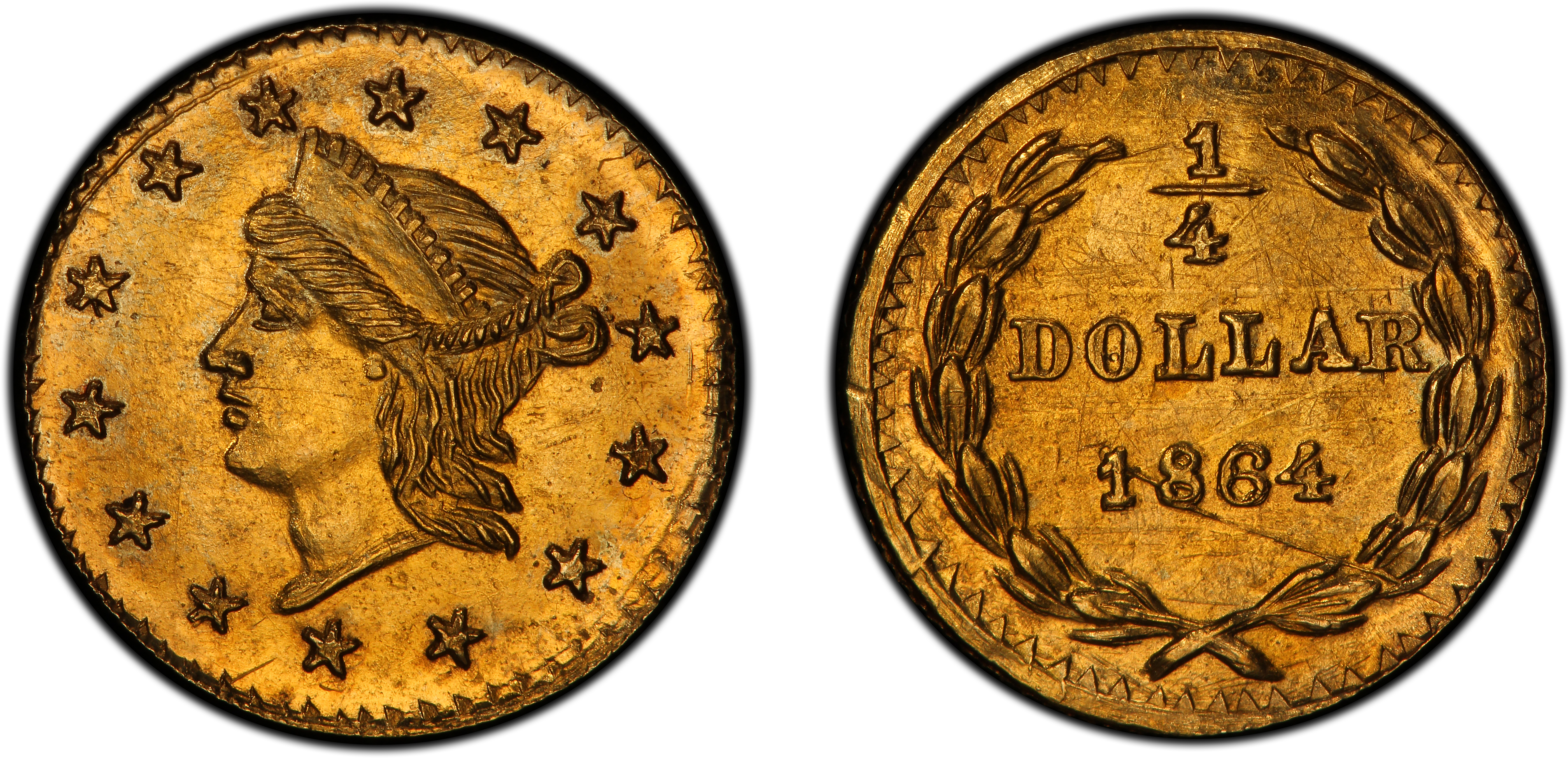
Obverse & Reverse
The 1864 G25C BG-866 is a fascinating and often misunderstood piece of American numismatic history. While its date suggests an origin during the Civil War, it is in fact a 'Period Three' issue, a term numismatists use to categorize California Fractional Gold pieces struck after the Secret Service crackdown of 1882-1883. The Coinage Act of April 22, 1864, had already made private coinage illegal, but enforcement was inconsistent. For two decades, jewelers in San Francisco produced denominated 'Period Two' pieces, primarily as souvenirs for tourists and collectors. However, by the early 1880s, federal agents began to actively suppress these private mints. In response, manufacturers who wished to continue profiting from the romantic allure of the Gold Rush adopted a clever subterfuge: they continued to strike small gold tokens but backdated them to earlier, pre-enforcement years, such as 1864. This created a plausible deniability, framing the items as old stock rather than newly, and illegally, minted coins. These Period Three pieces were never intended to circulate as money. Their purpose was purely nostalgic, serving as jewelry, charms, and collectibles that evoked the pioneering spirit of the '49ers. The manufacturer of BG-866 remains unknown, a common fate for these later, more clandestine operations. Despite their non-monetary purpose, these backdated issues are now an integral and highly collectible part of the California Fractional Gold series. They represent the final chapter of this uniquely American phenomenon, a testament to the enduring mythology of the California Gold Rush and the entrepreneurial spirit of the jewelers who catered to it, even in the face of federal prohibition. The BG-866, therefore, is not a product of the goldfields' desperate need for small change, but rather a product of its romantic memory.
Associated EventPost-Gold Rush Nostalgia / Federal Prohibition of Private Coinage
Reason For MintingTo serve as a collectible souvenir or jewelry charm, backdated to circumvent the federal prohibition on private coinage.
Minter HistoryThe identity of the specific private minter or jeweler who produced the BG-866 variety is unknown. Many Period Three issues were produced anonymously to avoid prosecution by the U.S. Secret Service, which began actively enforcing the 1864 Private Coinage Act in the early 1880s.
Historical SignificanceThe BG-866 is significant not as a circulating coin, but as a historical artifact representing the transition of California Fractional Gold from quasi-currency and contemporary souvenirs (Periods One and Two) to clandestine, backdated collectibles (Period Three) created in response to federal law enforcement.
BG-866
Denomination25 Cents
Minting PeriodStruck ca. 1883-1905 (Backdated 1864)
Assayer/MinterUnknown Private Minter
Geographic OriginSan Francisco, California
Obverse DescriptionA small head of Liberty, facing left, with LIBERTY inscribed on her coronet. Her hair is tied in a bun at the back. The portrait is surrounded by thirteen six-pointed stars, typically unevenly spaced and of somewhat crude style, consistent with many Period Three issues.
Obverse Inscription Reverse DescriptionThe denomination '1/4 DOLLAR' and the date '1864' are enclosed within a wreath. The wreath is composed of two branches tied with a bow at the bottom. The style of the wreath is often described as simple or somewhat crude. A key diagnostic for this variety is the presence of several die cracks in the field below the date.
Reverse Inscription1/4 DOLLAR 1864
CompositionGold
Stated Fineness Actual FinenessVariable, typically 10-14 Karat (.417-.585 fine), though scientific analysis on this specific variety is not widely published.
Weight0.24 grams
Diameter9.80 mm
EdgePlain
Unknown
Survival EstimateFewer than 75 believed to exist
Rarity ScaleLow R-6 (31-75 Known)
BG-866 appeals to specialists in the California Fractional Gold series, particularly those completing variety sets or focusing on the historically intriguing Period Three issues. Its status as a scarce, backdated piece tells a compelling story of defiance and nostalgia.
Key VarietiesThe primary issue is the regular business strike. No proof strikings or major die varieties from the period of manufacture are known or expected for this type of issue. As a Period Three piece, it is itself a 'special collector issue' by nature, distinct from the earlier circulating types. Collectors should be aware of the myriad of modern, non-gold replicas that imitate the style but lack a Breen-Gillio number.
Authentication TipsAuthentic pieces must be made of gold. Weight and diameter should conform to the specifications (approx. 0.24g, 9.8mm). The most critical diagnostic is the presence of die cracks on the reverse below the date; fakes are unlikely to replicate these specific die markers. The overall fabric should appear correct for a late 19th/early 20th-century striking, not modern or cast. Any piece without a clear denomination (e.g., featuring a bear on the reverse) is a 20th-century token or replica, not a genuine Breen-Gillio denominated variety.
Shopping ConsiderationsA premium quality example for this issue is defined by a sharp strike, particularly on Liberty's hair details and the numerals of the date. Original, lustrous surfaces are highly prized, often displaying a slightly brassy, reddish-gold hue. Weakness of strike is common, so a fully struck specimen commands a significant premium. Avoid examples that have been cleaned, tooled, or previously mounted as jewelry, as these issues severely impact value. Look for coins that have been certified by a major grading service (PCGS or NGC) to ensure authenticity and accurate grading, as the raw market is fraught with counterfeits and replicas.
A coin's grade is its condition, rated on a 1-70 scale. For rare coins, this is the most critical factor in determining value, as a tiny difference in preservation can mean a huge difference in price.
Relevant Grade TypesAll original BG-866 pieces are considered business strikes, though they were not intended for circulation. They are found in both Circulated (1-58, though rare as they didn't circulate) and, more commonly, Mint State (MS, 60-70) grades. No proofs were struck during the original manufacturing period, and no later restrikes are known to exist.
Mint State CharacteristicsUncirculated examples of BG-866 often exhibit a soft, satiny luster. The strike can be inconsistent; a well-struck coin will show clear details in Liberty's hair and the wreath's leaves, while average examples may show some softness. Planchet quality can be mediocre, with minor striations or adjustment marks sometimes visible. Small, intrinsic die polish lines or the noted reverse die cracks are characteristic of the issue and not considered defects.
Circulated Wear PatternsAlthough not intended for circulation, some examples show light wear from handling or use as a pocket piece. Wear first appears on the high points: Liberty's cheek, coronet, and hair bun on the obverse, and the leaves and bow of the wreath on the reverse. In lower grades, the stars and legends would become indistinct.
Key Factors For ValueThe primary drivers of value for a BG-866 are grade and surface quality. An example with sharp details and undisturbed original luster will command the highest prices. Eye appeal is crucial; collectors pay a premium for coins with attractive, original color and a clean appearance. The presence of a CAC sticker, indicating premium quality for the grade, adds a significant premium for this and other scarce California Fractional Gold issues.
PCGS Price Guide
| Grade | Price | Population |
|---|---|---|
| 50 | $265.00 | 1 |
| 50+ | $270.00 | N/A |
| 53 | $275.00 | N/A |
| 53+ | $285.00 | N/A |
| 55 | $300.00 | 1 |
| 55+ | $320.00 | N/A |
| 58 | $350.00 | 4 |
| 58+ | $385.00 | N/A |
| 60 | $500.00 | N/A |
| 61 | $700.00 | 1 |
| 62 | $800.00 | 10 |
| 62+ | $900.00 | N/A |
| 63 | $1,500.00 | 4 |
| 63+ | $2,500.00 | N/A |
| 64 | $4,750.00 | 2 |
| 64+ | $5,250.00 | N/A |
| 65 | $6,500.00 | 1 |