1875 25C BG-798, PL (Regular Strike)
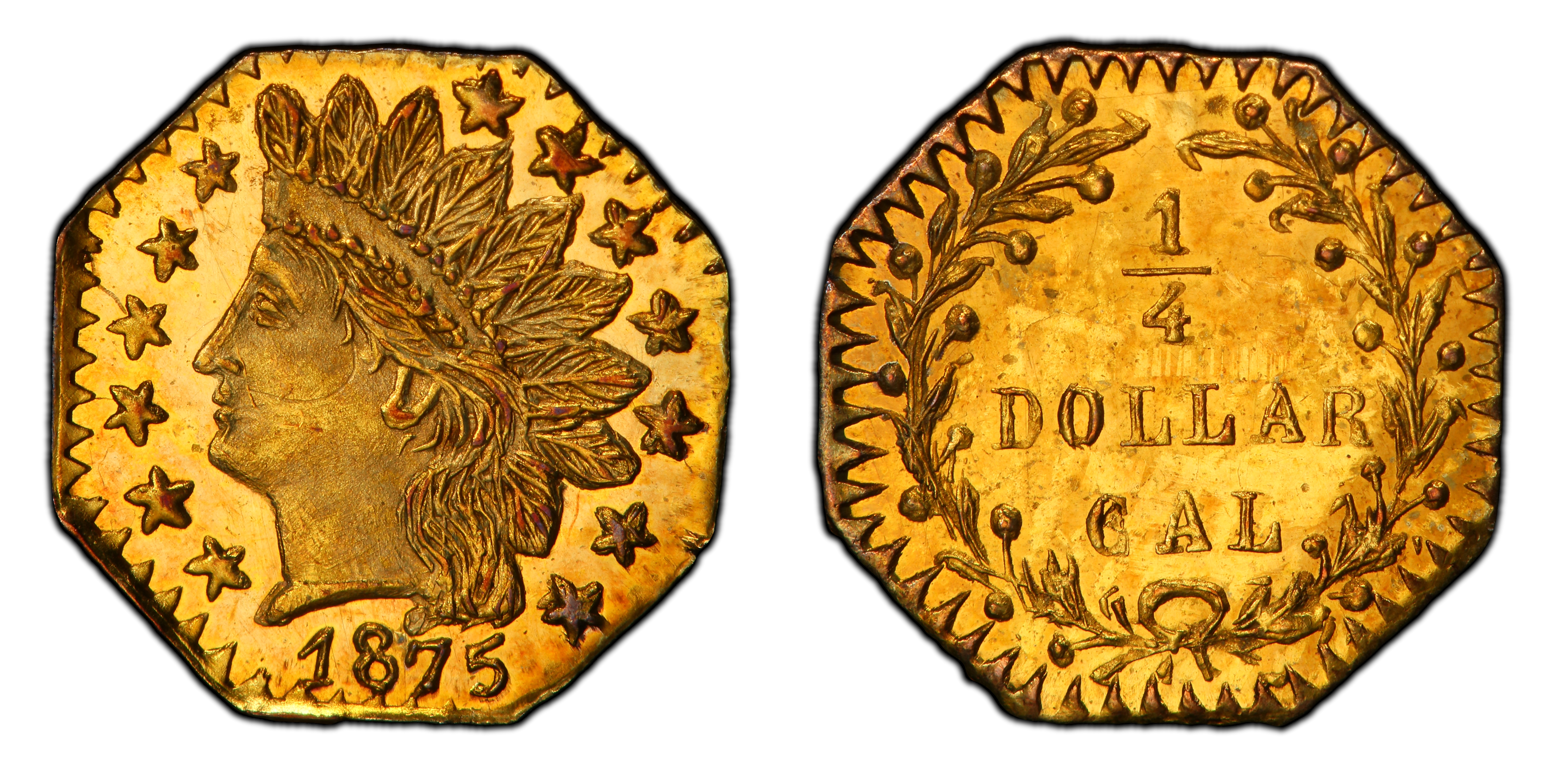
Obverse & Reverse
The 1875 BG-798 quarter dollar emerges from the second period (1858-1882) of California Fractional Gold production, a fascinating chapter in American numismatics that transitioned from necessity to novelty. The initial period (1852-1857) saw these tiny gold pieces struck to alleviate a severe shortage of small-denomination coinage during the height of the Gold Rush. However, by the mid-1850s, the new San Francisco Mint was in full operation, pumping federal silver and gold coins into the local economy and largely resolving the 'small change' crisis. This should have rendered the private fractionals obsolete. Instead, a new market emerged. Jewelers, many of French origin, recognized the allure of these miniature gold coins and continued to produce them, not primarily for circulation, but as souvenirs, keepsakes, and jewelry items for a populace still captivated by the romance of the Gold Rush. These 'Period Two' issues, often called 'jeweler's pieces,' were struck with a commercial rather than a monetary purpose. The Coinage Act of 1864 had explicitly outlawed private coinage, but enforcement in the far-flung West was lax, allowing production to flourish throughout the 1870s. The makers of BG-798 operated in this legally gray environment, creating pieces that were intentionally underweight for their face value, maximizing profit while selling them as charming mementos. The Indian Head motif, popularized by the federal cent of 1859, was a common design choice, tapping into the romanticized imagery of the American West. These pieces were often sold to tourists and locals alike, sometimes holed or mounted for use in necklaces, bracelets, or watch fobs. It wasn't until a crackdown by the U.S. Secret Service, concerned about potential for fraud, that production was finally suppressed by 1883, ending the era of this unique and popular private coinage.
Associated EventPost-Gold Rush economic development and tourism in California.
Reason For MintingPrimarily created as a commercial souvenir and novelty item for the jewelry trade rather than to fulfill a circulating monetary need.
Minter HistoryThe specific minter of the BG-798 dies remains anonymous, a common trait for Period Two issues where makers sought to avoid legal scrutiny. Numismatic scholarship by Walter Breen and Ronald J. Gillio links the style and die characteristics of BG-798 to other varieties (BG-796, BG-797), suggesting they were the work of a single, skilled but unidentified San Francisco jeweler. These craftsmen used hubbing and hand-engraving techniques to create their dies, often producing numerous varieties with subtle differences. Their business model relied on selling these gold tokens for slightly more than their minimal intrinsic value, catering to a market that valued them for their novelty and connection to California's golden identity.
Historical SignificanceThe BG-798 is significant not as a coin that financed commerce, but as a numismatic artifact that reflects the maturation of the California economy from a frontier society to a place of established wealth and tourism. It represents the commercialization of the Gold Rush legacy, transforming the concept of a private gold coin from a utilitarian monetary instrument into a desirable collectible and souvenir. Its existence demonstrates the persistent demand for gold mementos and the quasi-legal space in which private minters operated for decades after their monetary role had ceased.
K-N/A
Denomination25 Cents
Minting Period1875
Assayer/MinterUnknown private minter, likely a San Francisco-based jeweler. Attributed by Breen and Gillio to the same maker as BG-796 and BG-797.
Geographic OriginSan Francisco, California
Obverse DescriptionA stylized female head faces left, wearing a feathered headdress intended to represent a Native American. The portrait is often called an 'Indian Head.' The headdress feathers are crudely but boldly rendered. The portrait is surrounded by 13 five-pointed stars, typically unevenly spaced and of varying sharpness. The date '1875' is below the bust.
Obverse Inscription1875
Reverse DescriptionThe denomination '1/4' is centered within a wreath composed of two branches tied together at the bottom with a bow. The wreath is relatively simple, with berries or leaves depicted. The shape of the coin is octagonal.
Reverse Inscription1/4
CompositionGold
Stated Fineness Actual FinenessTypically ranges from .500 to .800 fine (12k to 19k gold), consistent with Period Two jeweler's issues being intentionally debased or underweight.
Weight0.24 grams
Diameter10.00 mm
EdgePlain
Unknown, but very low.
Survival EstimateFewer than 75 pieces are believed to exist in all grades.
Rarity ScaleR-5 (Very Scarce: 31-75 known)
The BG-798 is sought for its classic octagonal Indian Head design, a hallmark of the popular California Fractional Gold series. As a Period Two issue, it is more affordable than its Period One circulating counterparts, making it an accessible entry point into this historic field. The 'PL' (Prooflike) designation on some examples adds significant visual appeal.
Key VarietiesThe primary variety is the BG-798 regular business strike. While no major sub-varieties from the period of issue are cataloged for BG-798 specifically, collectors should note that the term 'Prooflike' (PL) or 'Deep Mirror Prooflike' (DMPL) is a surface designation applied by grading services to business strikes with highly reflective fields, not a separate striking. Unlike some territorial issues, there are no known official patterns, trial pieces, or later-date restrikes associated with this specific 19th-century die pair.
Authentication TipsGenuine BG-798 examples are very thin and lightweight. Counterfeits are often thicker and heavier, with a soapy or cast-like appearance. Look for sharp, albeit sometimes crude, die work; fakes often have soft, indistinct details, especially in the wreath and headdress feathers. The '1/4' on the reverse should be crisp. Original pieces will not have a bear on them, a common motif added to modern replicas. The stars on the obverse are often irregularly placed and may show die rust or other imperfections, which can be diagnostic die markers.
Shopping ConsiderationsA premium quality BG-798 is defined by a sharp strike, particularly on the highest points of the Indian's cheek and the feathers, as well as the bow on the reverse wreath. Seek out examples with smooth, Prooflike surfaces free of distracting marks or planchet flaws. Original, uncleaned surfaces will exhibit a rich, reddish-gold or orange-gold luster. Avoid pieces that have been harshly cleaned, which imparts a dull, lifeless appearance, or those showing evidence of being previously used as jewelry (solder marks, rim damage, or obvious polishing). Even high-grade examples can have minor planchet flakes, which is common for the series and should be evaluated for its impact on eye appeal.
A coin's grade is its condition, rated on a 1-70 scale. For rare coins, this is the most critical factor in determining value, as a tiny difference in preservation can mean a huge difference in price.
Relevant Grade TypesOriginal 1875 BG-798 coins were all struck as business strikes, intended for commercial sale as souvenirs. They are found in Circulated (1-58) and, more commonly, Mint State (MS, 60-70) grades. No true Proofs were struck during the original period of issue. The 'PL' (Prooflike) designation is given to business strikes that exhibit mirrored fields from being struck with freshly polished dies, a common characteristic for these jeweler-made pieces. These are not a separate issue but are highly desirable business strikes.
Mint State CharacteristicsIn Mint State, the quality is determined by the strike and surface preservation. The strike on BG-798 is often inconsistent; a sharp strike will show clear definition in all 13 stars and the details of the feathers. Luster is typically bright and flashy, often with deep reflectivity qualifying for a PL or DMPL designation. Due to the small size and handling, even uncirculated pieces commonly have tiny contact marks or faint hairlines that can affect the grade. Planchet quality can also vary, with minor striations or flakes sometimes seen.
Circulated Wear PatternsWear first appears on the high points of the design: the cheek, the eyebrow, and the upper feathers of the headdress. On the reverse, the highest points of the wreath and the loops of the bow will show initial friction and flattening. In lower circulated grades (VF and below), the date and stars will begin to weaken and merge with the fields. Due to their use in jewelry, examine the octagonal points of the rim carefully for wear or damage.
Key Factors For ValueThe most significant value drivers for a BG-798 are grade and surface quality. A high Mint State grade (MS-64 or better) carries a substantial premium. The presence of a PL or DMPL designation dramatically increases value and collector demand due to superior eye appeal. Coins with original, untouched 'skin' and attractive deep gold toning are prized over cleaned or polished examples. Finally, certification by a top-tier grading service (PCGS or NGC) is essential for marketability, and a CAC sticker, indicating premium quality for the grade, will add a further strong premium.
PCGS Price Guide
| Grade | Price | Population |
|---|---|---|
| 64 | $775.00 | 1 |
| 64+ | $950.00 | N/A |
| 65 | $1,650.00 | N/A |
| 65+ | $2,000.00 | N/A |
| 66 | $2,250.00 | 1 |