1881 G50C BG-957 (Regular Strike)
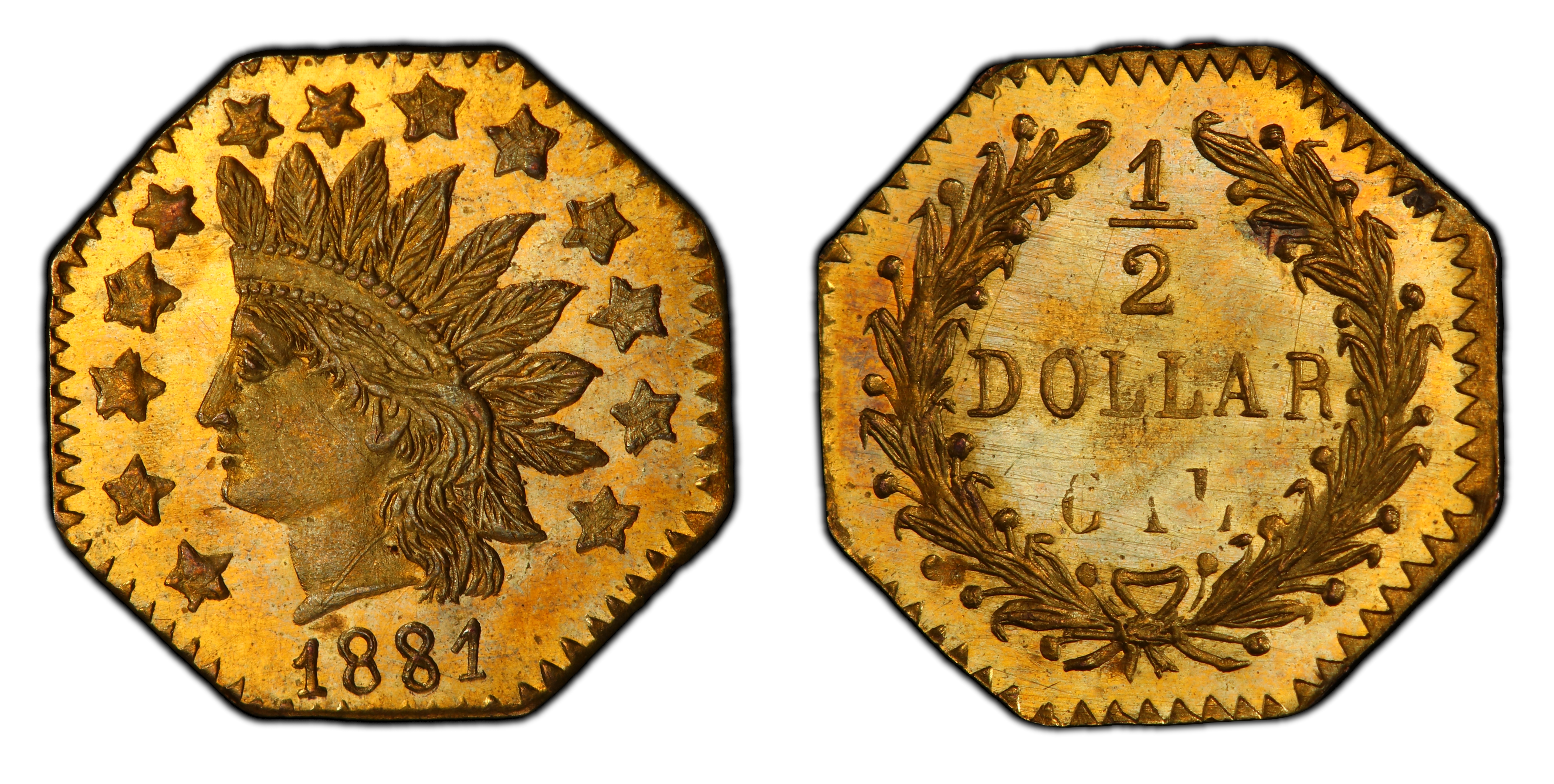
Obverse & Reverse
The 1881 Octagonal 50 Cents, cataloged as BG-957, is a fascinating artifact from the twilight of America's private coinage era. It belongs to what numismatists classify as 'Period Two' (1859-1882) of California Fractional Gold production. Unlike the earlier 'Period One' issues, which were struck out of genuine necessity to alleviate a severe shortage of small change during the initial Gold Rush, the pieces from this later period served a different purpose. By the 1880s, the United States Mint was supplying adequate coinage to California, and the desperate need for local, private issues had subsided. The Coinage Act of 1864 had officially prohibited private minting, but the law was not strictly enforced in the West until 1883. In this legal gray area, San Francisco jewelers and artisans continued to strike these miniature gold coins, catering less to commerce and more to the burgeoning souvenir and jewelry trade. These pieces were sold as keepsakes to tourists, given as gifts, and incorporated into rings, cufflinks, and brooches. The BG-957 is a product of this environment. It was not intended to be a workhorse of daily transactions but rather a memento of the California Gold Rush, which by then had passed into the realm of legend. Struck with an Indian Head motif popular in the late 19th century, its production reflects a shift from utilitarian currency to numismatic novelty. Despite their semi-official status, these later issues were produced with a high degree of craftsmanship, continuing the tradition of their predecessors. Their existence today provides a tangible link to a period of immense economic and social transformation in the American West, representing the final chapter of a uniquely American coinage phenomenon before federal authority consolidated control over all minting operations.
Associated EventPost-Gold Rush California Economy
Reason For MintingPrimarily struck for use in the jewelry trade and as souvenirs for tourists, rather than for general circulation.
Minter HistoryThe specific maker of BG-957 is unknown, which is common for Period Two California Fractional Gold. These pieces were typically produced by various San Francisco-based jewelers and artisans who created the dies and struck the coins in small workshops. Unlike the more prominent private minters of the Gold Rush's peak, these later producers often worked anonymously, leaving behind no mintmarks or identifiable records. Their business was in creating attractive, gold-based novelties that evoked the romance of the Gold Rush for a public eager for keepsakes of the era.
Historical SignificanceThe BG-957 is significant as a representative of the final phase of private gold coinage in the United States. It marks the transition of these pieces from essential circulating currency to commercial novelties and collector's items, struck in the shadow of impending federal prohibition. Its survival and rarity underscore the limited, specialized production of these late-date issues.
BG-957
Denomination50 Cents
Minting Period1881
Assayer/MinterUnknown Private Minter
Geographic OriginSan Francisco, California
Obverse DescriptionAn Indian Head (female Liberty wearing a feathered headdress) facing left, surrounded by thirteen six-pointed stars. The date '1881' is positioned below the bust.
Obverse Inscription1881
Reverse DescriptionA simple wreath composed of two branches tied with a bow at the bottom. The denomination '50 CENTS' is inscribed within the wreath. The legend 'CALIFORNIA GOLD' appears outside the wreath at the top, though on later die states of this variety, the letters 'CAL' are often very weak or completely effaced due to die lapping.
Reverse InscriptionCALIFORNIA GOLD 50 CENTS
CompositionGold
Stated Fineness Actual FinenessVariable, but generally between .500 and .900 fine.
Weight0.25 grams
Diameter10.00 mm
EdgePlain
Unknown
Survival Estimate16-30 coins
Rarity ScaleLow R-6
This coin is highly sought after for its rarity, octagonal shape, and classic Indian Head design. As a late-date, 'Period Two' issue, it appeals to specialists completing Breen-Gillio variety sets and collectors fascinated by the closing chapter of private American coinage.
Key VarietiesThe primary variety distinction is BG-957A, which represents an earlier die state. On these examples, the word 'CAL' on the reverse is fully or mostly visible. On the more common, later die state (regular BG-957), the dies were heavily lapped or polished, resulting in the near-complete obliteration of 'CAL.' No known proof restrikes or patterns exist for this specific variety.
Authentication TipsAuthentication by a major third-party grading service (PCGS or NGC) is essential, as the series is plagued by contemporary and modern counterfeits. Genuine pieces exhibit sharp, albeit sometimes uneven, strikes from high-pressure die stamping, unlike the mushy details of cast fakes. The gold alloy should have a characteristic hue, not the brassy look of many replicas. A key diagnostic for fakes is the presence of a bear on the reverse; no genuine, circulating California Fractional Gold coins from this era featured a bear.
Shopping ConsiderationsFor a premium quality BG-957, a potential buyer should prioritize a sharp strike on the central devices, particularly the details of the headdress on the obverse and the wreath on the reverse. Given the known issue with this die, the strength of the 'CALIFORNIA GOLD' legend is a critical factor; examples showing any portion of 'CAL' (approaching the BG-957A state) command significant premiums. Look for original, undisturbed surfaces with prooflike or satiny luster. Avoid examples that have been obviously cleaned, polished, or show evidence of being removed from jewelry, which often manifests as rim damage or solder marks.
A coin's grade is its condition, rated on a 1-70 scale. For rare coins, this is the most critical factor in determining value, as a tiny difference in preservation can mean a huge difference in price.
Relevant Grade TypesAll original 1881 BG-957 coins were struck as business strikes, intended for sale as souvenirs or jewelry items, not for circulation in the traditional sense. They are found in both Circulated (AU-58 and below) and, more commonly, Mint State (MS, 60-70) grades due to their limited use. No true Proofs were struck during the original period of issue. The surfaces are often prooflike (PL) due to polished dies, but these are not designated as true Proof strikings.
Mint State CharacteristicsIn uncirculated grades, the BG-957 often exhibits a decent strike in the center but weakness at the periphery, especially on the reverse legend. The fields are frequently prooflike, with deep, mirror-like surfaces. Luster is typically bright and flashy. Small planchet flaws, unstruck areas, or light adjustment marks are not uncommon given the private, less-controlled minting process. Contact marks, even on high-grade pieces, can be present due to the softness of the gold and handling over the years.
Circulated Wear PatternsAlthough most examples are uncirculated, on those with light wear (AU grades), friction first appears on the highest points: the cheek and feathers of the Indian Head, and the leaves and bow of the wreath. In lower grades, the stars on the obverse and the letters of the denomination on the reverse will begin to lose their sharpness.
Key Factors For ValueThe most significant value drivers for a BG-957 are the grade and the die state. An example graded MS-64 or higher will be worth substantially more than lower Mint State grades. The presence of the 'CAL' on the reverse (the BG-957A variety) elevates the coin to a higher level of rarity and desirability. Beyond grade, eye appeal is crucial; pieces with clean, prooflike surfaces and a sharp strike command the strongest prices. The presence of a CAC sticker, indicating premium quality for the grade, adds a significant premium for this and other California Fractional Gold issues.
PCGS Price Guide
| Grade | Price | Population |
|---|---|---|
| 55 | $300.00 | N/A |
| 55+ | $320.00 | N/A |
| 58 | $350.00 | 1 |
| 58+ | $375.00 | N/A |
| 60 | $430.00 | N/A |
| 61 | $480.00 | N/A |
| 62 | $525.00 | 2 |
| 62+ | $555.00 | N/A |
| 63 | $650.00 | 7 |
| 63+ | $715.00 | N/A |
| 64 | $850.00 | 8 |
| 64+ | $1,025.00 | N/A |
| 65 | $1,800.00 | 3 |
| 65+ | $2,000.00 | N/A |
| 66 | $2,300.00 | 1 |