1873 G50C BG-942 (Regular Strike)
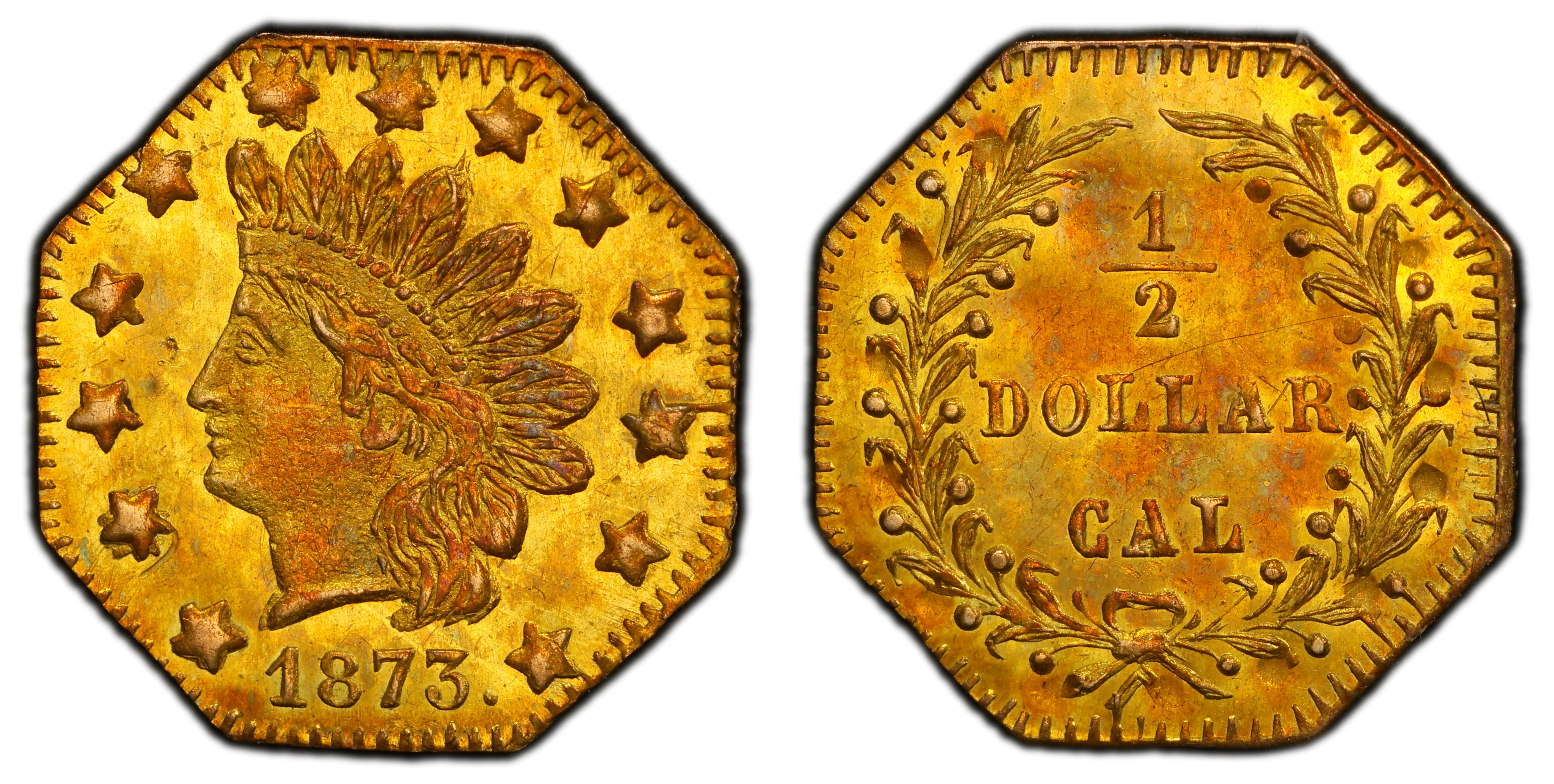
Obverse & Reverse
The 1873 BG-942 50 Cents token emerges from the second period (1858-1882) of California Fractional Gold production, a fascinating and complex era of private minting long after the initial chaos of the Gold Rush had subsided. Unlike the 'Period One' pieces, which were largely struck to alleviate a severe shortage of small denomination coinage for commerce, the later issues, including this one, were primarily created to satisfy a burgeoning market for souvenirs and collectibles. The great excitement of the Gold Rush had cemented California in the national imagination, and jewelers and private minters capitalized on this by producing these miniature gold pieces for tourists, merchants, and collectors. Gaetano F. Lanza, a manufacturing jeweler in San Francisco, is the most likely producer of the dies used for this variety. His work is characteristic of the period's style, often featuring Indian Head or Liberty motifs popular on contemporary federal coinage. These small-denomination gold pieces were sold as keepsakes and were not intended to function as circulating currency, a fact underscored by the Coinage Act of 1864 which criminalized private coinage. However, production of souvenir 'charms' and tokens continued, skirting the law by omitting the word 'DOLLAR' or 'CENTS'. The BG-942 variety, with its classic Indian Head design, was a popular motif. These pieces were struck in limited quantities and sold through local jewelers and merchants in San Francisco. Their survival rate is low due to their small size and the fact that many were incorporated into jewelry, suffering damage. Today, they are highly prized by specialists for their intricate designs, historical connection to the post-Gold Rush era of California, and their specific die characteristics cataloged meticulously by Breen and Gillio.
Associated EventPost-Gold Rush California economic expansion and souvenir trade.
Reason For MintingPrimarily minted as souvenirs and keepsakes for the tourist and collectible market, not for monetary circulation.
Minter HistoryGaetano F. Lanza was a manufacturing jeweler and die sinker active in San Francisco from the 1860s through the 1870s. While not a large-scale 'minter' in the territorial sense, he was one of the key figures in the production of Period Two California Fractional Gold pieces. His premises served as a workshop where he created dies not only for his own pieces but likely for other local jewelers as well. His designs are noted for their competent, if sometimes slightly crude, engraving style that mimicked federal coinage motifs. His operations were typical of the small-scale, entrepreneurial ventures that characterized this specialized niche of numismatics.
Historical SignificanceThe BG-942, like other Period Two fractionals, represents the commercialization of the Gold Rush legacy. It marks the transition of private gold coinage from a utilitarian response to a currency shortage to a nostalgic commodity. It is a tangible artifact of San Francisco's identity as a tourist destination and a center of commerce in the late 19th century, and it showcases the craftsmanship of private die sinkers of the era.
N/A
DenominationG50C (Gold 50 Cents)
Minting Period1873
Assayer/MinterAttributed to Gaetano F. Lanza
Geographic OriginSan Francisco, California
Obverse DescriptionA right-facing female head, often described as an Indian Head, with a feathered headdress. Thirteen stars encircle the portrait within a beaded border. The portrait style is distinct to this die.
Obverse Inscription[None, only stars and portrait]
Reverse DescriptionThe denomination '1/2' is enclosed within a wreath of two olive branches. The legend 'CALIFORNIA GOLD' appears above the wreath, and the date '1873' is below. A beaded border surrounds the design.
Reverse InscriptionCALIFORNIA GOLD 1/2 1873
CompositionGold
Stated Fineness Actual FinenessVaries, typically between .500 and .800 fine gold.
Weight0.25 grams
Diameter10.00 mm
EdgePlain
Unknown, but presumed to be very low, likely a few thousand at most.
Survival EstimateFewer than 100 known across all grades.
Rarity ScaleR-5 (Low R-5), indicating 31-75 surviving examples known to numismatists.
This variety appeals to specialists in California Fractional Gold due to its scarcity, classic Indian Head design, and specific Breen-Gillio attribution. Assembling a collection of these miniature gold pieces is a significant challenge, and well-struck, high-grade examples like the BG-942 are always in demand.
Key VarietiesThe primary variety is the BG-942 regular business strike. There are no known major die varieties from the time of issue, nor are there any known later-date Proof restrikes or special collector issues for this specific BG number. The 'varieties' in this series are the hundreds of different Breen-Gillio die marriages themselves.
Authentication TipsAuthentic examples have sharp, well-defined details, especially in the feathers and wreath, consistent with die-struck coins. The numerals in the date and fractions should match known exemplars precisely. Counterfeits are common and often have a soft, cast-like appearance, incorrect weight, or a soapy luster. Many fakes are gold-plated brass. The beaded borders on genuine pieces are typically distinct and uniform, whereas fakes often have mushy or irregular beads. Comparing against high-resolution images of certified examples is essential.
Shopping ConsiderationsA premium quality example for its grade will possess a sharp strike, particularly on the high points of the headdress feathers and the leaves of the reverse wreath. Look for clean, lustrous surfaces with minimal distracting marks; these tiny coins show every imperfection. Many surviving examples have been cleaned or damaged from use in jewelry; coins with original, unmolested 'skin' and a pleasing reddish-gold hue command significant premiums. Avoid examples with evidence of solder, harsh cleaning (hairlines), or tooling. A smooth, attractive surface is paramount for this issue.
A coin's grade is its condition, rated on a 1-70 scale. For rare coins, this is the most critical factor in determining value, as a tiny difference in preservation can mean a huge difference in price.
Relevant Grade TypesAll original BG-942 pieces were business strikes intended for sale as souvenirs, not circulation. They are found in Circulated (1-58) grades, often from being handled or mounted as jewelry, and Mint State (MS, 60-70) grades. No true Proofs were struck during the original period of issue, and there are no known later-date Proof restrikes for this variety.
Mint State CharacteristicsUncirculated examples of BG-942 are characterized by a soft, satiny luster. The strike can be variable, but high-quality examples will show full detail in the feathers of the headdress. Due to the nature of their production and handling, even Mint State examples may show minor planchet flaws or faint contact marks. Finding a sharply struck, lustrous, and mark-free specimen is very difficult.
Circulated Wear PatternsWear first appears on the high points of the design: the cheek and the upper feathers of the headdress on the obverse. On the reverse, the highest points of the wreath and the fraction '1/2' will show the first signs of friction. In lower grades (VF and below), the finer details of the feathers will merge and the legends will begin to weaken.
Key Factors For ValueFor the BG-942, the primary value drivers are grade and surface quality. A sharp, full strike is highly desirable and commands a premium. Eye appeal is crucial; collectors pay more for pieces with original, attractive golden or reddish toning over those that are dull or have been harshly cleaned. Given the prevalence of counterfeits, certification by a top-tier service like PCGS or NGC is nearly mandatory for establishing authenticity and market value. A CAC sticker on a certified coin indicates premium quality for the grade and will add a significant premium.
PCGS Price Guide
| Grade | Price | Population |
|---|---|---|
| 55 | $260.00 | 1 |
| 55+ | $285.00 | N/A |
| 58 | $325.00 | 9 |
| 58+ | $350.00 | N/A |
| 60 | $375.00 | 1 |
| 61 | $400.00 | 2 |
| 62 | $425.00 | 10 |
| 62+ | $450.00 | N/A |
| 63 | $500.00 | 16 |
| 63+ | $575.00 | 1 |
| 64 | $825.00 | 10 |
| 64+ | $1,150.00 | N/A |
| 65 | $1,750.00 | 2 |
| 65+ | $2,000.00 | N/A |
| 66 | $2,350.00 | N/A |
| 66+ | $2,750.00 | N/A |
| 67 | $3,500.00 | N/A |