1856 G25C BG-229, PL (Regular Strike)
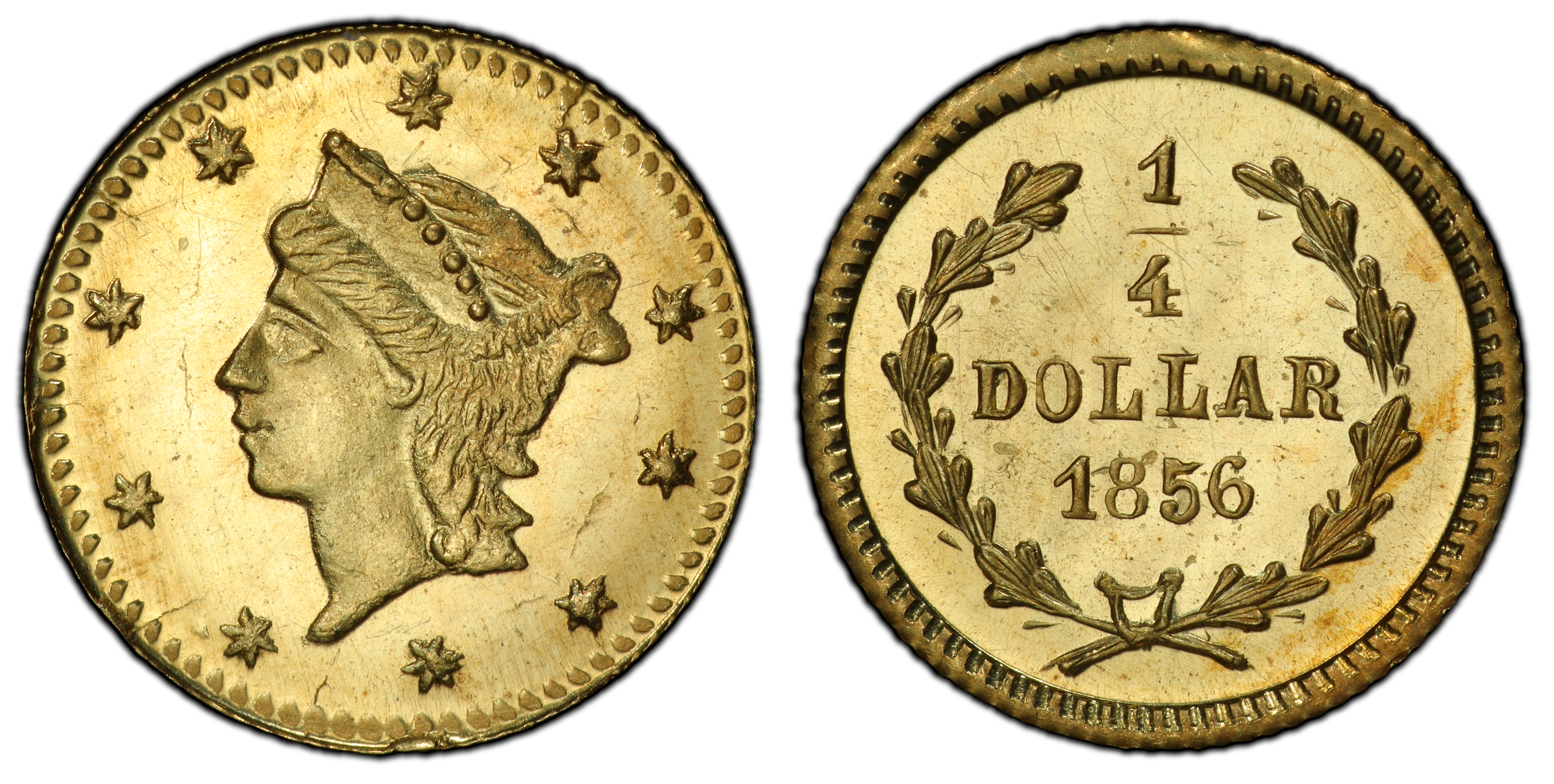
Obverse & Reverse
The 1856 BG-229 25 Cents represents a fascinating and essential chapter in the economic history of the American West. Born from the chaos and immense wealth of the California Gold Rush, these diminutive gold coins addressed a critical failure in the region's monetary supply. Following the discovery of gold at Sutter's Mill in 1848, a flood of prospectors and merchants descended upon California, creating a vibrant but chaotic economy. While massive quantities of raw gold dust and nuggets circulated, there was a severe, crippling shortage of small denomination coinage for daily transactions. A 'pinch' of gold dust for a drink or a loaf of bread was an imprecise and often contentious method of payment. Federal branch mints were slow to be established and supplied, leaving a vacuum that private enterprise rushed to fill. Enterprising jewelers and metallurgists in San Francisco, many of them French immigrants, began striking their own coins in 1852. These pieces, now known as California Fractional Gold, were produced in 25 Cent, 50 Cent, and $1 denominations. The BG-229 is a 'Period One' issue (1852-1857), a time when the coiners generally attempted to produce pieces that, while often slightly underweight, were intended for actual circulation and commerce. Unlike the later 'Period Two' and 'Period Three' issues, which were often made as souvenirs with less regard for intrinsic value, these early pieces were a genuine, albeit unofficial, solution to a systemic currency problem. They were struck by hand, using a hammer to force an obverse and reverse die onto a small gold planchet, resulting in varied strike quality. By 1856, the San Francisco Mint was increasing its output of official silver coinage, which gradually alleviated the shortage and rendered the private gold fractionals obsolete for circulation, marking the end of the Period One issues.
Associated EventCalifornia Gold Rush
Reason For MintingTo alleviate a severe shortage of small-denomination coinage for everyday commercial transactions in Gold Rush-era California.
Minter HistoryThe specific minter or jeweler responsible for the BG-229 variety is unknown, a common reality for many 'Period One' California Fractional Gold issues. Research by Breen and Gillio points to a small community of jewelers and artisans, many of French origin, operating in San Francisco during the 1850s. These individuals possessed the requisite skills in metallurgy and die-cutting to produce these small coins. Lacking any identifying initials or marks, BG-229 is what is known as an unattributed issue, its creation credited to the broader phenomenon of private minting rather than a specific, identifiable firm.
Historical SignificanceAs a 'Period One' issue, the BG-229 is a direct physical artifact of the commercial necessity that drove the creation of a private, localized currency during the California Gold Rush. It represents a temporary, entrepreneurial solution to the failure of the federal government to supply adequate coinage to the booming frontier economy, predating the more souvenir-like issues of later years.
BG-229
Denomination25 Cents
Minting Period1856
Assayer/MinterUnknown Private Minter
Geographic OriginSan Francisco, California
Obverse DescriptionA head of Liberty facing left, her hair tied in a bun. She is encircled by ten six-pointed stars, with the arrangement typically being five stars to the left and five to the right.
Obverse Inscription Reverse DescriptionThe denomination '1/4 DOLLAR' and the date '1856' are enclosed within a simple wreath composed of two branches tied together at the bottom with a bow.
Reverse Inscription1/4 DOLLAR 1856
CompositionGold
Stated Fineness Actual FinenessTypically around .875 to .900, using native California gold which contained a natural silver alloy.
Weight0.38 grams
Diameter9.70 mm
EdgePlain
Unknown
Survival Estimate76-200 coins
Rarity ScaleR-4 / R-5
This coin is highly sought after as a representative 'Period One' type, valued for its direct connection to the commercial needs of the Gold Rush. Its classic Liberty Head design, reminiscent of federal coinage, and its status as a tangible piece of Old West history make it a cornerstone of many territorial and pioneer gold collections. The potential for sharply struck, prooflike examples adds a further layer of appeal for quality-conscious collectors.
Key VarietiesThe primary variety is the regular business strike. No original proof strikings are known. However, some business strikes were produced using highly polished dies, resulting in coins with deeply reflective, mirror-like surfaces. These are designated as 'Prooflike' (PL) by grading services and command a significant premium. There are no known major die varieties for BG-229 itself, nor are there any known special collector restrikes from a later period.
Authentication TipsAuthentication is critical. Genuine pieces were struck, not cast, so surfaces should exhibit flow lines and sharp die-cut features, not a porous or soapy texture. Compare the specific die characteristics—the shape of the letters and numbers, the style of Liberty's portrait, and the star positions—to high-resolution images of certified BG-229 examples. The Breen-Gillio reference work is the definitive guide. Be wary of underweight pieces or those with incorrect dimensions. Modern replicas and fantasy pieces, often featuring bears, are common and should not be confused with genuine issues.
Shopping ConsiderationsA premium quality example for its grade is defined by a strong, well-centered strike. Look for sharpness in Liberty's hair details and the bow on the reverse wreath, which are often weakly struck. The most desirable pieces possess deeply reflective, prooflike (PL) surfaces, as mentioned in many high-end auction catalogs. Original, uncleaned surfaces with a hint of reddish-gold or greenish-gold toning are highly prized. Avoid examples that have been harshly cleaned, polished, or mounted in jewelry, which is a common fate for these small gold pieces. Check carefully for tooling or repairs in the fields, used to hide damage.
A coin's grade is its condition, rated on a 1-70 scale. For rare coins, this is the most critical factor in determining value, as a tiny difference in preservation can mean a huge difference in price.
Relevant Grade TypesOriginal 1856 issues of BG-229 are all business strikes, created for circulation. They are found in Circulated grades (AG-3 to AU-58) and Mint State grades (MS-60 to MS-70). No true Proofs were struck during the original period of issue. The 'PL' (Prooflike) designation seen on some certified examples refers to business strikes made with highly polished dies that exhibit mirrored fields, not a separate method of manufacture.
Mint State CharacteristicsAn uncirculated (MS) BG-229 is judged on three main factors. Luster: High-grade examples often have a vibrant, almost flashy luster, with the finest specimens displaying deeply reflective, prooflike fields. Strike: The sharpness of the strike is crucial. A full strike will show clear details in the strands of Liberty's hair and the knot of the bow on the reverse. Weakness in these areas is common and should be noted. Marks: As these coins were handled in bulk, even uncirculated examples can have small contact marks. The size, number, and location of these marks determine the specific grade from MS-60 upwards.
Circulated Wear PatternsWear first appears on the highest points of the design. On the obverse, check for flatness on Liberty's cheek, the hair above her eye, and the bun. On the reverse, the leaves and the bow of the wreath will show the first signs of friction. In lower grades (Fine and below), the stars on the obverse will begin to merge with the fields, and the legends on the reverse will become faint.
Key Factors For ValueFor the BG-229, value is driven by a combination of grade and eye appeal. A sharply struck coin with prooflike (PL) surfaces will command a massive premium over a softly struck or lackluster coin of the same numerical grade. Originality of the surfaces is paramount; a coin with its original 'skin' and attractive toning is far more valuable than one that has been cleaned or polished. Finally, certification by a top-tier grading service (PCGS or NGC) is essential for market acceptance, and a CAC sticker indicating premium quality for the grade will add a further significant premium.
PCGS Price Guide
| Grade | Price | Population |
|---|---|---|
| 62 | $525.00 | 1 |
| 62+ | $600.00 | N/A |
| 63 | $750.00 | N/A |
| 63+ | $1,000.00 | N/A |
| 64 | $1,350.00 | 1 |
| 64+ | $2,250.00 | 1 |
| 65 | $3,500.00 | 1 |
| 65+ | $4,000.00 | 2 |
| 66 | $5,000.00 | 3 |