1860/50 G25C BG-819 (Regular Strike)
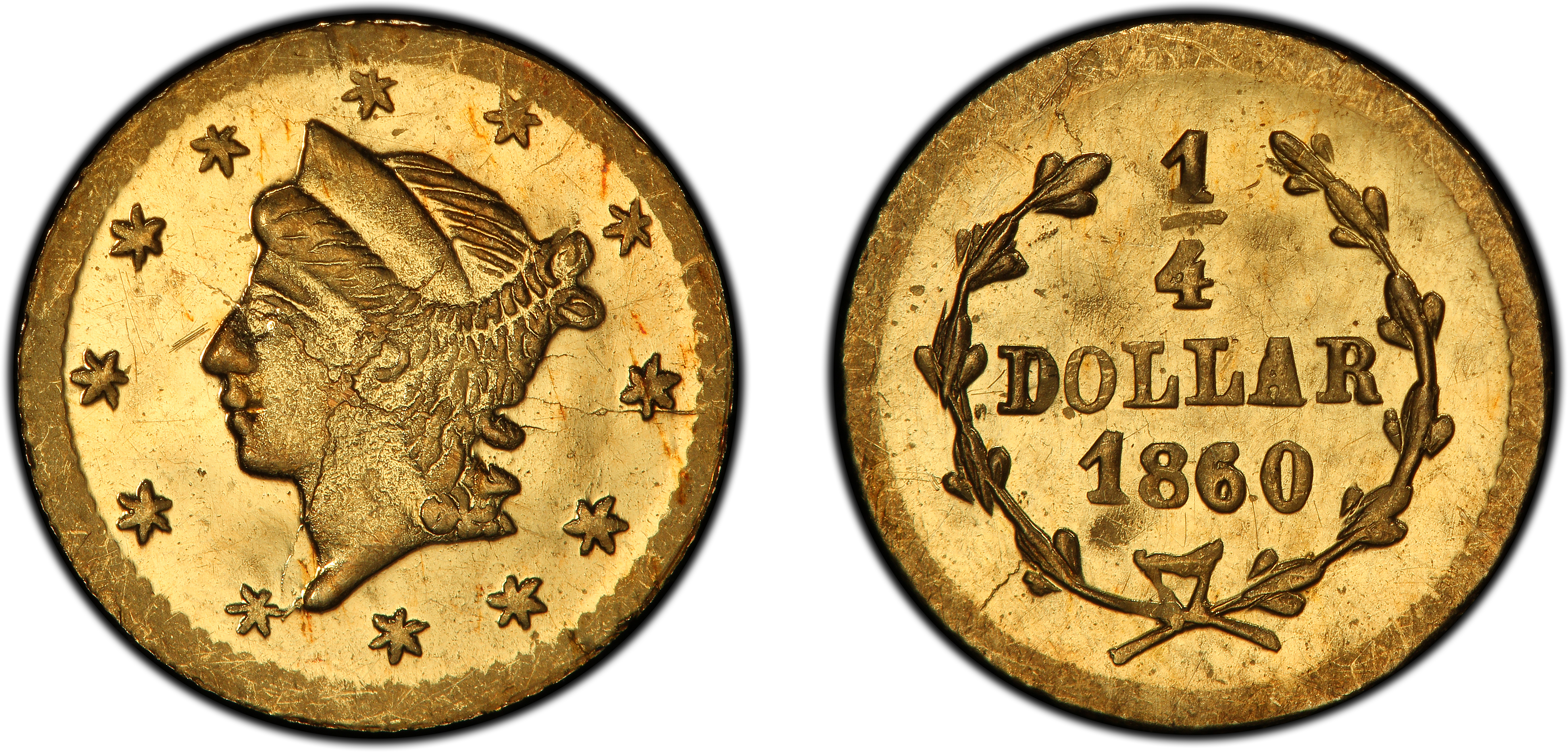
Obverse & Reverse
The 1860/50 25 Cents, cataloged as Breen-Gillio 819, is a fascinating product of the latter phase of private gold coining in California. By 1860, the initial acute shortage of small change that characterized the early Gold Rush had largely subsided. The San Francisco Mint, established in 1854, was producing official U.S. silver and gold coins in quantity, diminishing the civic necessity for privately issued fractional denominations. Consequently, the context for pieces like the BG-819 had shifted from utilitarian currency to that of souvenirs, keepsakes, and jewelry items. These miniature gold coins were popular mementos of the California adventure, easily sent back East to relatives or worn as personal adornments. Despite this shift, they remain an integral part of the Territorial gold story, reflecting the enduring entrepreneurial spirit and the public's fascination with gold. The minter, Robert B. Gray, was a prominent San Francisco jeweler who engaged in the production of these small-denomination pieces. The BG-819 is particularly noteworthy for being an overdate, with the 1860 date punched over a visible '50' from an earlier 1850-dated die. This practice of reusing and re-engraving dies was common among private minters to economize on the difficult and expensive process of die creation. Numismatically, this variety is also defined by its dramatic shattered obverse die, which displays two prominent bisecting die cracks. This characteristic serves as both a key diagnostic feature and a testament to the immense pressures and repeated use these dies endured. The continued production of such pieces, even as their role as circulating money waned, highlights the transition of California Fractional Gold from a necessary medium of exchange to a cherished collectible and a symbol of the Golden State's defining era.
Associated EventCalifornia Gold Rush
Reason For MintingPrimarily created as a souvenir or jewelry item by 1860, rather than to alleviate a currency shortage as the earlier issues had.
Minter HistoryRobert B. Gray & Co. was a jewelry firm operating in San Francisco during the mid-to-late 19th century. Like several other local jewelers and metalsmiths, Gray entered the lucrative business of producing California Fractional Gold pieces. These items met a strong public demand, first for small change and later for souvenirs. Gray's work is known for its distinctive style and occasional experimental die work, such as the overdates seen on BG-819 (1860/50) and other varieties like BG-1014 (1860/56). The quality of his products was generally good, though the shattered die of BG-819 indicates his equipment was used to its absolute limit.
Historical SignificanceThe BG-819 represents the evolution of California Fractional Gold from essential currency to commercial souvenir. Its existence as an overdate with a catastrophically failed die provides a tangible link to the methods and challenges of 19th-century private minting operations in the American West.
BG-819
Denomination25 Cents
Minting Period1860
Assayer/MinterRobert B. Gray & Co.
Geographic OriginSan Francisco, California
Obverse DescriptionA Liberty Head facing left, her hair tied in a bun and wearing a coronet inscribed LIBERTY. She is surrounded by 13 six-pointed stars. This variety is famously struck from a shattered die, exhibiting two prominent, bisecting die cracks across the entire obverse.
Obverse InscriptionLIBERTY
Reverse DescriptionThe denomination '25 CENTS' is enclosed within a beaded circle, which is itself surrounded by a wreath of leaves and berries. The date '1860' is below the wreath, clearly showing evidence of being punched over an underlying '1850'.
Reverse Inscription25 CENTS 1860
CompositionGold
Stated Fineness Actual FinenessVaries, but typically between .500 and .800 fine for Period Two issues.
Weight0.25 grams
Diameter9.50 mm
EdgePlain
Unknown
Survival Estimate75-125
Rarity ScaleR-5
This variety is highly sought after for its clear 1860/50 overdate, a feature that always excites specialists. The dramatic, bisecting die cracks on the obverse make it visually distinctive and easy to attribute. It combines the allure of Gold Rush history with specific, tangible die characteristics.
Key VarietiesThe primary variety is the BG-819 overdate itself. There are no known major sub-varieties or special collector restrikes of this specific BG number. The broader series is divided into Period One (1852-1857, generally intended for circulation), Period Two (1858-1882, primarily souvenirs and jewelry), to which this coin belongs, and Period Three (post-1882 tokens without a stated denomination).
Authentication TipsThe most critical diagnostic is the shattered obverse die with its two bisecting cracks; any purported BG-819 without them is suspect. The 1860/50 overdate should be visible under magnification. As with all fractional gold, be wary of modern replicas which are often the wrong weight, have a soapy or unnatural luster, and incorrect design details. Comparison with high-resolution images of certified examples is essential.
Shopping ConsiderationsA premium quality example will show a bold strike on the central devices and a clear overdate. Given the shattered die, some striking weakness is expected, but examples with strong details command a significant premium. Look for coins with clean, original surfaces and minimal distracting marks. A pleasing, lustrous surface with original golden-orange patina, as sometimes seen on this issue, is highly desirable. Avoid examples that have been harshly cleaned, polished, or used as jewelry, as this severely impacts value.
A coin's grade is its condition, rated on a 1-70 scale. For rare coins, this is the most critical factor in determining value, as a tiny difference in preservation can mean a huge difference in price.
Relevant Grade TypesAll original examples of BG-819 are business strikes. They are collected in all grades from well-circulated (Good-4 to Extremely Fine-45) to Mint State (MS-60 to MS-70). No proofs were struck during the original period of issue, and there are no known later-date proof restrikes of this specific variety.
Mint State CharacteristicsAn uncirculated BG-819 typically exhibits a semi-reflective or prooflike surface. Luster is often satiny. The strike can be inconsistent; the centers may be sharp while the peripheral legends or stars are soft. The prominent obverse die cracks are a defining characteristic, not a flaw. Small planchet flaws or adjustment marks are not uncommon. High-grade examples are prized for their clean fields and strong eye appeal.
Circulated Wear PatternsWear first appears on the highest points of the design: Liberty's cheek, hair, and coronet. On the reverse, the leaves and bow of the wreath will show the first signs of friction. In lower grades (below VF), the word LIBERTY on the coronet will begin to merge, and the finer details of the wreath will be lost.
Key Factors For ValueThe primary value driver is the grade. Beyond the technical grade, the clarity and boldness of the 1860/50 overdate is critical; a strong overdate adds a significant premium. Surface quality is paramount; collectors pay more for pieces with original, uncleaned 'skin' and attractive luster. The prominence of the diagnostic die cracks, while inherent to the variety, can also contribute to eye appeal. A CAC sticker, indicating premium quality for the grade, will add a substantial premium for this popular variety.
PCGS Price Guide
| Grade | Price | Population |
|---|---|---|
| 50 | $180.00 | 1 |
| 50+ | $182.00 | N/A |
| 53 | $185.00 | 4 |
| 53+ | $190.00 | N/A |
| 55 | $200.00 | 10 |
| 55+ | $205.00 | N/A |
| 58 | $225.00 | 9 |
| 58+ | $240.00 | N/A |
| 60 | $275.00 | 3 |
| 61 | $325.00 | 13 |
| 62 | $485.00 | 22 |
| 62+ | $525.00 | N/A |
| 63 | $565.00 | 16 |
| 63+ | $600.00 | N/A |
| 64 | $750.00 | 8 |
| 64+ | $900.00 | N/A |
| 65 | $1,400.00 | 1 |