1868 G50C BG-906 (Regular Strike)
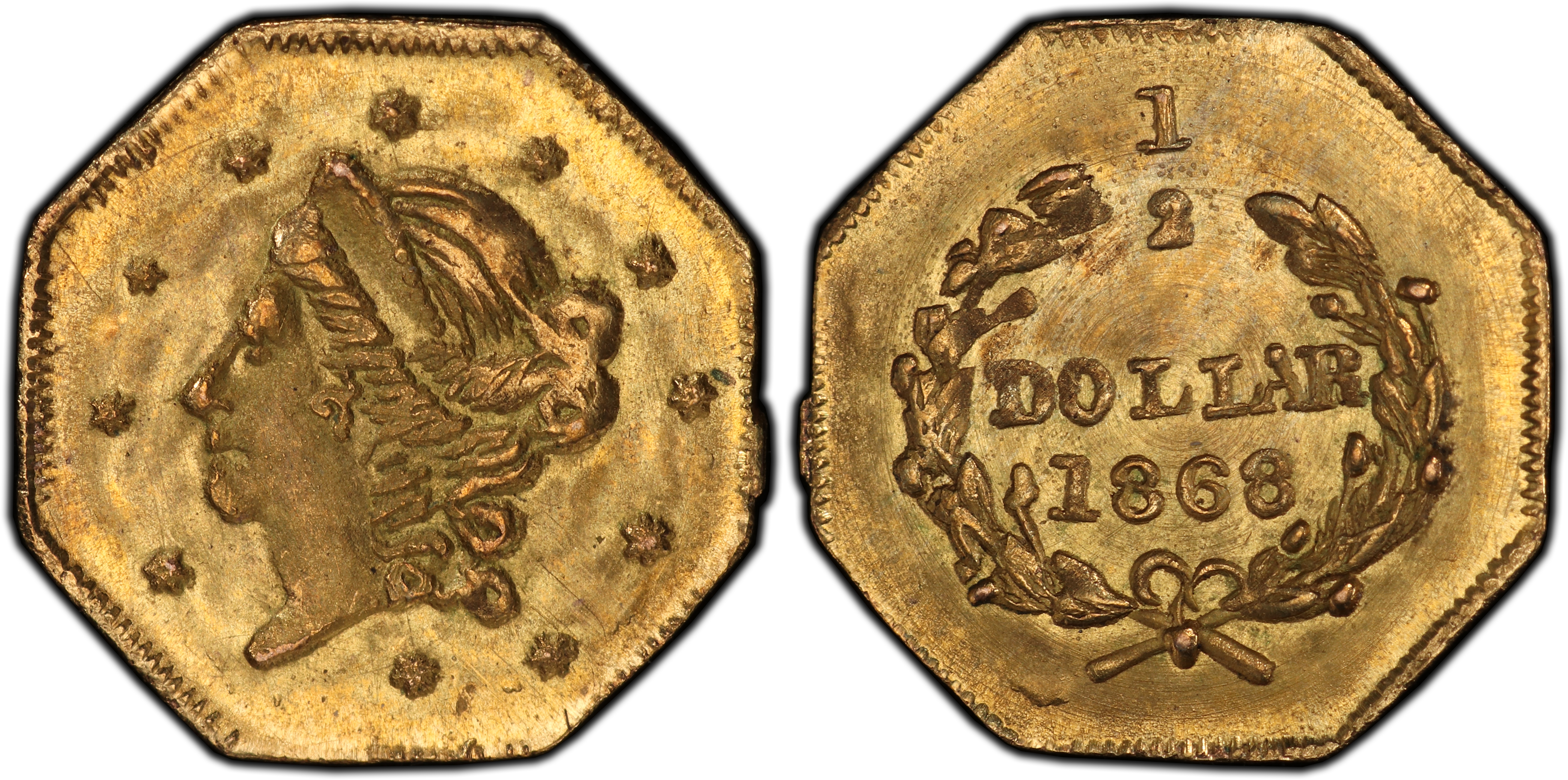
Obverse & Reverse
The 1868 BG-906 50 Cents piece is a quintessential example of 'Period Two' California Fractional Gold, a fascinating and complex series born from unique economic conditions. Following the initial Gold Rush boom, California's economy stabilized, but a chronic shortage of small-denomination coinage persisted. The U.S. Mint in San Francisco, established in 1854, primarily produced larger gold and silver coins, leaving a void for everyday transactions. This void was filled by private minters, often jewelers by trade, who began producing fractional gold pieces in quarter dollar, half dollar, and dollar denominations starting in 1852. By the time the BG-906 was struck in 1868, the nature of these coins had shifted. The initial 'Period One' (1852-1857) issues were struck with the genuine intent of serving as circulating currency, containing gold value close to their face value. However, 'Period Two' (1858-1882) issues, including the BG-906, were significantly lighter and contained less gold than their stated value. This transition occurred as the pieces became increasingly popular as souvenirs, keepsakes, and jewelry items for tourists and locals alike, who were captivated by the romance of the Gold Rush. The Coinage Act of 1864 had made private coinage illegal, but enforcement was lax, allowing jewelers like Robert B. Gray & Co. to continue production. These 'jeweler's issues' were not intended to defraud, but rather to meet a commercial demand for novelties. The crude yet charming manufacturing process, often involving a sledgehammer to strike the dies, resulted in coins of varying quality, each with a unique, handmade character. The BG-906, with its classic Liberty Head design, represents this later, more commercial phase of fractional gold production, a tangible link to a post-Gold Rush California where gold was not just money, but also a powerful symbol and a desirable memento.
Associated EventPost-California Gold Rush Economic Period
Reason For MintingPrimarily created to satisfy the large demand for souvenirs and novelty jewelry items related to the California Gold Rush, rather than for circulation.
Minter HistoryRobert B. Gray & Co. was a prominent San Francisco jewelry firm active during this period. Around 1859-60, Gray acquired the business of another notable fractional gold minter, Antoine Nouizillet. Gray continued to use some of Nouizillet's existing dies while also creating his own, often marked with a 'G'. The firm was a key producer of 'Period Two' fractional gold, capitalizing on the booming market for gold rush souvenirs before selling its interests to the California Jewelry Co. in 1871.
Historical SignificanceThe BG-906 is significant as a representative of the 'jeweler's issue' or 'souvenir' phase of California Fractional Gold. It illustrates the transition of these pieces from quasi-circulating currency to popular keepsakes, reflecting a maturing California economy and the romantic allure the Gold Rush held for the rest of the nation. It highlights a period of ambiguous legality where private production continued despite federal laws, showcasing the unique economic freedoms and challenges of the American West.
N/A
Denomination50 Cents
Minting Period1868
Assayer/MinterRobert B. Gray & Co.
Geographic OriginSan Francisco, California
Obverse DescriptionA stylized head of Liberty faces left, wearing a coronet. Thirteen stars encircle the bust, representing the original colonies. The date, 1868, is positioned below the truncation of the neck.
Obverse Inscription1868
Reverse DescriptionThe denomination '50 CENTS' is displayed within a wreath composed of two branches tied together with a bow at the bottom. The legend 'CALIFORNIA GOLD' is inscribed above the wreath, following the octagonal border of the coin. A distinctive diagnostic for this variety is that the fraction bar between the '5' and '0' in '50' is absent.
Reverse InscriptionCALIFORNIA GOLD 50 CENTS
CompositionGold
Stated Fineness Actual FinenessVaries, typically 14 to 22 karats for Period Two issues.
Weight0.25 grams
Diameter10.00 mm
EdgePlain
Unknown
Survival EstimateFewer than 75 believed to exist
Rarity ScaleR-6
This variety appeals to collectors due to its high rarity (R-6), classic octagonal shape, and connection to the historic San Francisco jewelry firms of the post-Gold Rush era. As a 'Period Two' issue, it is more attainable than many 'Period One' pieces but remains a significant challenge to acquire in high grade.
Key VarietiesThe primary issue is the business strike of 1868. There are no known major varieties, patterns, or official restrikes for the BG-906. Collectors should be aware that the term 'Proof-Like' (PL) is sometimes used to describe specimens with highly polished fields, which was a common characteristic of later-date jeweler's issues, but these are not true Proofs. No Proofs were struck during the original period of issue.
Authentication TipsGenuine BG-906 specimens have specific die characteristics. A key diagnostic is the missing fraction bar between '5' and '0' on the reverse. The style of the date, stars, and lettering should be carefully compared to known genuine examples. Counterfeits often have incorrect details, a soapy or cast-like appearance, incorrect weight and dimensions, or may be gold-plated brass. Third-party certification from PCGS or NGC is highly recommended.
Shopping ConsiderationsA premium quality BG-906 will exhibit a sharp strike, particularly on Liberty's hair details and the leaves of the wreath. Many examples are weakly struck in the centers due to the crude hammer-striking process. Look for original, undisturbed surfaces with frosty or semi-prooflike luster. Avoid examples that have been cleaned, polished, or mounted for jewelry, as this severely impacts value. Attractive honey-gold or orange-gold patina is highly desirable. Minor planchet flaws are common and generally accepted, but large, distracting marks or scratches should be avoided.
A coin's grade is its condition, rated on a 1-70 scale. For rare coins, this is the most critical factor in determining value, as a tiny difference in preservation can mean a huge difference in price.
Relevant Grade TypesOriginal period issues of BG-906 were business strikes, created for souvenir purposes rather than circulation, but are graded as such. They are found in both Circulated (1-58) and, more commonly, Mint State (MS, 60-70) grades. No true Proof (PR/PF) examples were struck in 1868. Some Mint State coins display highly reflective, proof-like (PL) surfaces from being struck on polished planchets, a characteristic of these jeweler's issues, but they are not a distinct striking type.
Mint State CharacteristicsAn uncirculated BG-906 is judged by the quality of its strike, luster, and surface preservation. Strike weakness is common, especially on the highest points of Liberty's hair and the center of the wreath. Luster can range from frosty to satiny to semi-prooflike. Due to their small size and handling as souvenirs, even high-grade examples can show minor contact marks or hairline scratches. A superior Mint State coin will have minimal marks, strong luster, and better-than-average strike detail.
Circulated Wear PatternsAlthough most examples are uncirculated, any wear would first appear on the high points: Liberty's coronet, cheek, and hair above the ear on the obverse. On the reverse, wear is first evident on the leaves and bow of the wreath. In lower grades (VF and below), the stars and peripheral lettering will begin to show significant flattening.
Key Factors For ValueFor the 1868 BG-906, value is driven by several key factors. Rarity is paramount, as this is an R-6 variety. Grade is the next most critical factor, with a significant price jump between MS-63, MS-64, and higher grades. Surface quality is crucial; coins with clean, original, and lustrous surfaces command strong premiums over those that have been cleaned, polished, or damaged. Eye appeal, including attractive natural toning and a sharp strike, significantly enhances value. A CAC sticker for this issue indicates superior quality for the grade and will typically result in a substantial price premium.
PCGS Price Guide
| Grade | Price | Population |
|---|---|---|
| 58 | $280.00 | 1 |
| 58+ | $290.00 | N/A |
| 60 | $325.00 | N/A |
| 61 | $350.00 | 1 |
| 62 | $375.00 | 1 |
| 62+ | $390.00 | N/A |
| 63 | $410.00 | 11 |
| 63+ | $450.00 | N/A |
| 64 | $500.00 | 20 |
| 64+ | $585.00 | N/A |
| 65 | $700.00 | 17 |
| 65+ | $825.00 | N/A |
| 66 | $1,250.00 | 7 |
| 66+ | $1,300.00 | N/A |
| 67 | $1,400.00 | 2 |