1875 G50C BG-947 (Regular Strike)
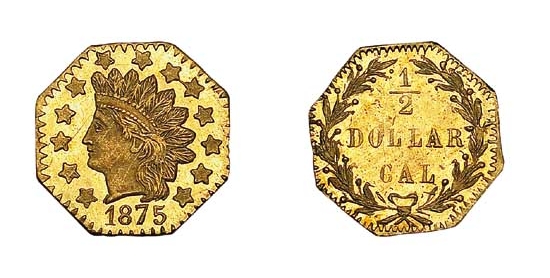
Obverse & Reverse
The 1875 G50C BG-947 is a quintessential example of a 'Period Two' California Fractional Gold piece. The story of these diminutive coins begins with the massive influx of population during the California Gold Rush, starting in 1849. The sudden economic boom created a severe shortage of small denomination coinage for daily transactions. While the United States Mint in San Francisco, established in 1854, began to alleviate the shortage of larger coins, the need for small change persisted. Initially, from 1852 to roughly 1858 (Period One), private minters, jewelers, and assayers struck fractional gold coins in 25c, 50c, and $1 denominations that were intended to, and did, circulate to facilitate commerce. However, by the 1870s, the original commercial necessity had largely faded. The pieces struck during this later era, including the BG-947, are categorized by numismatists as 'Period Two' (1858-1882) issues. These were primarily produced not as circulating currency but as souvenirs and keepsakes for tourists, merchants, and visitors to California, capitalizing on the romantic allure of the Gold Rush. Despite the Coinage Act of 1864, which made private coinage illegal, the law was not strictly enforced against these small tokens until 1883. Jewelers continued to produce them, often backdating them to circumvent legal scrutiny. The BG-947, with its Indian Head motif, was designed to be an attractive memento. The production method for most fractional gold was crude, often involving a sledgehammer to strike a planchet between two dies, but the surviving examples of BG-947 suggest a higher level of care in their manufacture. Its extreme rarity today indicates an exceedingly small original mintage, even for a souvenir issue. These pieces were not intended to contain their full face value in gold, functioning essentially as tokens. Their modern numismatic significance is immense, representing the tail-end of a uniquely American era of private coinage and serving as tangible links to the enduring legacy of the California Gold Rush.
Associated EventCalifornia Gold Rush Era
Reason For MintingPrimarily struck as a souvenir or collectible item for the tourist trade, rather than to fill a circulating coinage need which had characterized earlier issues.
Minter HistoryThe specific minter for the BG-947 die pair is unknown, which is common for Period Two issues. The production of these pieces was dominated by a community of San Francisco jewelers, many of French origin, such as Frontier & Deviercy or Deriberpe & Nouizillet. These artisans created a wide variety of designs to appeal to the public's appetite for Gold Rush memorabilia. They operated small-scale minting operations within their jewelry shops, using hand-operated presses or simpler hammer-striking methods to produce the coins.
Historical SignificanceThe BG-947 is significant as a representative of the later, souvenir-driven phase of California Fractional Gold production. It illustrates the transition of these pieces from utilitarian commercial coins to romanticized mementos of the Gold Rush. Its high rarity makes it a key variety for specialists, representing one of the most difficult-to-obtain die marriages in the entire series.
N/A
Denomination50 Cents
Minting Period1875
Assayer/MinterUnknown private minter, likely a San Francisco jeweler.
Geographic OriginSan Francisco, California
Obverse DescriptionFeatures a stylized Indian Head facing left, a popular motif for the era. The portrait is adorned with a feathered headdress. The field is typically surrounded by 13 stars, representing the original colonies.
Obverse InscriptionNo inscription. The design consists of the Indian Head and 13 stars.
Reverse DescriptionWithin a wreath of leaves and berries, the denomination '1/2' is displayed prominently. Below the fraction, the word 'DOLLAR' appears. The date '1875' is positioned beneath the wreath.
Reverse Inscription1/2 DOLLAR 1875
CompositionGold
Stated Fineness Actual FinenessVaries, but typically less than face value for Period Two issues, often ranging from 14 to 22 karats.
EdgePlain
Extremely low, likely fewer than 20 pieces.
Survival EstimateFewer than 10 known examples. The combined PCGS and NGC population reports show only a handful of graded specimens.
Rarity ScaleHigh R-7 to R-8. Often cited as R-7+ or simply R.8 in auction catalogs, signifying 2 to 4 known specimens.
The BG-947 is a trophy coin for advanced specialists in California Fractional Gold. Its appeal lies in its extreme rarity, attractive Indian Head design, and its status as one of the ultimate condition rarities of the series, with all known examples being in high grades.
Key VarietiesNo significant varieties are known for the BG-947 die marriage from the original minting period. As a Period Two souvenir issue, there are no known patterns, trial pieces, or later-date restrikes associated with this specific variety.
Authentication TipsAuthenticity is paramount. Genuine examples will exhibit sharp die characteristics consistent with known specimens. Look for a precise, well-defined wreath and date on the reverse. The stars and portrait details should be sharp, not mushy or cast-looking. Weight and specific gravity tests can help, but comparison to high-resolution images of certified examples is crucial. Counterfeits are common in the Cal Gold series, but fakes of a specific rare die marriage like BG-947 are less so; more often, common varieties are passed off as genuine. Third-party certification by PCGS or NGC is virtually mandatory for a legitimate transaction.
Shopping ConsiderationsPotential buyers will have very few opportunities to acquire this coin. When one appears at auction, it is a major event. A premium quality example is defined primarily by its existence and authenticity. Look for bright, prooflike or semi-prooflike surfaces, as noted on several certified examples. Check for any planchet issues, such as buckling or waviness, which can occur during the crude striking process. The strike should be as full as possible, though minor weakness in the centers is not unusual for the type. Originality of the surfaces is key; any evidence of cleaning, polishing, or tooling would be a major detriment. Given the small population, every known example is significant, and bidding will be competitive.
A coin's grade is its condition, rated on a 1-70 scale. For rare coins, this is the most critical factor in determining value, as a tiny difference in preservation can mean a huge difference in price.
Relevant Grade TypesOriginal period issues of BG-947 were business strikes, although produced with more care than circulating coins and sold as souvenirs, meaning most never circulated. They are found almost exclusively in high Circulated (AU) and Mint State (MS, 60-70) grades. No proofs were struck during the original period of issue, and there are no known later-date Proof restrikes for this specific Breen-Gillio number.
Mint State CharacteristicsSurviving examples of BG-947 are known for their superb quality, often exhibiting prooflike surfaces with significant reflectivity in the fields. A top-tier Mint State example will have a sharp, well-defined strike on the central motifs (Indian Head and denomination). Luster is typically vibrant and frosty on the devices, contrasting with the mirrored fields. As these were made on small, thin planchets, they are susceptible to minor planchet flaws or slight buckling, but the best examples are flat and well-formed. Any contact marks, however small, will be a factor in the final grade.
Circulated Wear PatternsWhile it is highly unlikely to encounter a circulated example, theoretical wear would first appear on the high points: the cheek and feathers of the Indian Head on the obverse, and the numerals '1/2' and the highest leaves of the wreath on the reverse. In lower grades, the stars and date would begin to lose their sharpness.
Key Factors For ValueFor the BG-947, rarity is the overwhelming driver of value. With only a few known specimens, any example is a treasure. Beyond that, the key factors are surface preservation and eye appeal. A coin with pristine, reflective fields free of distracting marks or hairlines will command a significant premium. The sharpness of the strike is also critical. An example graded MS-63 could be worth substantially more than an MS-62 if it possesses superior eye appeal. A CAC sticker would provide further validation of quality for the grade and would be highly desirable to discerning collectors.
PCGS Price Guide
| Grade | Price | Population |
|---|---|---|
| 58 | $1,000.00 | N/A |
| 58+ | $1,075.00 | N/A |
| 60 | $1,450.00 | N/A |
| 61 | $1,600.00 | 1 |
| 62 | $1,750.00 | 1 |
| 62+ | $2,000.00 | N/A |
| 63 | $2,500.00 | 5 |
| 63+ | $2,750.00 | N/A |
| 64 | $3,250.00 | 2 |
| 64+ | $3,500.00 | N/A |
| 65 | $4,500.00 | 1 |