1876 G25C BG-849 (Regular Strike)
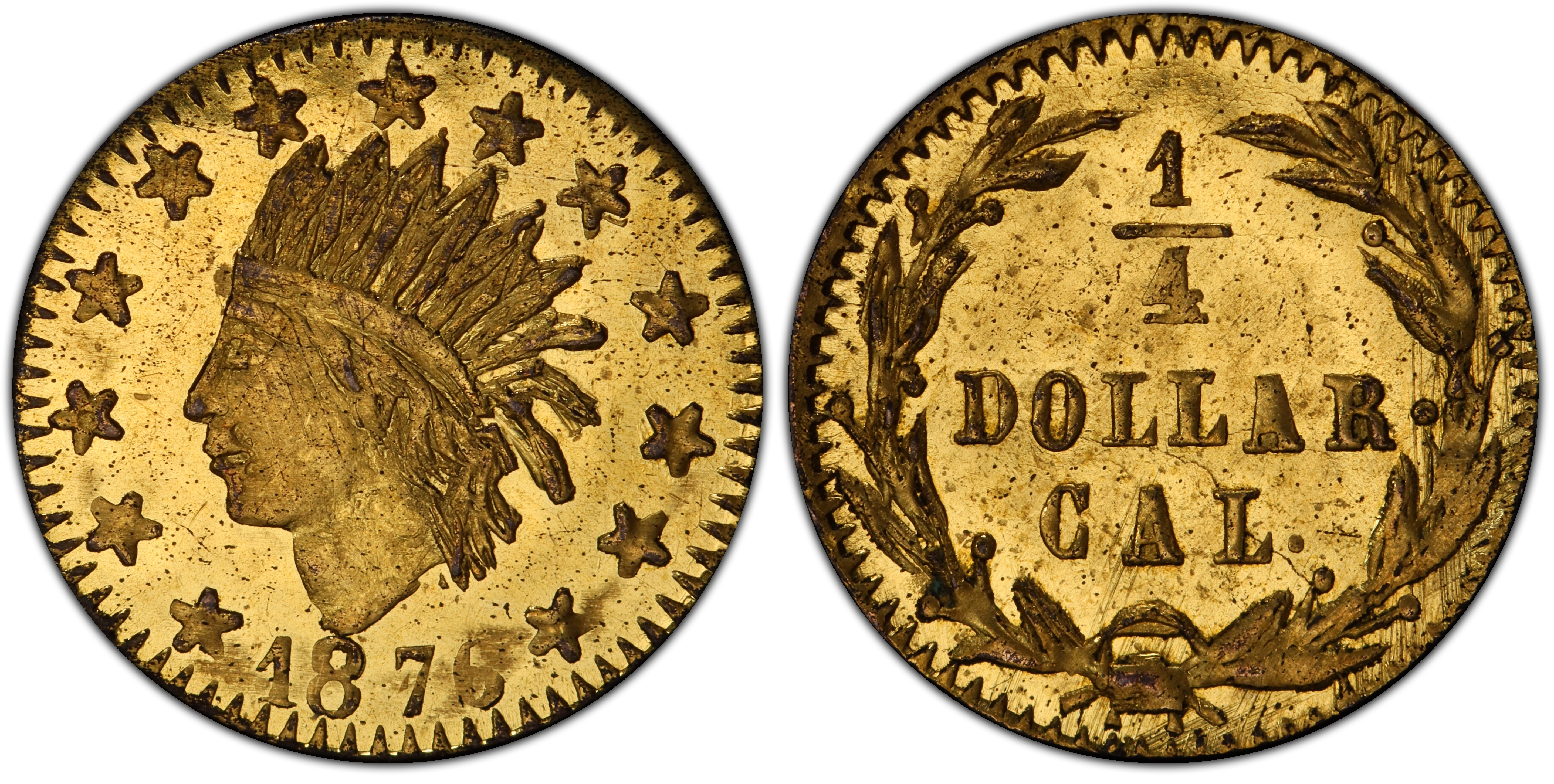
Obverse & Reverse
The 1876 BG-849 25 Cents represents the third and final phase of California Fractional Gold production, a fascinating and complex chapter in American numismatics. By 1876, the original impetus for these tiny gold coins—a severe shortage of small change during the Gold Rush—had long vanished. The San Francisco Mint, operating since 1854, produced ample federal silver and minor coinage to facilitate commerce. The Coinage Act of 1864 had explicitly forbidden private coinage, yet production of these 'tokens' persisted. This paradox defines the 'Period Three' (1871-1882) issues. These pieces were no longer intended to function as circulating money but were created to satisfy a burgeoning tourist and souvenir trade. Jewelers in San Francisco, recognizing the nostalgic appeal of the Gold Rush era, began manufacturing these small gold pieces as keepsakes, charms, and curiosities. To circumvent the 1864 law, these manufacturers often backdated their creations to a period when private coinage was more common and less legally perilous. The 1876 date on the BG-849, therefore, reflects this practice. While struck in 1876, it was part of a tradition that looked backward, capitalizing on the romanticism of the '49ers. These pieces were typically underweight for their stated value and of varying fineness, confirming their non-monetary purpose. The U.S. Secret Service finally cracked down on the makers of these tokens in 1882-1883, bringing a definitive end to the era of California Fractional Gold production. The BG-849, therefore, is not a relic of the Gold Rush proper, but rather a memento of its powerful and enduring legacy, a numismatic echo of one of America's most transformative economic and social events.
Associated EventPost-Gold Rush Souvenir Trade
Reason For MintingTo be sold as a souvenir or jewelry item capitalizing on the nostalgia of the California Gold Rush.
Minter HistoryThe specific minter of BG-849 is unrecorded, a common trait for Period Three issues as makers sought to remain anonymous to avoid legal trouble. However, it was almost certainly produced by one of the manufacturing jewelers active in San Francisco in the 1870s. Firms like the California Jewelry Co. (successors to Robert B. Gray & Co. and operated by the Levison Brothers) were major producers of jewelry and similar souvenir items. These firms possessed the skilled engravers and coining presses necessary to strike such pieces. The crude but charming style of many Period Three issues suggests they were often a side business for these establishments, produced to meet tourist demand.
Historical SignificanceThe BG-849 is significant not as a coin that circulated, but as a tangible artifact of how the Gold Rush was memorialized and commercialized. It represents the transition of fractional gold from a necessity of commerce (Period One) to a nostalgic souvenir (Period Three), illustrating the enduring cultural and economic impact of the initial rush. It is a prime example of a quasi-legal token made in the shadow of federal anti-private-coinage laws.
BG-849
Denomination25 Cents
Minting Period1876
Assayer/MinterUnknown San Francisco Jeweler
Geographic OriginSan Francisco, California
Obverse DescriptionA small, somewhat crudely rendered bust of a female figure representing Liberty, facing left, wearing a feathered headdress, in the style of the contemporary Indian Head cent. The portrait is surrounded by thirteen stars.
Obverse Inscription1876
Reverse DescriptionThe denomination '1/4 DOLLAR' is enclosed within a simple wreath of leaves and berries. The wreath is open at the top.
Reverse Inscription1/4 DOLLAR
CompositionGold
Stated Fineness Actual FinenessVaries, but typically lower than coinage standard.
EdgePlain
Unknown
Survival Estimate31-75
Rarity ScaleR-5+
This variety appeals to collectors specializing in the fascinating California Fractional Gold series, particularly those completing date or Breen-Gillio (BG) variety sets. As a Period Three issue, it tells the final story of this unique coinage. Its relative scarcity (R-5+) makes it a challenging but obtainable piece.
Key VarietiesThe BG-849 itself is the key variety. No major sub-varieties from the original minting period are widely recognized. Unlike some earlier territorial issues, there are no known later-date Proof restrikes or patterns associated with BG-849. The entire class of Period Three issues is sometimes considered a special collector category in itself, distinct from the circulating Period One coinage.
Authentication TipsGenuine examples are very thin and often weakly struck in spots. Replicas are often thicker, have a soapy or cast-like appearance, and may show a brassy or copper core where the gold plating has worn. The style of the engraving on genuine pieces, while sometimes crude, is distinct and sharp under magnification, whereas fakes often have poorly defined details. All genuine pieces must have a denomination (e.g., 'DOLLAR'); pieces marked 'CAL GOLD' without a denomination are tokens or charms. Authentication by PCGS or NGC is highly recommended for this series.
Shopping ConsiderationsA premium quality example for its grade will exhibit a sharp strike for the variety, particularly on the central portrait details and the numerals of the date. As noted in auction records, the '1' and '76' in the date and the 'A' in DOLLAR are often soft; examples with better definition command a premium. Look for original, undisturbed surfaces with some remaining mint luster. Many have been cleaned or used as jewelry, so problem-free examples are scarce. Avoid pieces with excessive marks, scratches, evidence of tooling, or repairs. An attractive, original reddish-gold toning adds to the eye appeal and value.
A coin's grade is its condition, rated on a 1-70 scale. For rare coins, this is the most critical factor in determining value, as a tiny difference in preservation can mean a huge difference in price.
Relevant Grade TypesOriginal 1876 BG-849 issues were business strikes intended for sale as souvenirs, not for circulation. They are found in Circulated grades (AU-58 and lower, often from handling or jewelry use) and, more commonly, in Mint State (MS, 60-70) grades. No Proofs were struck during the original period of issue, and there are no known later-date Proof restrikes.
Mint State CharacteristicsUncirculated examples of BG-849 are characterized by a soft, satiny luster that can sometimes be prooflike in the fields. The strike is characteristically weak on certain design elements, notably the first and last two digits of the date and letters in the reverse legend. Due to the primitive, often hand-operated minting process, planchet quality can be inconsistent, with minor flaws being common. Contact marks can be present but should not be heavy or distracting for a high-grade specimen.
Circulated Wear PatternsOn circulated examples, wear first appears on the high points of the Indian's cheek, the tip of the nose, and the feathers in the headdress. On the reverse, the highest points of the wreath's leaves and bow will show the first evidence of friction. In lower grades (Fine and below), the date and stars will become indistinct and the legends will weaken significantly.
Key Factors For ValueFor the BG-849, value is primarily driven by grade and surface quality. A sharp strike, though atypical for the issue, will command a significant premium. The most desirable examples exhibit pristine, lustrous surfaces free of cleaning, harsh marks, or other damage. Eye appeal is crucial; a coin with attractive original color will be valued more highly than a dull or discolored specimen of the same grade. Certification by a top-tier service like PCGS or NGC is essential for market acceptance, and a CAC sticker indicating premium quality for the grade adds another layer of value.
PCGS Price Guide
| Grade | Price | Population |
|---|---|---|
| 53 | $250.00 | 1 |
| 53+ | $255.00 | N/A |
| 55 | $265.00 | 1 |
| 55+ | $270.00 | N/A |
| 58 | $300.00 | 1 |
| 58+ | $310.00 | N/A |
| 60 | $350.00 | 1 |
| 61 | $400.00 | 2 |
| 62 | $475.00 | 4 |
| 62+ | $575.00 | N/A |
| 63 | $800.00 | 12 |
| 63+ | $875.00 | N/A |
| 64 | $1,075.00 | 5 |
| 64+ | $1,350.00 | N/A |
| 65 | $2,000.00 | 1 |