1872 G50C BG-938 (Regular Strike)
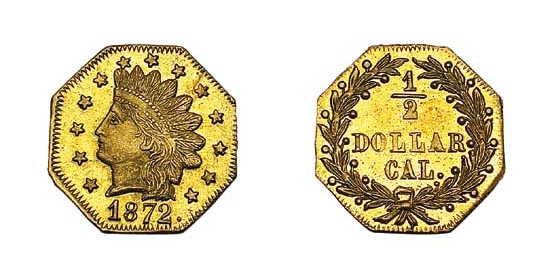
Obverse & Reverse
The 1872 BG-938 50 Cent piece emerges from the second great era of California Fractional Gold, a period numismatically distinct from the initial 'Period One' (1852-1857) issues born of pure necessity. By the early 1870s, the acute shortage of small change that had plagued Gold Rush California had largely been rectified by the steady output of the U.S. Mint in San Francisco, which opened in 1854. The raison d'être for fractional gold had fundamentally shifted from utilitarian commerce to novelty and souvenir trade. These later pieces, often termed 'jeweler's issues,' were crafted by San Francisco's skilled metalworkers—many of them French immigrants—who recognized a burgeoning market for mementos of the Golden State. Tourists, merchants, and even locals sought these miniature gold coins for use in jewelry, as keepsakes, or as symbols of California's unique gold-based economy. The production of these pieces occupied a legally gray area. The Coinage Act of 1864 had explicitly forbidden private coinage, but the law was not aggressively enforced against these tiny, low-value tokens until the Secret Service, concerned about potential fraud, began a crackdown in the early 1880s. Thus, the minters of 1872 operated with a degree of impunity, creating a wide variety of designs, including the popular Indian Head motif seen on BG-938, which mimicked the design of the new federal copper-nickel cent. These pieces were not intended to compete with federal coinage but rather to satisfy a commercial demand for tangible, affordable souvenirs made of the state's most famous product. They were typically struck using the 'hammer method'—a top die struck with a sledgehammer onto a planchet resting on a bottom die—a process that accounts for the often-uneven strikes and unique character of each piece. The BG-938, with its distinctive octagonal shape and artistic Indian Head, stands as a prime example of this fascinating chapter in American enterprise, a testament to a time when private ingenuity continued to convert California's gold into miniature works of art long after their official monetary need had passed.
Associated EventPost-Gold Rush Economic Expansion & Tourism
Reason For MintingPrimarily produced as souvenirs and for use in jewelry, satisfying a commercial demand for keepsakes rather than a monetary need for circulating change.
Minter HistoryThe specific minter of the BG-938 die marriage is unconfirmed. However, it is a product of the 'Period Two' or 'Jeweler's Period' of fractional gold production. Prominent San Francisco jewelers of this era, such as Robert B. Gray & Co. (successors to Antoine Nouizillet), were major producers. These artisans and businessmen created a wide array of fractional gold pieces to sell as souvenirs. The work was often done by hand, with dies engraved and coins hammer-struck in small workshops, leading to the large number of distinct varieties cataloged by Breen and Gillio (BG).
Historical SignificanceThe BG-938 is significant not as a coin for circulation, but as a tangible artifact of California's evolving identity in the 1870s. It represents the transition of gold from a raw medium of exchange to a symbol of the state's wealth and allure, marketed to a growing tourist trade and a populace proud of its Gold Rush heritage. Its existence highlights a period of lax federal oversight on private minting and the persistent ingenuity of local craftsmen.
BG-938
Denomination50 Cents
Minting Period1872
Assayer/MinterUnknown, likely a San Francisco jeweler. Attributed by some researchers to the workshop of Robert B. Gray & Co.
Geographic OriginSan Francisco, California
Obverse DescriptionA stylized head of Liberty facing left, wearing a Native American war bonnet. The word 'LIBERTY' is inscribed on the headband, though it is often weakly struck and illegible. The portrait is encircled by thirteen stars, representing the original colonies.
Obverse InscriptionLIBERTY
Reverse DescriptionThe denomination '1/2' is centered within a continuous, ornate wreath of leaves and berries. The wreath is open at the top. The date '1872' is positioned below the wreath, and the inscription 'CALIFORNIA GOLD' follows the upper periphery outside the wreath. The denomination 'CENTS' is located within the wreath, below the fraction.
Reverse InscriptionCALIFORNIA GOLD / 1/2 / CENTS / 1872
CompositionGold
Stated Fineness Actual FinenessVariable, typically between 14 and 22 karats for jeweler's issues of this period.
Weight0.25 grams
Diameter10.00 mm
EdgePlain
Unknown
Survival Estimate13-30
Rarity ScaleLow R-6
The 1872 BG-938 is highly prized for its classic Indian Head design, desirable octagonal shape, and significant rarity. As a 'Period Two' issue, it appeals to specialists who appreciate the history of California's souvenir gold coinage. Its status as a Low R-6 variety, with fewer than 30 thought to exist, ensures strong demand whenever an example appears on the market.
Key VarietiesThis is a specific die marriage (BG-938). No major varieties from the original minting period are known for this specific BG number. Unlike some territorial issues, there are no known official Proof restrikes. All genuine BG-938 coins are considered business strikes, although many exhibit prooflike surfaces due to the minting process with polished dies.
Authentication TipsGenuine examples must have the denomination spelled out as 'CENTS' on the reverse. Many contemporary counterfeits and 20th-century replicas are unmarked or say 'CAL GOLD' in place of a denomination. Look for characteristics of a hammer strike: fields may be slightly wavy, and the strike depth can be inconsistent across the coin. The planchets are typically very thin. Replicas are often thicker, have a soapy or cast-like texture, and may show a coppery core where the gold plating has worn. The specific die markers for BG-938 should be consulted in the Breen-Gillio reference for definitive attribution.
Shopping ConsiderationsA premium quality example for this issue is defined by a sharp, well-centered strike, which is uncommon due to the hammer-striking process. Look for boldness on the high points of the Indian's bonnet and the details of the wreath. Many genuine specimens exhibit beautiful, prooflike (PL) or deep mirror prooflike (DMPL) fields; coins with these flashy surfaces command significant premiums. Original, uncleaned surfaces with a hint of reddish-gold toning are highly desirable. Avoid examples that have been harshly cleaned, show evidence of being mounted in jewelry (solder marks, rim damage), or have been bent or tooled. Even on a high-grade example, some weakness on peripheral lettering or stars is common and should be considered characteristic rather than a flaw.
A coin's grade is its condition, rated on a 1-70 scale. For rare coins, this is the most critical factor in determining value, as a tiny difference in preservation can mean a huge difference in price.
Relevant Grade TypesAll original 1872 BG-938 pieces are considered business strikes intended for sale as souvenirs, not for circulation. They are found in both Circulated (AU-58 and below) and Mint State (MS, 60-70) grades. No true Proofs were struck in 1872. However, due to the production method of using polished dies on polished planchets to create flashy souvenirs, many Mint State examples possess prooflike (PL) or deep mirror prooflike (DMPL) surfaces. These are not a different type of coin but a desirable surface characteristic that carries a premium.
Mint State CharacteristicsIn uncirculated (MS) condition, the BG-938 typically exhibits a very flashy, reflective surface. Luster on non-PL examples is often satiny and delicate. The strike is a key determinant of quality; many are weakly struck on the stars or the date. A coin with a full, sharp strike on both the central devices and peripheral legends is rare and valuable. Due to the softness of the gold and the manufacturing process, it is common to see minor planchet irregularities or handling marks, even on high-grade specimens. The overall eye appeal, combining luster, strike, and surface preservation, is paramount.
Circulated Wear PatternsOn circulated examples, wear first appears on the highest points of the design. On the obverse, this includes the cheek, the feathers of the war bonnet, and the eyebrow. On the reverse, the leaves and berries of the wreath and the fraction '1/2' will show the first signs of friction. In lower grades (VF and below), the word 'LIBERTY' on the headband will be completely gone, and the peripheral legends will begin to merge with the fields.
Key Factors For ValueThe primary value drivers for an 1872 BG-938 are rarity, grade, and eye appeal. A high numerical grade (e.g., MS-64 vs. MS-62) significantly impacts value. The presence of prooflike (PL) or deep mirror prooflike (DMPL) surfaces can add a substantial premium. Surface quality is critical; an example with clean, original surfaces will always be worth more than a cleaned, scratched, or damaged coin of the same grade. A sharp strike is a major differentiating factor. Finally, certification by a top-tier grading service (PCGS or NGC) is essential for marketability, and a CAC sticker indicating premium quality for the grade will further enhance its value.
PCGS Price Guide
| Grade | Price | Population |
|---|---|---|
| 62 | $500.00 | 4 |
| 62+ | $525.00 | N/A |
| 63 | $700.00 | 8 |
| 63+ | $750.00 | N/A |
| 64 | $1,250.00 | 4 |
| 64+ | $1,500.00 | N/A |
| 65 | $2,000.00 | 1 |
| 66 | N/A | N/A |