1864 50C BG-1016a Silver DT (Regular Strike)
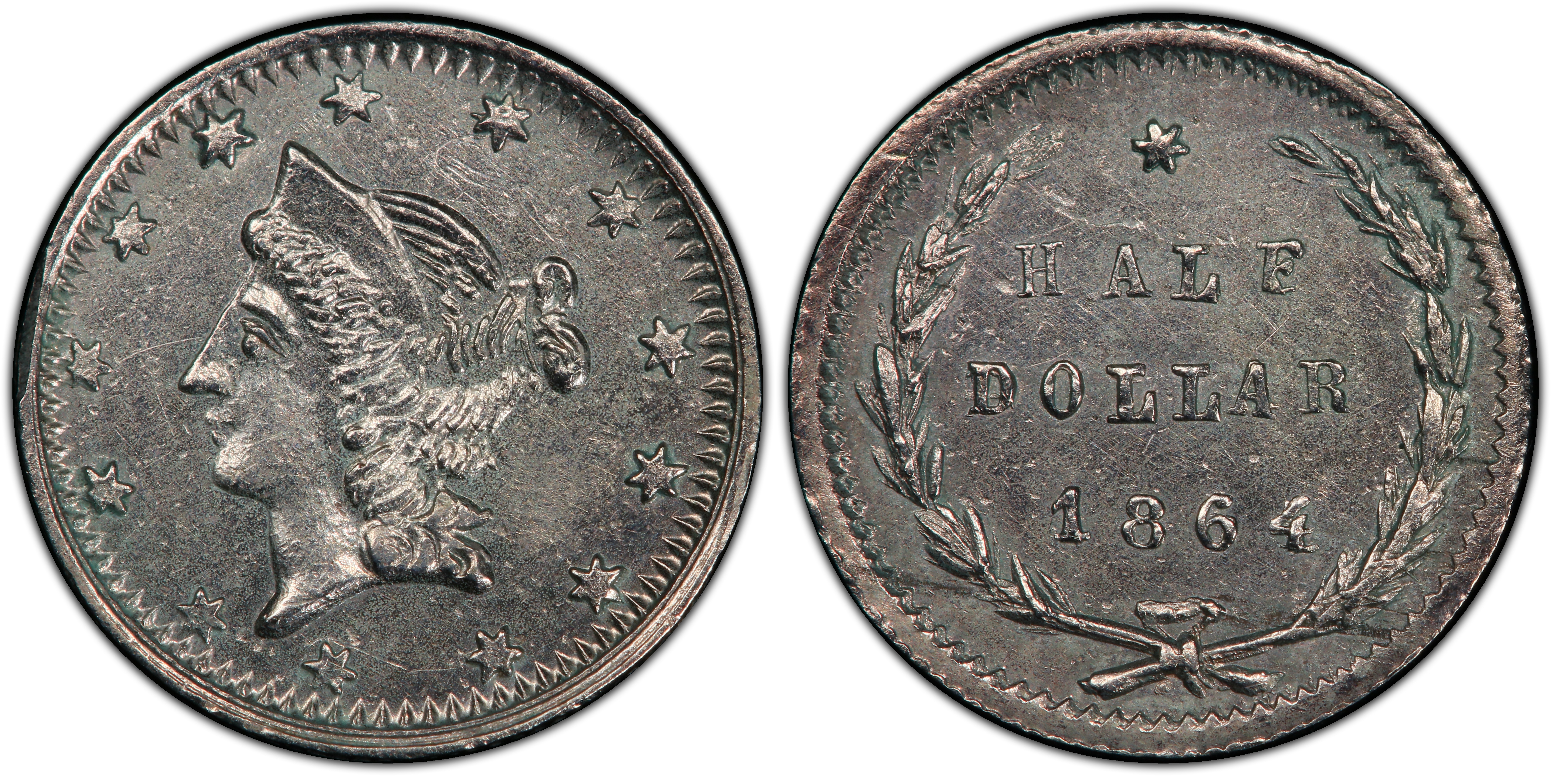
Obverse & Reverse
The 1864 50 Cents BG-1016a is not a coin intended for circulation, but rather a numismatic artifact of immense rarity and historical significance: a silver die trial for a gold coin struck at a pivotal moment in American monetary history. By 1864, the initial frenzy of the California Gold Rush had subsided, but the region's economy still contended with a chronic shortage of small-denomination coinage. Private jewelers and minters, who had been striking fractional gold pieces since 1852 to fill this commercial void, were facing a new threat. On April 22, 1864, the U.S. Congress passed a Coinage Act that, among other things, explicitly outlawed the private issuance of coinage. This legislation was aimed at standardizing the nation's money and eliminating the wide variety of private tokens and coins that had proliferated, particularly during the Civil War. It is in this precise context that San Francisco jeweler Robert B. Gray & Co. prepared the dies for its new 1864-dated 50 Cent gold piece, designated BG-1016 by modern numismatists. Before committing to a production run in gold, it was standard practice to test the dies. This was done by striking impressions in a softer, less expensive metal to check for design clarity, die integrity, and overall quality. The BG-1016a is one such test piece, struck from the regular BG-1016 dies but in silver. The creation of this die trial in 1864 is particularly poignant; it represents one of the last gasps of this uniquely Western American industry just as federal law was closing in. While the law was not strictly enforced until 1883, its passage marked the beginning of the end for these 'Period Two' (1858-1882) souvenir and commercial issues. The silver die trial serves as a tangible link to the technical process of a private minter operating on the edge of legality, perfecting his design for a product whose very existence was now prohibited. As an artifact that was never meant to be spent, its survival is miraculous, offering a rare glimpse into the minting process of these fascinating and ephemeral issues.
Associated EventCalifornia Gold Rush and the Coinage Act of 1864
Reason For MintingThis piece was a technical die trial struck in silver to test the dies intended for the regular BG-1016 gold striking.
Minter HistoryRobert B. Gray & Co. was a prominent San Francisco jewelry and private minting firm active during the 'Period Two' of fractional gold production. The firm was the successor to the earlier operations of Antoine Louis Nouzillet and F. Routhier, having purchased their business around 1859. Gray utilized some of his predecessors' existing dies but also created his own, often bearing a distinctive 'G' initial. The firm was known for producing some of the heaviest and most intrinsically valuable fractional gold pieces of the later period. Robert B. Gray & Co. operated until 1871, when the business was sold to the California Jewelry Co., owned by the Levison Brothers.
Historical SignificanceThe BG-1016a is a direct link to the private coining process of the California Gold Rush era. Its existence as a die trial provides insight into the manufacturing techniques of private minters. Struck in the same year the Coinage Act outlawed such issues, it symbolizes the twilight of a uniquely American numismatic chapter.
N/A
Denomination50 Cents
Minting Period1864
Assayer/MinterRobert B. Gray & Co.
Geographic OriginSan Francisco, California
Obverse DescriptionLiberty Head facing left, with hair tied in the back. The portrait is surrounded by thirteen stars, representing the original colonies. The date '1864' is below the bust.
Obverse Inscription1864
Reverse DescriptionThe denomination '1/2' is enclosed within a wreath of leaves and berries. The word 'DOLLAR' appears below the wreath. Advanced states of the die (Die State II) are known to show significant die cracks on the reverse.
Reverse Inscription1/2 DOLLAR
CompositionSilver
Stated Fineness Actual FinenessAn analysis of one specimen indicated it was composed of sterling silver.
EdgePlain
Extremely low; likely fewer than 5 were struck.
Survival Estimate2-3 known specimens.
Rarity ScaleR-8
This is a landmark rarity in the California Fractional Gold series. Its appeal lies in its status as a die trial, its composition in silver (as opposed to the intended gold), its connection to the final year of legal private coinage, and its extreme scarcity, with only two or three examples known to exist.
Key VarietiesBG-1016: The regular issue, struck in gold for circulation or as a souvenir. It is itself a scarce variety (R-5). BG-1016a: The present variety, a die trial struck in silver. BG-1016b: A related die trial struck in copper is also listed in the Breen-Gillio reference.
Authentication TipsAuthentication requires comparison to the known genuine examples and die characteristics of the BG-1016 gold issue. Key diagnostics for the die state include the presence and location of prominent reverse die cracks. The piece should have the 'soft', authentic look of a 19th-century strike, not the hard, prooflike surfaces or tool marks associated with modern replicas. Any suspected example must be authenticated by a top-tier grading service familiar with the series.
Shopping ConsiderationsAcquiring a BG-1016a is a major event, occurring only when one of the few known specimens comes to market. A potential buyer should prioritize a specimen with a solid provenance, tracing its ownership history through major collections (e.g., Jay Roe). For a piece of this magnitude, third-party certification from PCGS or NGC is non-negotiable. Eye appeal will be paramount; look for well-struck details, minimal and non-distracting contact marks, and original, stable surfaces. Given its status as a die trial, any evidence of circulation would be highly unusual and should be scrutinized.
A coin's grade is its condition, rated on a 1-70 scale. For rare coins, this is the most critical factor in determining value, as a tiny difference in preservation can mean a huge difference in price.
Relevant Grade TypesOriginal period issues like the BG-1016 were business strikes, intended for potential circulation, and are found in Circulated (1-58) and Mint State (MS, 60-70) grades. As a die trial, the BG-1016a was never intended for circulation and should only exist in high grades, typically Mint State. There is no evidence of Proofs being struck for this issue during the original period of manufacture.
Mint State CharacteristicsA Mint State BG-1016a would be judged on the quality of its strike, luster, and surface preservation. While some examples of the gold BG-1016 are known to be weakly struck on the portrait and date, a prime example of the silver die trial would ideally be sharp. Luster would likely be bright and reflective, characteristic of a fresh strike on a silver planchet. As these were not made for circulation, any marks would be from handling or storage over nearly two centuries and would be noted for their severity and location.
Circulated Wear PatternsAs a die trial, this piece was not intended for circulation, and therefore wear patterns are not applicable. Any wear would be considered post-striking damage and would significantly detract from its character and value. A collector's focus would be entirely on its Mint State characteristics.
Key Factors For ValueFor the BG-1016a, value is driven almost entirely by its legendary rarity as one of only 2-3 known examples. Beyond that, the primary factor is the specific grade assigned by PCGS or NGC. A higher grade (e.g., MS63 vs. MS62) represents a significant leap in value. The quality of the strike is also a key consideration; a well-struck example is far more desirable than one showing weakness on the central devices. Finally, provenance and eye appeal—the overall visual quality of the piece—play a major role for an item of this caliber.
PCGS Price Guide
| Grade | Price | Population |
|---|---|---|
| 45 | $3,250.00 | 1 |
| 58 | N/A | N/A |
| 61 | $10,000.00 | 1 |
| 62 | $13,500.00 | 1 |