1864 G50C BG-1016 (Regular Strike)
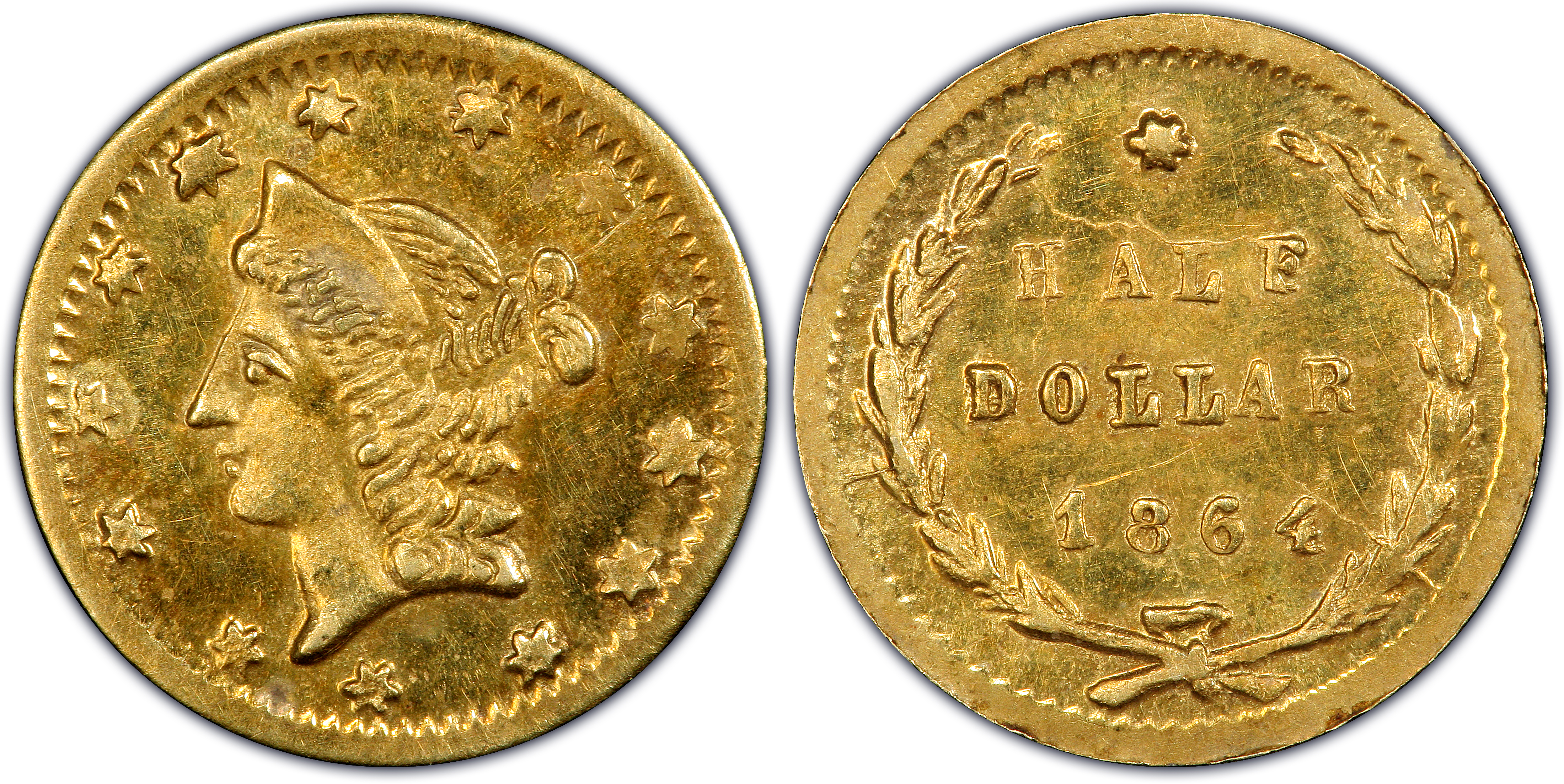
Obverse & Reverse
The 1864 G50C BG-1016 is a fascinating artifact from the second period of California's private gold coinage, a tumultuous and innovative era in American monetary history. Following the initial gold discoveries at Sutter's Mill in 1848, a massive influx of prospectors and merchants created a thriving but chaotic economy. A severe shortage of circulating small-denomination coinage plagued daily commerce; transactions were often conducted with gold dust, a pinch of which might buy a drink, though this was an imprecise and unsatisfactory method. To address this 'small change' crisis, private jewelers and assayers in San Francisco began striking their own coins in 1852. These 'California Fractional Gold' pieces, in denominations of 25 cents, 50 cents, and one dollar, filled a crucial economic void. The first period of production (1852-1856) saw coins with relatively high intrinsic value, intended to circulate as true money. However, by the second period (1859-1882), the purpose of these pieces had shifted. While still denominated, they were often underweight for their face value and functioned more as popular souvenirs and keepsakes of the Gold Rush, easily mailed back East by tourists and settlers. The Coinage Act of April 22, 1864, officially outlawed the private minting of currency. This specific coin, BG-1016, was struck in the very year this act was passed. However, enforcement was lax, and production of these 'jeweler's issues' continued for nearly two more decades. The dies for BG-1016 were created by Antoine Louis Nouizillet, a French die-sinker, but the coins themselves were likely struck by Robert B. Gray & Co., who succeeded the partnership of Nouizillet & Routhier. This transitional nature adds to the coin's historical appeal, representing a defiant continuation of a uniquely Californian tradition in the face of federal legislation. These tiny gold pieces are enduring symbols of the ingenuity and entrepreneurial spirit that defined the California Gold Rush.
Associated EventCalifornia Gold Rush
Reason For MintingInitially created to alleviate a severe shortage of small-denomination coinage for daily commerce, they later transitioned into popular souvenirs.
Minter HistoryThe dies for this issue were cut by Antoine Louis Nouizillet, a French jeweler and die-sinker active in San Francisco. This variety is attributed to Robert B. Gray & Co., who took over the operations of Nouizillet & Routhier, continuing the production of fractional gold pieces. These jewelers were central figures in the 'Period Two' issuance of fractional gold, which were often lighter than their stated value and intended as souvenirs.
Historical SignificanceThis coin represents the latter period of private gold coining in California, struck in the same year that federal law made such practices illegal. It symbolizes the transition of these pieces from necessity-based currency to commercial souvenirs, and the persistent, independent economic spirit of the West.
BG-1016
DenominationG50C
Minting Period1864
Assayer/MinterRobert B. Gray & Co. (Successor to Nouizillet & Routhier)
Geographic OriginSan Francisco, California
Obverse DescriptionA small bust of Liberty facing left, wearing a coronet inscribed with 'LIBERTY'. Her hair is tied in a bun at the back. The portrait is surrounded by 13 six-pointed stars, representing the original colonies.
Obverse Inscription Reverse DescriptionThe denomination '1/2' is located in the center, surrounded by an open wreath of leaves and berries tied with a bow at the bottom. The inscription 'CALIFORNIA GOLD' encircles the wreath along the upper periphery. The date '1864' is below the wreath's bow.
Reverse InscriptionCALIFORNIA GOLD 1/2 1864
CompositionGold
Stated Fineness Actual FinenessVaries, but generally lower than monetary-issue gold.
Weight0.25 grams
Diameter10.00 mm
EdgePlain
Unknown
Survival EstimateFewer than 100
Rarity ScaleR-5 (Very Scarce)
The BG-1016 is popular due to its direct connection to the California Gold Rush, its status as a 'Period Two' jeweler's issue, and the historical context of being struck in the same year private coinage was outlawed. Its small size and affordability relative to larger territorial gold make it an accessible entry point into the series.
Key VarietiesThe primary variety is the regular business strike. A notable characteristic of the BG-1016 die state is the presence of lapped or polished surfaces on the dies, which can impart a prooflike or reflective quality to some specimens. Advanced die states show prominent die cracks on the reverse. No proof restrikes are known from this period.
Authentication TipsGenuine examples often exhibit a weak or uneven strike, particularly on the highest points of the design, due to the hand-hammering process. Replicas and fakes are common; they often have a soapy, cast-like appearance, incorrect weight, or exhibit a coppery core where the gold plating has worn off. Authentic pieces will be denominated (e.g., '1/2' or 'DOLLAR'), whereas many later tokens and fakes are not. Look for diagnostic die cracks and lapped surfaces characteristic of the BG-1016 variety.
Shopping ConsiderationsFor this issue, a premium-quality example would possess a sharp strike for the variety, especially on Liberty's coronet and the details of the wreath. Many surviving examples are weakly struck. Look for original, uncleaned surfaces with some remaining luster; prooflike examples with reflective fields command a significant premium. Avoid coins that have been harshly cleaned, bent, or used in jewelry, as these problems are common and significantly reduce value. Mottled reddish toning can sometimes be found and is considered attractive by many collectors.
A coin's grade is its condition, rated on a 1-70 scale. For rare coins, this is the most critical factor in determining value, as a tiny difference in preservation can mean a huge difference in price.
Relevant Grade TypesOriginal period issues were business strikes intended for circulation or sale as souvenirs, and are found in Circulated (1-58) and Mint State (MS, 60-70) grades. No true Proofs were struck during the original minting period. However, some examples are designated as 'Prooflike' (PL) by grading services due to the polished dies used in their manufacture, which created reflective, mirror-like surfaces. These are not true Proofs but are highly desirable business strikes.
Mint State CharacteristicsUncirculated examples of BG-1016 are defined by their luster. The strike is often somewhat weak, a characteristic of the issue. Luster can range from satiny to highly reflective (prooflike). Due to the softness of the gold and small size, even high-grade Mint State examples will typically show small handling marks or planchet imperfections. The presence of lapped die surfaces, giving a mirrored finish to parts of the portrait, is a key diagnostic for the variety.
Circulated Wear PatternsWear first appears on the highest points of the design: Liberty's cheek, the hair above her ear, and the leaves and bow of the wreath on the reverse. On more heavily worn examples, the stars on the obverse will begin to lose their definition and the date and legends will become weak.
Key Factors For ValueThe primary value drivers for this coin are grade and surface quality. An uncirculated example is worth many times more than a circulated one. Among uncirculated coins, those with a 'Prooflike' (PL) designation command a substantial premium. Original, uncleaned surfaces with minimal distracting marks are essential for a high-end valuation. A sharp strike, though atypical for the issue, will also add a premium. The presence of a CAC sticker indicates premium quality for the assigned grade and can significantly increase the coin's market value.
PCGS Price Guide
| Grade | Price | Population |
|---|---|---|
| 45 | $210.00 | 3 |
| 45+ | $215.00 | N/A |
| 50 | $235.00 | 5 |
| 50+ | $250.00 | N/A |
| 53 | $265.00 | 4 |
| 53+ | $280.00 | N/A |
| 55 | $300.00 | 11 |
| 55+ | $325.00 | N/A |
| 58 | $350.00 | 14 |
| 58+ | $375.00 | N/A |
| 60 | $425.00 | 4 |
| 61 | $475.00 | 6 |
| 62 | $525.00 | 25 |
| 62+ | $550.00 | N/A |
| 63 | $600.00 | 6 |
| 63+ | $750.00 | N/A |
| 64 | $1,250.00 | 3 |