1856 G25C BG-111, PL (Regular Strike)
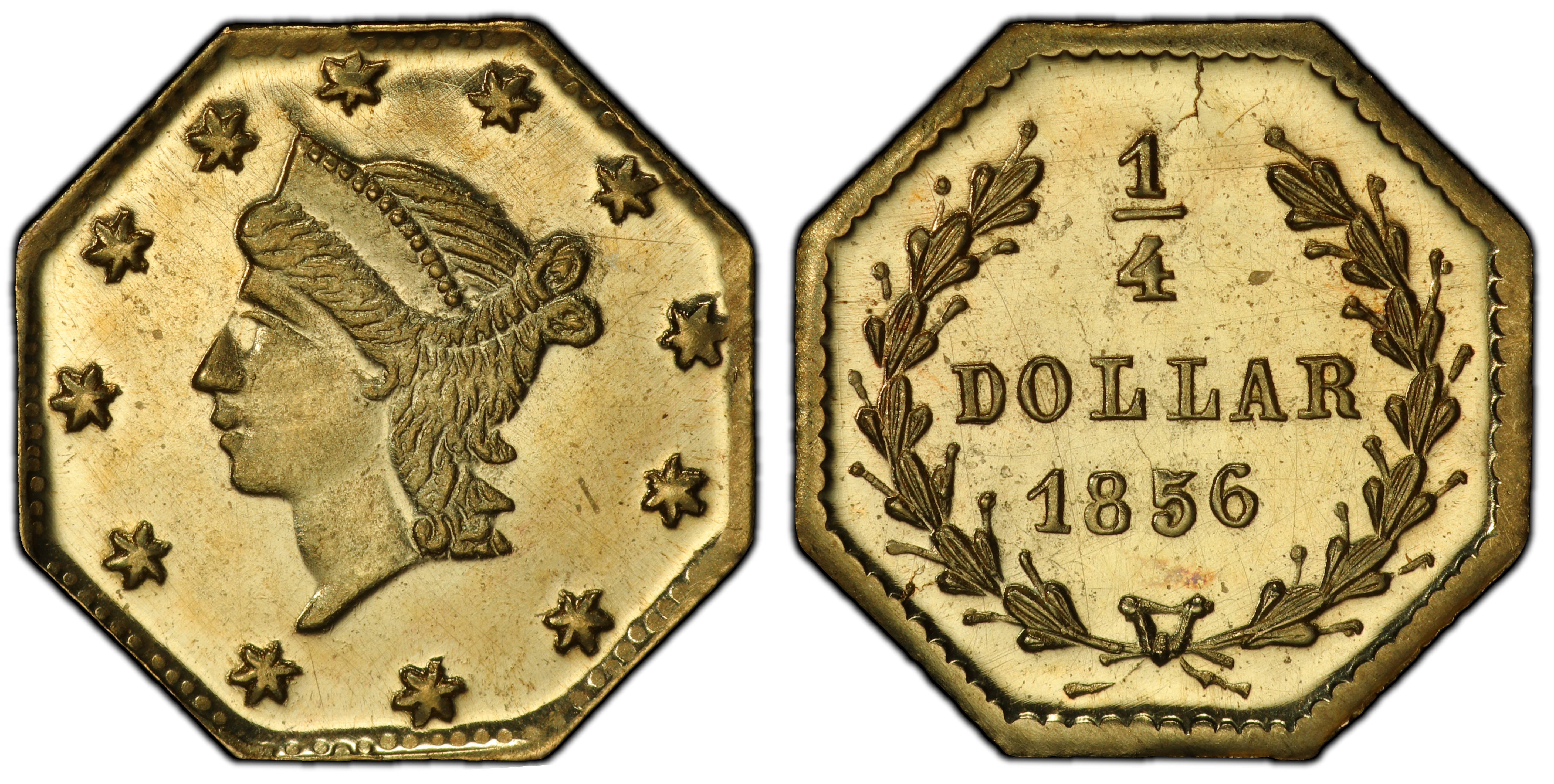
Obverse & Reverse
The 1856 BG-111 octagonal quarter dollar is a quintessential artifact of 'Period One' of California's private gold coinage era. Born from the acute economic necessities of the Gold Rush, these minuscule coins addressed a severe shortage of small-denomination currency for everyday transactions. Following the massive influx of population after the 1848 gold discovery, the region was awash in gold dust and large denomination coins, but lacked the federal silver coinage needed to make change for simple purchases. A pinch of gold dust for a drink or a loaf of bread was an imprecise and often contentious method of payment. Enterprising jewelers and metalsmiths in San Francisco stepped into this monetary vacuum, creating their own fractional gold coins in 25 cent, 50 cent, and one dollar denominations. These 'Period One' issues (1852-1856) were generally intended for actual circulation and were modeled, albeit crudely, on the designs of official U.S. gold coinage. The production process was rudimentary, often involving hand-cut dies and a hammer strike, leading to significant variation in strike quality. While accepted in local commerce out of necessity, they were consistently underweight for their face value, a fact that did not go unnoticed. Banks generally refused them. As the U.S. Mint in San Francisco ramped up production of official coinage in the mid-1850s, the utility of these private issues waned. They quickly transitioned from being essential pocket change to popular souvenirs, easily mailed back East as a memento of the California adventure. The BG-111 variety, with its distinctive octagonal shape and Liberty head design, is a direct legacy of this entrepreneurial, chaotic, and uniquely American period of monetary improvisation.
Associated EventCalifornia Gold Rush
Reason For MintingTo alleviate a severe shortage of circulating small-denomination coinage for daily commercial transactions in Gold Rush-era California.
Minter HistoryThe specific minter for the BG-111 variety remains anonymous, a common characteristic for many 'Period One' California fractional gold issuers. Production was often carried out by jewelers and other artisans in San Francisco who had the requisite skills for die-sinking and striking but did not formally mark their work. These individuals operated in a legally grey area, filling a commercial need that the federal government had not yet met.
Historical SignificanceThe BG-111 and its contemporaries are historically significant as a physical manifestation of frontier capitalism and monetary self-sufficiency. They represent a period when private citizens stepped in to create a functional medium of exchange in the absence of adequate federal coinage, reflecting the unique economic conditions of the California Gold Rush. These tiny gold pieces are among the most evocative relics of that transformative era.
BG-111
Denomination25 Cents
Minting Period1856
Assayer/MinterUnknown Private Minter
Geographic OriginSan Francisco, California
Obverse DescriptionA rudimentary depiction of a left-facing Liberty Head, with hair tied back. The head is surrounded by thirteen stars, representing the original colonies. The date, 1856, is below the bust. The die work is often characterized by a broken nose on Liberty in later die states.
Obverse Inscription1856
Reverse DescriptionThe central device is the denomination '1/4' on a single line, enclosed within a wreath of leaves and berries. The wreath is open at the top.
Reverse Inscription1/4
CompositionGold
Stated Fineness Actual FinenessVariable, but typically struck from native California gold of approximately .880 to .900 fineness.
Weight0.25 grams
Diameter9.00 mm
EdgePlain
Unknown
Survival Estimate300-500
Rarity ScaleR-4 (61-125 known per Breen-Gillio, though some sources suggest R-3)
The BG-111 is highly popular as a representative 'Period One' issue. Its appeal lies in its direct connection to the Gold Rush, its charmingly crude design, octagonal shape, and relative affordability compared to rarer varieties. The 'PL' (Prooflike) designation, as seen in the remarkable S.S. Central America shipwreck treasure, adds immense appeal for its stunning visual contrast.
Key VarietiesThe primary variety is the regular business strike. Several die states are known, showing progressive degradation, particularly a break on Liberty's nose and fragmentation of the bow on the reverse wreath. A key related issue is the BG-818A, a circa 1860 restrike made from the BG-111 dies but struck on a round planchet. Collectors should also be aware of copies made by Herman Kroll circa 1906, which resemble BG-111 but use a different date.
Authentication TipsAuthentication requires die characteristic matching. Key diagnostics for a genuine BG-111 include the specific shape of the '5' in the date, the positioning of the stars relative to the Liberty head, and the details of the wreath leaves. The surfaces of genuine pieces often exhibit parallel die polishing lines. Counterfeits often have incorrect details, a soapy or cast appearance, and are typically made of brass or low-karat gold. Comparison with high-resolution images from major grading services or reference books like Breen-Gillio's is essential.
Shopping ConsiderationsFor a premium quality example, seek a sharp, well-centered strike. On the BG-111, this means a fully defined Liberty head, clear date, and strong details in the wreath. 'Prooflike' (PL) or 'Semi-Prooflike' examples command a significant premium and exhibit reflective, mirror-like fields. Original, uncleaned surfaces with lustrous, greenish-gold or reddish-gold hues are highly desirable. Avoid examples that have been harshly cleaned, polished, or exhibit scratches or rim damage, which are common on these tiny, easily mishandled coins. The planchets were often crudely prepared, so some natural waviness can be expected.
A coin's grade is its condition, rated on a 1-70 scale. For rare coins, this is the most critical factor in determining value, as a tiny difference in preservation can mean a huge difference in price.
Relevant Grade TypesOriginal 1856 issues of BG-111 were business strikes intended for circulation, so they are found in Circulated grades (AG-3 to AU-58) and Mint State grades (MS-60 to 70). No true Proofs were struck during the original minting period. However, some planchets were highly polished, resulting in coins with mirror-like surfaces that are designated as Prooflike (PL) by grading services. These are not a different type of strike but rather a special surface characteristic of a business strike and are highly prized. The S.S. Central America treasure, which sank in 1857, contained a number of pristine, high-grade PL examples of this variety, establishing them as the finest known.
Mint State CharacteristicsAn uncirculated (MS) BG-111 typically displays a soft, satiny luster, though some are known with intensely prooflike, reflective fields. The strike is often uneven due to the hammer-striking process; weakness on the highest points of Liberty's hair and the wreath is common. Die polishing lines are frequently visible in the fields and are a positive characteristic. Bag marks are less common than on larger coins, but small nicks and scratches from handling are typical, even on high-grade specimens.
Circulated Wear PatternsWear first appears on the high points of Liberty's hair, cheek, and the strands of hair above the ear. On the reverse, the highest points of the wreath leaves and the bow will show initial friction and flatness. On moderately circulated examples, the date and stars will begin to show weakness. In lower grades, the portrait and wreath become significantly flattened, with legends merging toward the rim.
Key Factors For ValueThe primary value drivers are grade and surface quality. A high-grade Mint State coin is worth exponentially more than a circulated one. The 'PL' designation adds a very significant premium, as it indicates a coin of exceptional original quality. Coins with original, uncleaned surfaces and attractive, lustrous eye appeal are most sought after. A sharp, well-centered strike for the grade is critical. The presence of a CAC sticker, indicating premium quality for the grade, adds another layer of value for discerning collectors.
PCGS Price Guide
| Grade | Price | Population |
|---|---|---|
| 63 | $2,500.00 | 2 |
| 63+ | $2,750.00 | 1 |
| 64 | $3,000.00 | 2 |
| 64+ | $3,250.00 | 1 |
| 65 | $3,750.00 | 2 |
| 65+ | $4,000.00 | N/A |
| 66 | $4,500.00 | 2 |
| 66+ | $5,000.00 | 1 |
| 67 | $5,500.00 | 2 |
| 67+ | $6,500.00 | 2 |
| 68 | $8,500.00 | 1 |