1871 G50C BG-925 (Regular Strike)
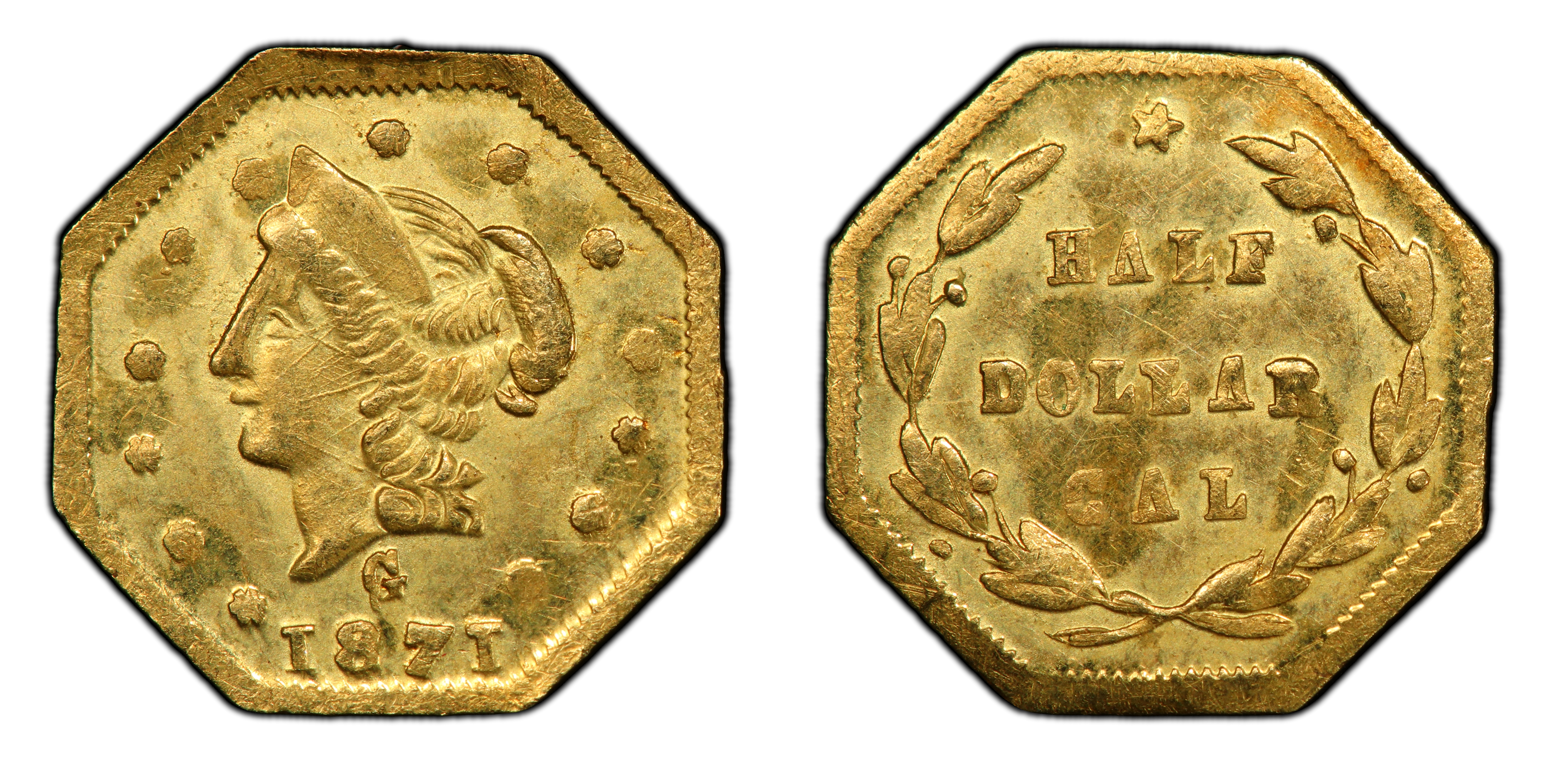
Obverse & Reverse
The 1871 Octagonal 50 Cents, cataloged as Breen-Gillio 925, is a quintessential example of a 'Period Two' California Fractional Gold piece. The story of these fascinating numismatic relics begins with the California Gold Rush of 1849. The initial influx of gold dust and nuggets, coupled with a severe shortage of circulating federal coinage in the isolated Western territory, created a desperate need for a medium of exchange. To fill this void, 'Period One' (1852-1857) fractional gold coins were privately struck by various jewelers and assayers. These early issues were generally of good faith, intended to circulate and facilitate commerce, and they loosely mimicked the designs of official U.S. gold coinage. However, by the late 1850s, the San Francisco Mint was in full operation, alleviating the acute coin shortage. The original impetus for fractional gold vanished, but a new market emerged. The Gold Rush had become a legendary American event, and San Francisco was a burgeoning tourist destination. Enterprising jewelers, including Robert B. Gray & Co., recognized a demand for souvenirs and keepsakes that captured the spirit of the '49ers. Thus began 'Period Two' (1859-1882), during which fractional gold pieces were produced not as essential currency, but as popular tokens for the tourist trade and jewelry trade. These 'jewelers' issues,' including the BG-925, were often underweight for their stated value, with variable fineness, and struck with a wider variety of designs than their Period One predecessors. The Coinage Act of April 22, 1864, officially prohibited private coinage, but the law was not strictly enforced by the Secret Service until 1883. This legal gray area allowed jewelers to continue production for nearly two decades, with output actually increasing in the 1870s to meet demand. The BG-925 was struck in this environment, a tiny, tangible memento of a romanticized golden era, destined for a parlor cabinet or a watch fob rather than a merchant's till. Its existence speaks to a shift from functional necessity to commercial nostalgia, making it a critical artifact in understanding the economic and cultural aftermath of the Gold Rush.
Associated EventCalifornia Gold Rush Legacy & Tourism
Reason For MintingPrimarily produced as a souvenir or charm for the burgeoning tourist and jewelry trade in post-Gold Rush San Francisco.
Minter HistoryRobert B. Gray was a San Francisco manufacturing jeweler. Around 1859-60, he acquired the business of Antoine Nouizillet, one of the prominent Period One minters. Gray continued to produce fractional gold using some of Nouizillet's old dies before creating his own. His pieces are often identified by a 'G' mintmark, and his firm, Robert B. Gray & Co., was a significant producer of these 'Period Two' souvenir coins. He sold his interests to the California Jewelry Company in 1871, the same year this piece was struck, marking the end of his direct involvement in the trade.
Historical SignificanceThe BG-925 represents the transition of fractional gold from a necessary form of circulating currency to a commercial souvenir. It is a tangible link to the popular romanticism of the Gold Rush that captivated America in the latter half of the 19th century and highlights a period of lax federal enforcement regarding private coinage laws.
BG-925 (Breen-Gillio)
Denomination50 Cents
Minting Period1871
Assayer/MinterRobert B. Gray & Co.
Geographic OriginSan Francisco, California
Obverse DescriptionA head of Liberty facing left, her hair tied in a bun. She is surrounded by 13 five-pointed stars along the octagonal border. The date, 1871, appears below the bust. The portrait style is typical of the simplified, somewhat crude engraving characteristic of many Period Two issues.
Obverse Inscription1871
Reverse DescriptionThe denomination '1/2' appears in the center, enclosed within an olive wreath. The wreath is composed of numerous leaves and berries, tied with a bow at the bottom. The inscription 'CALIFORNIA GOLD' is located outside the wreath, following the upper octagonal border. Some varieties from this maker feature a 'G' for Gray, but it is not a standard feature of this die pair.
Reverse InscriptionCALIFORNIA GOLD 1/2
CompositionGold
Stated Fineness Actual FinenessVariable, often between .500 and .750 fine. Period Two issues are known for being underweight and of inconsistent purity compared to federal coinage.
Weight0.24 grams
Diameter10.00 mm
EdgePlain
Unknown
Survival EstimateFewer than 75
Rarity ScaleR-5
The BG-925 is sought after for its direct connection to the romantic legacy of the California Gold Rush. Its tiny size, octagonal shape, and status as a 'jeweler's issue' make it a fascinating and historically rich collectible. Assembling a collection of the hundreds of Breen-Gillio varieties is a monumental challenge, and any specific, attributed variety is desirable.
Key VarietiesThe BG-925 itself is a key variety, defined by a specific die pairing from Robert B. Gray & Co. No major sub-varieties or special collector restrikes from the period are noted for this specific die marriage. The primary variation within the broader series is the vast number of different die pairs (BG numbers) created by numerous competing jewelers.
Authentication TipsGenuine Period Two pieces must be denominated (e.g., '1/2', 'DOLLAR', 'CENTS'). Be highly suspicious of pieces with a bear on the reverse, as this is a hallmark of modern replicas. Originals are very thin and often weakly struck in areas, with a soft, lustrous gold surface. Fakes are often brassy in color, may have a copper core visible on the edge, feel unnaturally heavy or thick, and often exhibit a uniform, sharp strike with a 'soapy' or proof-like modern luster. The engraving on genuine pieces is often crude but stylistically consistent, while fakes can appear cartoonish or too perfect.
Shopping ConsiderationsA premium quality example for this issue would be a well-struck piece, showing clear details in Liberty's hair and the wreath leaves, which are often weak. Original, lustrous surfaces are highly prized over cleaned, dull, or overly polished examples. Given their common use in jewelry, prospective buyers must carefully check for evidence of mounting, tooling, or significant rim damage, which drastically reduces value. Look for examples with attractive, original reddish-gold or mellow yellow-gold toning. An uncirculated specimen with proof-like fields would command a significant premium. Given the prevalence of fakes, purchasing examples certified by PCGS or NGC is strongly recommended.
A coin's grade is its condition, rated on a 1-70 scale. For rare coins, this is the most critical factor in determining value, as a tiny difference in preservation can mean a huge difference in price.
Relevant Grade TypesOriginal 1871 issues were all business strikes, although many were sold as souvenirs and never circulated. They are found in Circulated (1-58) and Mint State (MS, 60-70) grades. Due to their status as collectibles from the time of issue, high-grade examples are more common than for Period One pieces, but true gems are still rare. No official Proofs were struck during the original period of minting.
Mint State CharacteristicsUncirculated examples of BG-925 typically exhibit a soft, satiny luster. The strike is often somewhat weak, particularly in the center of the obverse (Liberty's hair) and reverse (the numerals and wreath). Planchet quality can be inconsistent, with minor striations or adjustment marks sometimes visible but not necessarily detrimental. Contact marks, even small ones, are magnified due to the coin's tiny size and the softness of the gold, so a 'clean' surface is a major value driver.
Circulated Wear PatternsWear first appears on the highest points of the design. On the obverse, this includes Liberty's cheek, the hair above her eye, and the coronet. On the reverse, the highest leaves of the wreath and the bow will show the first signs of friction. On lower grade examples, the stars and legends begin to merge with the fields, and the date can become faint.
Key Factors For ValueBeyond the numerical grade, value is driven by three key factors: strike, surface, and eye appeal. A sharply struck coin that shows full detail is far more desirable than a weakly struck example of the same grade. Original, lustrous surfaces free of distracting marks, cleaning, or jewelry mounting are paramount. Finally, coins with attractive, even toning and a pleasing overall look command significant premiums. Certification by a top-tier grading service (PCGS or NGC) is nearly essential for market acceptance, and a CAC sticker indicates premium quality for the grade.
PCGS Price Guide
| Grade | Price | Population |
|---|---|---|
| 40 | $215.00 | 1 |
| 45 | $220.00 | 1 |
| 45+ | $225.00 | N/A |
| 50 | $235.00 | N/A |
| 50+ | $240.00 | N/A |
| 53 | $250.00 | 4 |
| 53+ | $255.00 | N/A |
| 55 | $260.00 | 8 |
| 55+ | $265.00 | N/A |
| 58 | $275.00 | 12 |
| 58+ | $285.00 | N/A |
| 60 | $300.00 | 3 |
| 61 | $325.00 | 8 |
| 62 | $375.00 | 20 |
| 62+ | $395.00 | N/A |
| 63 | $600.00 | 10 |
| 63+ | $725.00 | N/A |
| 64 | $1,000.00 | 4 |
| 64+ | $1,250.00 | N/A |
| 65 | $1,750.00 | N/A |
| 65+ | $1,950.00 | N/A |
| 66 | $2,200.00 | N/A |
| 66+ | $2,550.00 | N/A |
| 67 | $3,150.00 | N/A |