1859 G50C BG-1001 (Regular Strike)
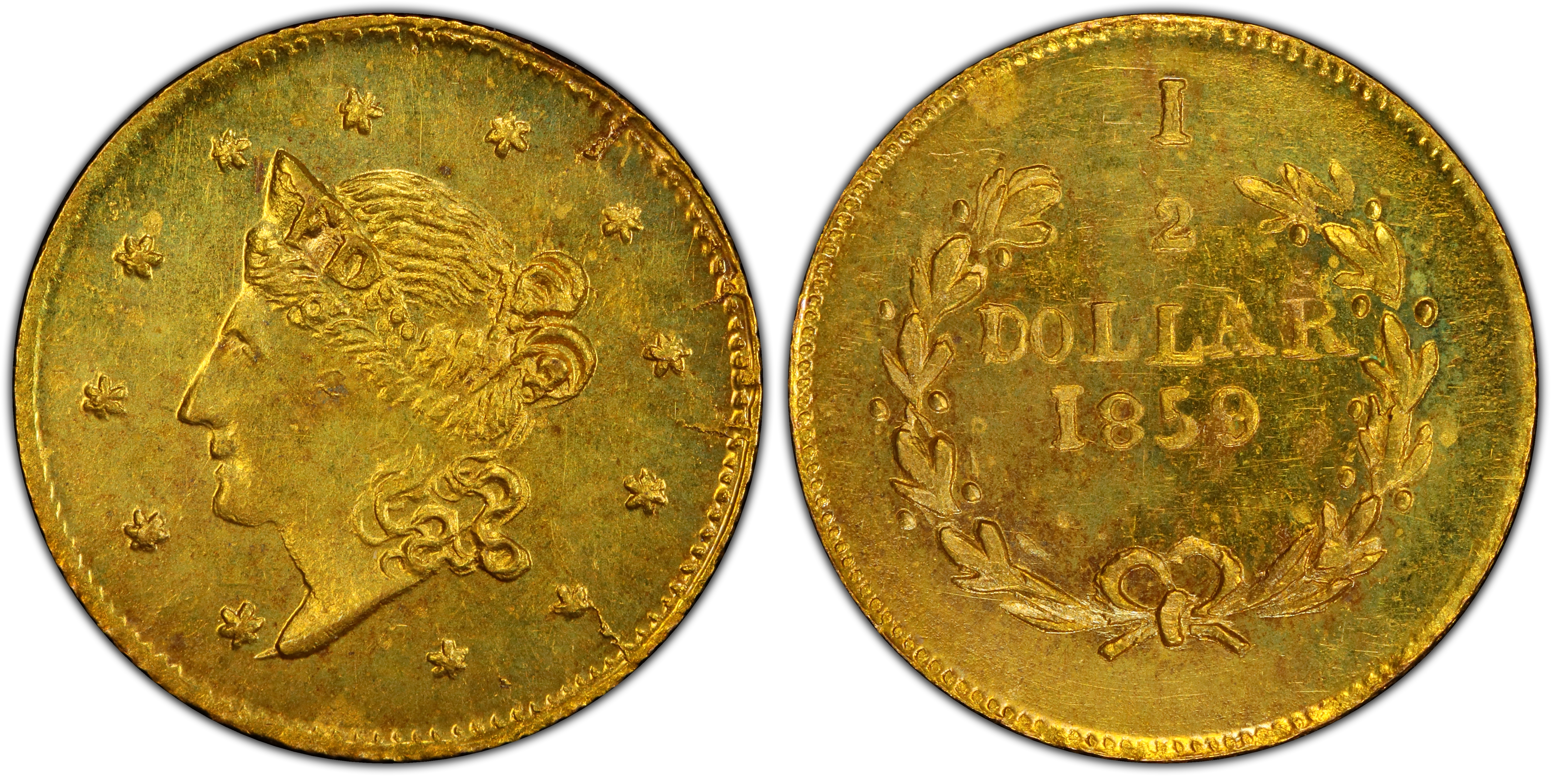
Obverse & Reverse
The 1859 BG-1001 50-cent piece emerges from the second major phase of California's private gold coinage, a period numismatists classify as 'Period Two' or the 'Jeweler's Issues' (circa 1859-1882). By the late 1850s, the acute shortage of small change that characterized the initial Gold Rush had been somewhat alleviated by the output of the U.S. Mint in San Francisco, which opened in 1854. However, a different market had developed. The tiny, intricate gold coins that were once a commercial necessity had become popular keepsakes and souvenirs of the California adventure. Jewelers, many of French origin, stepped in to meet this demand, producing a wide variety of charming but often significantly underweight pieces. Frontier, Deviercy & Co. was one such prominent firm of San Francisco jewelers. Their work, like that of their contemporaries, was not primarily intended to circulate as money, but rather to be sold as novelties to tourists and locals alike. These 'jeweler's issues' are distinct from the earlier 'Period One' coins (1852-1856), which were generally of more honest weight and struck with the genuine intent of filling a commercial void. The production of BG-1001 coincides with a California that was maturing; the wild frontier was giving way to a more established society, yet the romance of gold was a powerful marketing tool. These pieces were often struck using the 'hammer method,' a manual process where dies were struck with a sledgehammer, resulting in inconsistent strike quality. The passage of the Coinage Act of 1864 would eventually make all private coinage illegal, but enforcement was lax until the 1880s, allowing these fascinating 'suppressed issues' to be produced for over two decades. The BG-1001 is a quintessential example of this later period—a beautifully crafted but intrinsically deficient memento of an era, struck by jewelers capitalizing on the legend of the Gold Rush.
Associated EventCalifornia Gold Rush (Later Souvenir Period)
Reason For MintingPrimarily struck to be sold as souvenirs and keepsakes to tourists and locals, rather than to alleviate a currency shortage.
Minter HistoryFrontier, Deviercy & Co. was a firm of jewelers operating in San Francisco during the mid-19th century. Composed of principals Pierre Frontier and Eugene Deviercy, the firm was part of a network of largely French artisans who became the primary producers of 'Period Two' California Fractional Gold. Before this partnership, they were associated with Alexandre Dubois & Co. Their operations continued in various configurations through the 1860s. Their creations, identified by die characteristics and sometimes the 'FD' initials on other varieties, are typical of the 'jeweler's issues'—artistically rendered but not intended for circulation at face value.
Historical SignificanceThe BG-1001 is a tangible artifact of the commercial evolution of the Gold Rush, representing the shift from creating necessary coinage to producing souvenir tokens. It highlights a period when private minters, operating in a legally grey area, catered to a burgeoning tourist trade and the public's fascination with gold, making it a key piece in understanding the later history of the series.
N/A
Denomination50 Cents
Minting Period1859
Assayer/MinterFrontier, Deviercy & Co.
Geographic OriginSan Francisco, California
Obverse DescriptionA left-facing Liberty Head, stylistically similar to contemporary U.S. gold coinage but cruder in execution. Liberty's hair is tied in a bun, and she wears a coronet. The field is surrounded by thirteen stars.
Obverse Inscription Reverse DescriptionThe denomination '1/2' is centered within a wreath composed of leaves and berries. The wreath is tied with a bow at the bottom.
Reverse InscriptionCALIFORNIA GOLD DOLLAR
CompositionGold
Stated Fineness Actual Fineness EdgePlain
Unknown
Survival Estimate4-12 (Implied by R-7 rating)
Rarity ScaleR-7-
As an extreme rarity from the popular California Fractional Gold series, the BG-1001 is a prize for advanced specialists. Its appeal lies in its elusiveness, its connection to the known jewelers Frontier, Deviercy & Co., and its status as a representative of the fascinating 'Period Two' souvenir issues. Any example offered at auction generates significant excitement.
Key VarietiesNo major varieties are known for the BG-1001 die marriage. It is a single, distinct issue. There are no known patterns, trial pieces, or restrikes associated with this specific variety. All known examples are considered original business strikes from the 1859 period.
Authentication TipsAuthentication requires expert examination. Genuine examples are struck, not cast, exhibiting sharp details under magnification, particularly in the hair and wreath leaves. The planchet fabric should be consistent with 19th-century gold pieces. Key diagnostics for BG-1001 include awkwardly repunched 'AR' in DOLLAR on the reverse and the presence of several faint, radial die cracks on the obverse. Counterfeits are often soapy in appearance, may have the wrong weight or specific gravity, and will lack these precise die markers.
Shopping ConsiderationsFor a coin of this rarity, any opportunity to acquire one is significant. A 'premium quality' example would be one that is well-centered and sharply struck, as many fractional pieces are found with weak or off-center strikes. Look for remaining mint luster, which often has a semi-prooflike or satiny texture. Avoid examples that have been harshly cleaned, which strips the original surface, or those that show evidence of being used in jewelry (e.g., solder marks, edge filing, or plugging). The faint die cracks are a characteristic of the die, not a flaw. A specimen with a strong, clear strike on the Liberty Head and the reverse wreath, coupled with clean surfaces for the grade, would be considered highly desirable.
A coin's grade is its condition, rated on a 1-70 scale. For rare coins, this is the most critical factor in determining value, as a tiny difference in preservation can mean a huge difference in price.
Relevant Grade TypesOriginal period issues were business strikes. As they were sold primarily as souvenirs, they are most often encountered in high grades, from About Uncirculated (AU) to Mint State (MS, 60-70). Circulated examples are exceptionally rare. No true Proofs were struck during the original period of issue, and there are no known later-date Proof restrikes for this variety.
Mint State CharacteristicsAn uncirculated BG-1001 typically exhibits a soft, satiny to semi-prooflike luster. The strike can be variable due to the manual hammer-striking process; a key determinant of quality is the sharpness of Liberty's hair details and the definition of the individual leaves in the wreath. Small planchet imperfections or adjustment marks are not uncommon. The presence of the faint obverse die cracks is a diagnostic of the variety and should not be considered a post-minting flaw.
Circulated Wear PatternsOn circulated examples, wear will first appear on the highest points: the hair above Liberty's eye and ear, the coronet, and the tops of the leaves and the bow on the reverse wreath. As wear progresses, the stars on the obverse will begin to lose their detail, and the 'CALIFORNIA GOLD' legend on the reverse will become soft.
Key Factors For ValueFor the BG-1001, rarity is the primary value driver. Given that, value differences are determined by grade and eye appeal. A sharply struck coin with lustrous, original surfaces will command a significant premium over a weakly struck or cleaned example in the same grade. The ideal specimen would possess a bold strike, attractive original color (often a straw-gold or coppery-gold), and minimal distracting marks. A CAC sticker for this issue would be a strong endorsement of its quality for the assigned grade and would add a substantial premium.
PCGS Price Guide
| Grade | Price | Population |
|---|---|---|
| 50 | $1,500.00 | 1 |
| 50+ | $1,600.00 | N/A |
| 53 | $1,750.00 | N/A |
| 53+ | $1,850.00 | N/A |
| 55 | $2,000.00 | 1 |
| 55+ | $2,200.00 | N/A |
| 58 | $2,400.00 | N/A |
| 58+ | $2,550.00 | N/A |
| 60 | $2,850.00 | N/A |
| 61 | $3,500.00 | N/A |
| 62 | $4,000.00 | 5 |
| 62+ | $4,350.00 | N/A |
| 63 | $4,750.00 | 5 |
| 63+ | $5,250.00 | N/A |
| 64 | $6,000.00 | 2 |