1876 G25C BG-856 (Regular Strike)
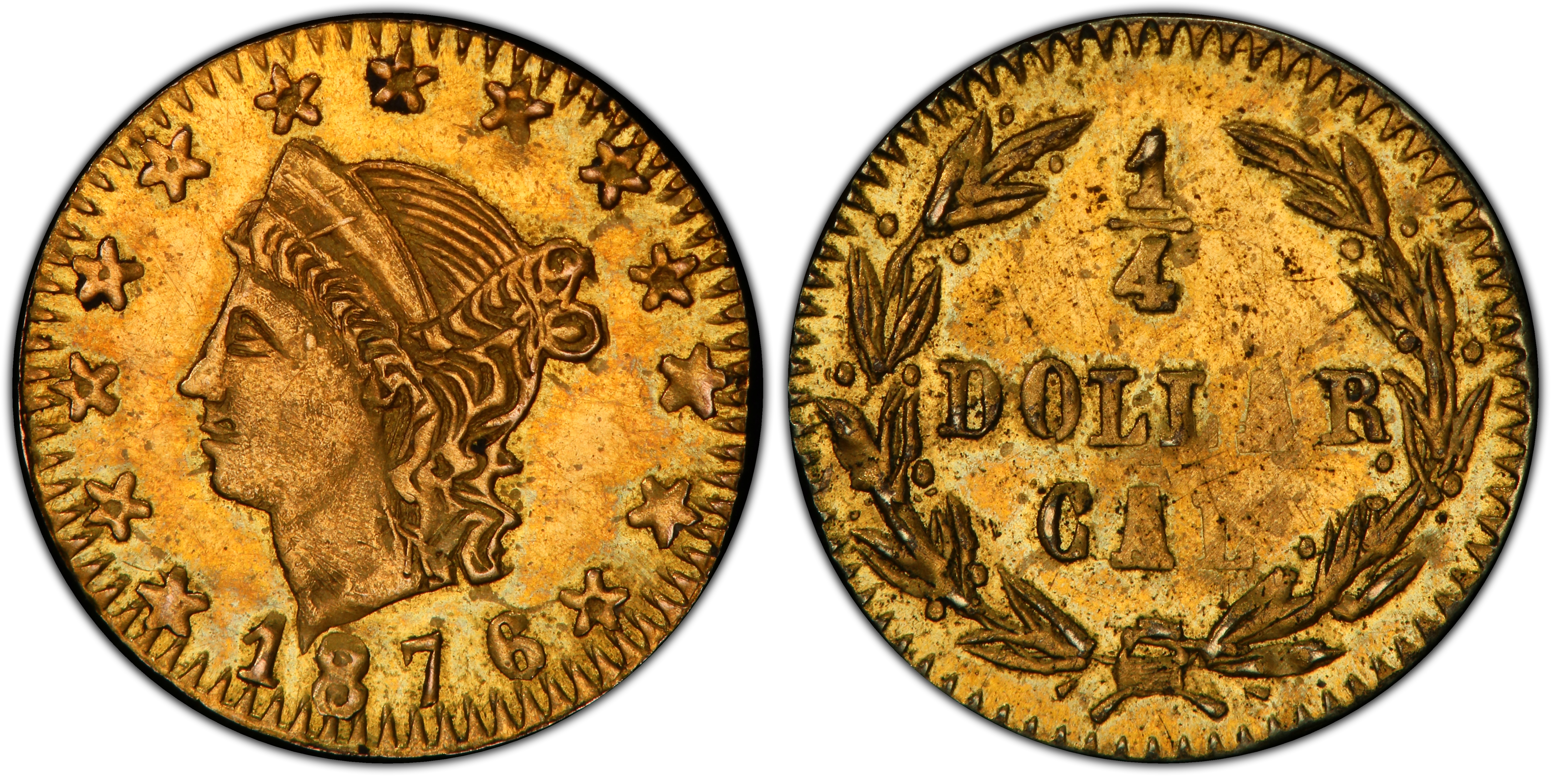
Obverse & Reverse
The 1876 G25C BG-856 represents a fascinating later chapter in the story of California Fractional Gold. By the mid-1870s, the initial, desperate need for small-denomination coinage that characterized the Gold Rush era had largely subsided. The United States Mint in San Francisco was in full operation, producing ample quantities of federal silver and minor coinage. The continued production of these tiny gold 'charms' or 'tokens' transitioned from a primarily utilitarian function to one driven by commerce, nostalgia, and the burgeoning tourist trade. Jewelers and private minters, such as Robert B. Gray & Co., recognized a persistent market for these pieces as souvenirs, keepsakes, and affordable gold items for jewelry. The year 1876 was particularly significant due to the Centennial Exposition in Philadelphia, which celebrated the 100th anniversary of American independence and fueled a nationwide interest in historical and souvenir items. These late-date fractionals were often machine-struck with greater precision than their earlier, cruder counterparts, exhibiting standardized designs like the Indian Head and wreath motifs. However, their legal status was ambiguous at best. The Act of June 8, 1864, had prohibited private coinage, yet production of these pieces continued, often omitting the word 'DOLLAR' or 'CENTS' to circumvent the law, replacing it with 'D.' or 'C.' or no denomination at all. The BG-856, with its clear '25 CENTS' denomination, was a bolder issue, likely relying on its small size and souvenir status to avoid Treasury Department scrutiny. These pieces circulated minimally, if at all, and were primarily sold by jewelers directly to the public, preserving many in higher grades than earlier issues. Their existence speaks to a resilient entrepreneurial spirit and a market that cherished the legacy of the Gold Rush in a tangible, golden form.
Associated EventPost-Gold Rush Economic Period / U.S. Centennial
Reason For MintingPrimarily produced as souvenirs and for use in the jewelry trade rather than for general circulation.
Minter HistoryRobert B. Gray & Co. was a prominent San Francisco die-sinking and engraving firm active in the latter half of the 19th century. While not a 'mint' in the traditional sense, they produced a wide variety of medals, tokens, and store cards. They are believed to be the manufacturers of numerous varieties of California Fractional Gold pieces during the 1870s and early 1880s. Their work is generally characterized by higher quality and more standardized, professional-looking designs compared to the cruder pieces of the early 1850s. They capitalized on the souvenir market, creating attractive and affordable gold tokens for tourists and locals alike, often featuring popular motifs such as the Liberty Head or, in this case, the Indian Head.
Historical SignificanceThe BG-856 is significant as a representative of the commercially-driven 'Period Three' (1872-1882) of California Fractional Gold production. It illustrates the transition of these pieces from quasi-circulating currency to souvenir items, reflecting a maturing California economy and a growing romanticism for the Gold Rush era. Its explicit denomination, despite federal prohibitions, highlights the lax enforcement regarding these small, privately issued gold tokens.
N/A
Denomination25 Cents
Minting Period1876
Assayer/MinterAttributed to Robert B. Gray & Co. of San Francisco
Geographic OriginSan Francisco, California
Obverse DescriptionA well-defined portrait of an Indian Head facing left, wearing a feathered headdress. The headdress is adorned with the word 'LIBERTY' on the band, though it is often weakly struck. The portrait is encircled by 13 six-pointed stars.
Obverse InscriptionLIBERTY
Reverse DescriptionThe denomination '25 CENTS' is displayed prominently within a continuous wreath of leaves and berries, tied with a bow at the bottom. A small mintmark 'G' for Gray is located below the bow.
Reverse Inscription25 CENTS
CompositionGold
Stated Fineness Actual FinenessTypically ranges from .500 to .600 fine (12-14 karat), though composition could vary.
Weight0.25 grams
Diameter9.70 mm
EdgePlain
5,000-10,000
Survival Estimate500-750
Rarity ScaleR-4
The BG-856 is popular with collectors due to its status as a dated, denominated issue from the Centennial year. Its attractive Indian Head design, affordability relative to earlier issues, and the presence of a known maker's mark ('G') make it a desirable type coin for collectors of California Fractional Gold.
Key VarietiesThe primary variety is the regular strike BG-856. There are no major, intentionally created varieties from the original minting period. Prooflike or specimen strikings are not typically associated with this issue; however, some early strikes may exhibit reflective surfaces. Research has not identified any subsequent restrikes or special collector issues for this specific Breen-Gillio number.
Authentication TipsGenuine examples have a sharp, albeit sometimes uneven, strike from machine presses. The 'G' mintmark below the wreath's bow should be clear and correctly formed. Check for the proper die characteristics, such as the position of the stars and letters, as cataloged in Breen-Gillio. Counterfeits are common; many are cast and will show soft details, porosity, or a seam on the edge. Others are underweight or made of brass. Be wary of coins with perfect, fully struck-up details, as genuine pieces almost always show some minor striking weakness, particularly on 'LIBERTY' in the headdress.
Shopping ConsiderationsA premium quality example for its grade will possess a strong strike, particularly on the portrait details and the '25 CENTS' on the reverse. Seek out pieces with smooth, lustrous surfaces free of distracting marks, evidence of cleaning, or jewelry mounting/removal. Original, unconserved surfaces with a nice reddish-gold or orange-peel texture are highly desirable. Check the rim for evidence of being previously mounted in a bezel. Common problems include harsh cleaning, which dulls the luster, and minor scratches from handling.
A coin's grade is its condition, rated on a 1-70 scale. For rare coins, this is the most critical factor in determining value, as a tiny difference in preservation can mean a huge difference in price.
Relevant Grade TypesOriginal period issues of BG-856 were business strikes. While intended for sale rather than circulation, many saw handling and are found in Circulated grades (AU-50 to AU-58 being common) as well as Mint State (MS, 60-70). No true Proofs were struck during the original period of issue for this variety. Any coin described as 'Prooflike' (PL) is a business strike with unusually reflective surfaces from polished dies, which carries a premium.
Mint State CharacteristicsAn uncirculated BG-856 will exhibit full mint luster, often with a slightly satiny or subtly prooflike texture. The strike is a key variable; many were not perfectly struck. A high-quality MS example will show sharp details on the feathers and facial features of the Indian Head. The reverse wreath should be crisp. Minor planchet imperfections or trivial die polish lines are common and acceptable. Contact marks, while expected, should be minimal and not located in focal areas like the cheek or the denomination.
Circulated Wear PatternsThe first signs of wear appear on the highest points: the cheek of the Indian Head, the eyebrow, and the feathers in the headdress. On the reverse, friction will first dull the surfaces and then flatten the high points of the leaves in the wreath and the numerals of '25'. In lower grades (VF and below), the word 'LIBERTY' in the headdress may become indistinct, and the stars will lose their sharpness.
Key Factors For ValueThe primary value drivers for BG-856 are grade and surface quality. An example with original, lustrous surfaces will command a significant premium over a cleaned or polished one of the same numerical grade. Strike quality is also critical; a coin with a full, sharp strike is much more desirable than a weakly struck example. Eye appeal, encompassing attractive natural toning and a lack of distracting marks, is paramount. A sticker from CAC (Certified Acceptance Corporation) indicates a premium quality coin for the grade and will add a significant percentage to its value.
PCGS Price Guide
| Grade | Price | Population |
|---|---|---|
| 50 | $900.00 | 1 |
| 50+ | $915.00 | N/A |
| 53 | $930.00 | N/A |
| 53+ | $945.00 | N/A |
| 55 | $965.00 | N/A |
| 55+ | $980.00 | N/A |
| 58 | $1,000.00 | 1 |
| 58+ | $1,200.00 | N/A |
| 60 | $1,350.00 | N/A |
| 61 | $1,550.00 | N/A |
| 62 | $1,850.00 | 3 |
| 62+ | $2,250.00 | N/A |
| 63 | $3,000.00 | 2 |
| 63+ | $3,500.00 | N/A |
| 64 | $4,000.00 | 3 |
| 64+ | N/A | N/A |