1873 G25C BG-817 (Regular Strike)
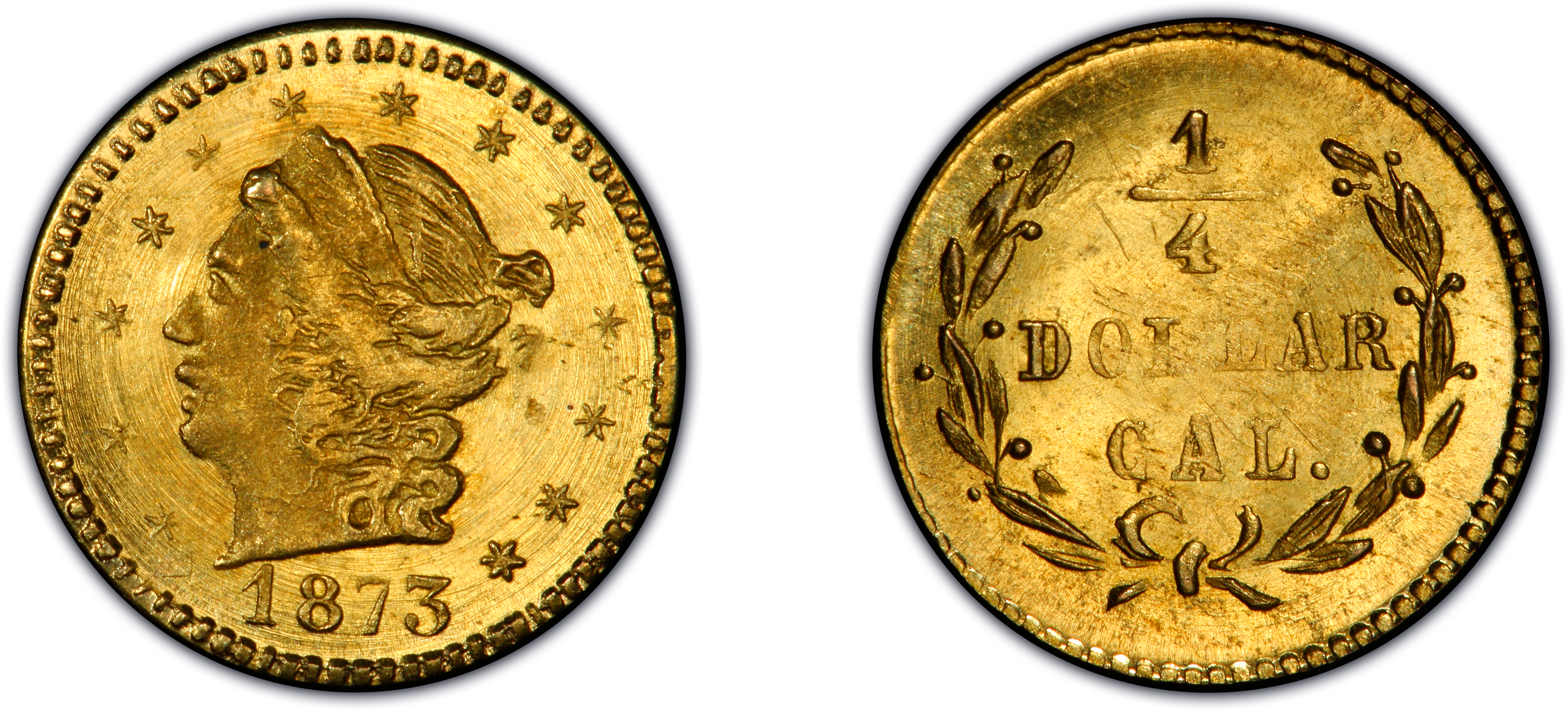
Obverse & Reverse
The 1873 BG-817 25 Cents is a quintessential example of 'Period Two' California Fractional Gold. These small-denomination coins arose from a chronic shortage of circulating currency that plagued California following the 1849 Gold Rush. While the United States Mint in San Francisco produced larger denomination gold coins, the explosive population growth created an immense need for small change for everyday transactions. Initially, gold dust and nuggets were used, but this was impractical and prone to inaccuracies. In response, private jewelers and metallurgists began striking their own fractional denominations—25 cents, 50 cents, and one dollar—starting in 1852. These pieces, while technically tokens as they contained less than their face value in gold and were not government legal tender, were widely accepted in local commerce out of sheer necessity. The first period (1852-1857) saw coins that more closely resembled federal issues. The second period (1859-1882), to which the BG-817 belongs, is characterized by a greater diversity of design and lighter weights, often earning them the moniker 'jeweler's issues.' By 1873, the immediate post-Gold Rush frenzy had subsided, but California's economy was still robust and the need for small change persisted. The Coinage Act of 1864 had made private coinage illegal, but the law was not strictly enforced in the West until the early 1880s, allowing production of these 'tokens' to continue. Many of these later-period pieces, including the BG-817, were also likely produced as souvenirs for tourists and collectors, capitalizing on the romantic allure of the Gold Rush. This dual purpose—serving a lingering commercial need while also catering to a growing souvenir market—defines the context of the 1873 issues. Most were crudely produced using a hammer-striking method, resulting in significant variability in strike quality. Today, California Fractional Gold coins are prized by numismatists for their direct connection to the American West's most iconic era, representing a tangible piece of the region's unique economic development.
Associated EventCalifornia Gold Rush and Western Expansion
Reason For MintingTo alleviate a severe shortage of small-denomination coinage for daily commercial transactions in post-Gold Rush California.
Minter HistoryThe specific minter for BG-817 is not definitively known, which is common for Period Two issues. The production of these fractionals was dominated by a community of San Francisco jewelers, many of French origin. Prominent minters of the era included figures like Robert B. Gray, Deriberpe & Nouizillet, and Frontier & Deviercy. These craftsmen used their skills to create dies and strike coins, often as a profitable sideline to their main jewelry business. Their work is characterized by artistic license and less adherence to federal coinage standards, resulting in a wide array of designs. While unattributed, the BG-817 was certainly a product of this competitive and somewhat clandestine minting environment that thrived in San Francisco during the 1870s.
Historical SignificanceThe BG-817 and its contemporaries are historically significant as a physical manifestation of frontier capitalism and ingenuity. They represent a grassroots solution to a systemic failure of the federal government to supply adequate coinage to the rapidly growing West. These pieces illustrate the transition of California's economy from one based on barter with gold dust to a more sophisticated monetized system, all driven by private enterprise.
N/A
Denomination25 Cents
Minting Period1873
Assayer/MinterUnknown, likely various San Francisco jewelers
Geographic OriginSan Francisco, California
Obverse DescriptionA beaded border encloses a Liberty Head facing left, her hair tied in the back. Thirteen stars encircle the portrait.
Obverse InscriptionNo inscription. The date 1873 appears below the bust.
Reverse DescriptionA beaded border surrounds the denomination '1/4 DOLLAR' enclosed within a wreath of leaves and berries.
Reverse Inscription1/4 DOLLAR
CompositionGold
Stated Fineness Actual Fineness0
Weight0.25 grams
Diameter9.70 mm
EdgePlain
Unknown
Survival Estimate200-300
Rarity ScaleR-4
The BG-817 is popular among collectors due to its classic Liberty Head design, affordability relative to earlier issues, and its direct, tangible link to the romantic history of the California Gold Rush. It serves as an accessible entry point into the complex and fascinating series of California Fractional Gold.
Key VarietiesThe primary 'variety' for BG-817 relates to the die state. Early strikes (State I) are sharper, while later strikes show progressive die cracks and weakness. No major design variations or intentional restrikes are known for this specific variety from the original minting period. Collectors should be aware that the broader California Fractional Gold series includes numerous other designs and minters for the 1873 date, as well as souvenir tokens and replicas which are not genuine gold.
Authentication TipsAuthentic BG-817s are struck in genuine gold, albeit of varying fineness. Key diagnostics include the specific positioning of the date numerals relative to the bust and the style of the wreath on the reverse. Counterfeits and modern souvenir tokens are common; these are often gold-plated brass, feel lightweight, and have a soapy or crude appearance. Authentic pieces, even if weakly struck, will show sharp details under magnification that are lacking on fakes. Comparison with high-resolution images from major grading services is essential for authentication. Genuine issues will also have the denomination clearly stated as '1/4 DOLLAR'.
Shopping ConsiderationsWhen purchasing an 1873 BG-817, strike quality is paramount. These were often weakly and unevenly struck by hammer, so a specimen with a bold strike on Liberty's portrait and the central reverse details commands a significant premium. Look for original, undisturbed surfaces with a pleasing golden luster. Many surviving examples have been cleaned, polished, or previously mounted in jewelry, all of which drastically reduce value. A 'premium quality' example for its grade would exhibit minimal distracting marks, a sharp strike for the issue, and attractive, original eye appeal. Avoid coins with tooling, rim damage, or evidence of being harshly cleaned.
A coin's grade is its condition, rated on a 1-70 scale. For rare coins, this is the most critical factor in determining value, as a tiny difference in preservation can mean a huge difference in price.
Relevant Grade TypesOriginal 1873 BG-817 issues were business strikes intended for commerce or as high-quality souvenirs and are found in Circulated (1-58) and Mint State (MS, 60-70) grades. No Proofs were struck during the original period of issue. Any piece described as a 'Proof' is likely a modern copy or a misattribution of a very sharply struck, lustrous Mint State example. Some Period Two pieces can have prooflike surfaces, but these are distinct from true Proofs.
Mint State CharacteristicsUncirculated examples of BG-817 are defined by their luster. This typically presents as a satiny or slightly prooflike sheen. A key challenge for this issue is the strike; many Mint State examples are weakly struck, particularly in the center of the obverse (Liberty's hair) and reverse (the denomination). A well-struck MS example with full details is rare and highly desirable. Due to the small size and handling over the years, even uncirculated specimens may show minor ticks and hairlines, but these should not be heavy or distracting.
Circulated Wear PatternsWear first appears on the highest points of the design. On the obverse, this includes Liberty's cheek, the hair just above her eye, and the tops of the letters in the date. On the reverse, the highest points of the wreath's leaves and the numerals of the fraction '1/4' will show the first signs of friction and metal loss. In lower grades (VG and below), the stars on the obverse and the individual leaves on the reverse will begin to merge and lose their definition.
Key Factors For ValueFor the BG-817, the primary value drivers are grade and surface quality. An original, uncleaned coin with pleasing luster will always be worth more than a cleaned coin of the same grade. Strike is a close second; a sharply struck coin can command a premium of 50% or more over a weakly struck example in the same numerical grade. Eye appeal is crucial; coins with a rich, reddish-gold toning are often prized over bright, yellow-gold specimens. Certification by a top-tier service like PCGS or NGC is essential for market acceptance, and a CAC sticker for this issue indicates superior quality for the grade and adds a significant premium.
PCGS Price Guide
| Grade | Price | Population |
|---|---|---|
| 35 | $170.00 | 1 |
| 40 | $175.00 | N/A |
| 45 | $180.00 | N/A |
| 45+ | $182.00 | N/A |
| 50 | $190.00 | 1 |
| 50+ | $192.00 | N/A |
| 53 | $195.00 | 1 |
| 53+ | $197.00 | N/A |
| 55 | $200.00 | 8 |
| 55+ | $205.00 | N/A |
| 58 | $210.00 | 13 |
| 58+ | $215.00 | N/A |
| 60 | $220.00 | 4 |
| 61 | $240.00 | 11 |
| 62 | $285.00 | 43 |
| 62+ | $325.00 | N/A |
| 63 | $400.00 | 78 |
| 63+ | $450.00 | N/A |
| 64 | $500.00 | 52 |
| 64+ | $575.00 | N/A |
| 65 | $700.00 | 20 |
| 65+ | $825.00 | N/A |
| 66 | $1,075.00 | 7 |
| 66+ | $1,250.00 | N/A |
| 67 | $1,500.00 | N/A |