1871 G25C BG-839 (Regular Strike)
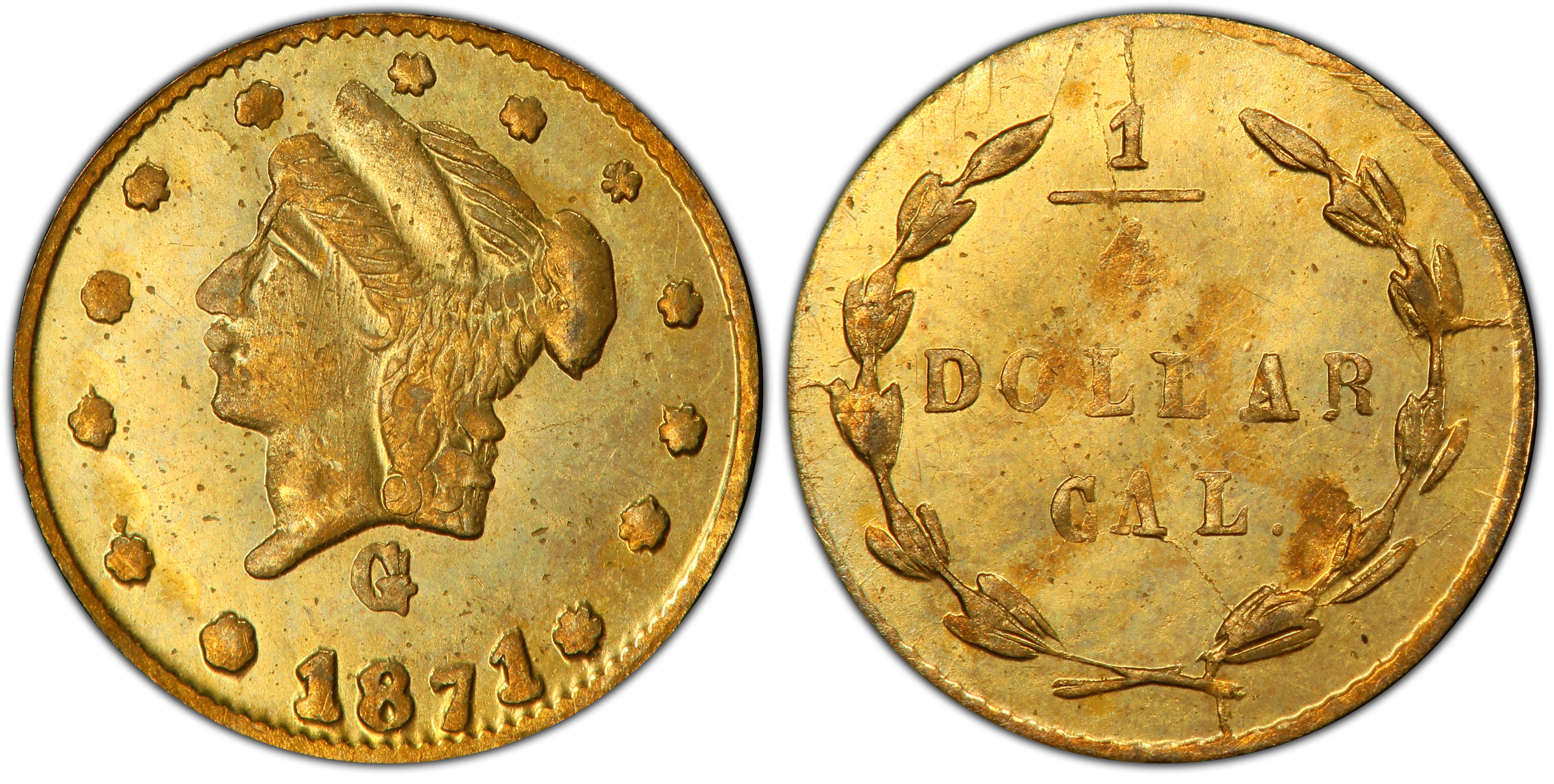
Obverse & Reverse
The 1871 25 Cents, cataloged as Breen-Gillio 839, is a quintessential example of a 'Period Two' California Fractional Gold piece. These later issues, starkly different in intent from their 'Period One' predecessors, were not struck to alleviate the severe shortage of small denomination coinage that plagued the early years of the Gold Rush. By 1871, the San Francisco Mint was in full operation, supplying the region with ample federal coinage. Instead, the BG-839 and its contemporaries were 'Jeweler's Issues,' created to satisfy a burgeoning tourist and souvenir market. San Francisco had become a major metropolis and a destination, and these tiny gold coins were romantic, affordable mementos of the Golden State and its famous rush. Produced by jewelers like Robert B. Gray & Co., these pieces often played fast and loose with intrinsic value; their gold content was frequently less than their stated face value, a practice that would have been unacceptable in the 1850s when fractional gold was used in daily commerce. The production of these pieces existed in a legal gray area. The Private Coinage Act of 1864 had made such private issues illegal, but the law was not strictly enforced by the Secret Service until the early 1880s. This lax enforcement allowed a thriving industry to continue for nearly two decades. The BG-839 was likely produced using the 'hammer method,' where dies were struck by hand, leading to variability in strike quality. Their primary market was not the citizens of San Francisco, but rather visitors from the East Coast or Europe who desired a keepsake. Today, these 'Suppressed Jewelers' Issues,' as termed by Breen and Gillio, are a fascinating and widely collected numismatic field, representing the commercial maturation of California and the enduring romanticism of its Gold Rush origins.
Associated EventPost-Gold Rush California Tourism
Reason For MintingPrimarily struck to be sold as souvenirs and keepsakes to tourists, not for general circulation.
Minter HistoryRobert B. Gray & Co. was a prominent San Francisco jewelry firm active in the production of California Fractional Gold during the 'Period Two' era (1858-1882). In the late 1850s, Gray acquired the business and equipment, including dies and hubs, of another significant fractional gold producer, Antoine Louis Nouzillet. This acquisition allowed Gray to continue and expand production. Gray's issues are often identifiable by a hallmark 'G' on the obverse, although this feature is not present on the BG-839 variety. The firm was known for producing some of the heaviest and most intrinsically valuable of the Period Two issues, though many were still underweight relative to their face value. They produced a wide variety of both octagonal and round quarter, half, and dollar denominations until federal enforcement finally halted the practice in the early 1880s.
Historical SignificanceThe BG-839 is significant not as a coin of commerce, but as a cultural artifact representing the transition of California from a raw frontier to a romanticized destination. It marks the shift in private gold minting from a necessity to a novelty.
BG-839
Denomination25 Cents
Minting Period1871
Assayer/MinterRobert B. Gray & Co.
Geographic OriginSan Francisco, California
Obverse DescriptionThe obverse features a Liberty Head, facing left, with 'LIBERTY' inscribed on her coronet. The portrait is encircled by thirteen six-pointed stars, representing the original colonies.
Obverse InscriptionLIBERTY
Reverse DescriptionThe reverse design consists of the denomination '1/4 DOLLAR' and the date '1871' enclosed within a beaded circle. The circle is itself enclosed by a wreath of two olive branches tied together at the bottom with a bow.
Reverse Inscription1/4 DOLLAR 1871
CompositionGold
Stated Fineness Actual FinenessFineness for Period Two issues varied widely, often ranging from 14 to 22 karats. The intrinsic value was typically less than the face value.
Weight0.25 grams
Diameter9.80 mm
EdgePlain
Unknown
Survival Estimate81-200 (Based on Low R-4 rating; combined PCGS and NGC population reports show approximately 110 graded examples as of late 2025, suggesting the total is likely within this range.)
Rarity ScaleLow R-4
This variety appeals to collectors due to its affordability relative to Period One issues, its direct connection to the romantic post-Gold Rush era of San Francisco, and the challenge of collecting the numerous Breen-Gillio varieties. Its simple, classic Liberty Head design is representative of the type.
Key VarietiesNo major varieties, patterns, or official restrikes are known for the BG-839. The California Fractional Gold series as a whole is rife with die states and minor die variations, but BG-839 is treated as a single, distinct issue from its original period of production.
Authentication TipsGenuine Period Two fractionals like BG-839 must have a denomination (e.g., 'DOLLAR', 'DOL.', or 'CENTS'). Replicas and later souvenir tokens often omit a denomination, sometimes saying 'CAL GOLD' or featuring a grizzly bear on the reverse; these are key signs of a non-authentic piece. Look for the characteristic softness of a genuine gold strike; fakes are often unnaturally sharp or have a soapy, cast-like appearance. The planchets are very thin, so weak strikes, particularly in the center, are common and can be an indicator of authenticity.
Shopping ConsiderationsA premium quality example for its grade will exhibit a sharp strike, especially on Liberty's hair details and the numerals of the date. Luster is a key value driver; seek out pieces with original, frosty or prooflike surfaces rather than those that are dull or have been cleaned. Many of these tiny coins were mounted as jewelry, so carefully check the rims and surfaces under magnification for evidence of mounting, solder, tooling, or harsh cleaning, all of which will significantly reduce the value. Attractive, original reddish-gold toning is highly desirable and commands a premium.
A coin's grade is its condition, rated on a 1-70 scale. For rare coins, this is the most critical factor in determining value, as a tiny difference in preservation can mean a huge difference in price.
Relevant Grade TypesOriginal issues of BG-839 were business strikes, although not intended for widespread circulation. They are found in Circulated (1-58) and, more commonly, Mint State (MS, 60-70) grades. No true Proofs were struck during the original period of issue. Some high-quality Mint State examples exhibit reflective, prooflike (PL) surfaces from being struck with polished dies, but these are distinct from true Proof coins and are considered a desirable attribute of a business strike.
Mint State CharacteristicsUncirculated examples of BG-839 are characterized by their luster, which can range from soft and satiny to deeply prooflike. Strike quality varies due to the hand-hammered production method; well-struck examples with full details on Liberty's coronet and the wreath's leaves are scarce and desirable. Being small and made of soft gold, even high-grade specimens often show tiny handling marks or planchet imperfections. A lack of such marks is a sign of exceptional quality.
Circulated Wear PatternsWear first appears on the highest points of the design. On the obverse, look for friction on Liberty's cheek, the hair just above the ear, and the letters in 'LIBERTY' on the coronet. On the reverse, the high points of the wreath leaves and the bow will show initial flatness. In lower grades (VF and below), the stars on the obverse will begin to merge with the fields and the finer details of the wreath will be lost.
Key Factors For ValueThe primary drivers of value for an 1871 BG-839 are grade and surface quality. An example with original, undisturbed luster will always be worth more than a cleaned or polished piece of the same grade. Strike sharpness is a major factor; a weakly struck MS-62 may be less desirable than a sharply struck AU-58. Eye appeal, encompassing toning and the absence of distracting marks, is paramount. Finally, certification by a top-tier service (PCGS or NGC) is essential for market acceptance, and a CAC sticker indicates premium quality for the grade, often adding a significant price premium.
PCGS Price Guide
| Grade | Price | Population |
|---|---|---|
| 40 | $180.00 | 1 |
| 45 | $185.00 | 1 |
| 45+ | $187.00 | N/A |
| 50 | $190.00 | 4 |
| 50+ | $192.00 | N/A |
| 53 | $200.00 | 4 |
| 53+ | $202.00 | N/A |
| 55 | $205.00 | 11 |
| 55+ | $207.00 | N/A |
| 58 | $210.00 | 11 |
| 58+ | $225.00 | N/A |
| 60 | $275.00 | 6 |
| 61 | $300.00 | 17 |
| 62 | $350.00 | 48 |
| 62+ | $375.00 | N/A |
| 63 | $425.00 | 21 |
| 63+ | $500.00 | N/A |
| 64 | $800.00 | 7 |