1873 G50C BG-928 (Regular Strike)
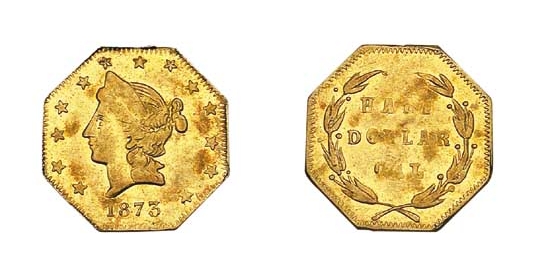
Obverse & Reverse
The 1873 G50C BG-928 is a fascinating artifact from the third and final period of California Fractional Gold production (1872-1882). Unlike the earlier issues of the 1850s, which were struck out of genuine commercial necessity to alleviate a chronic shortage of small-denomination coinage in the rapidly growing state, pieces from this later era served a different purpose. By the 1870s, the initial chaos of the Gold Rush had subsided, and the supply of official United States coinage had become more regular. The Coinage Act of 1864 had explicitly prohibited the private issuance of coinage, but enforcement was lax, allowing jewelers and private minters, primarily in San Francisco, to continue striking these miniature gold pieces. These later-dated fractionals were largely produced as souvenirs, keepsakes for tourists, and items for the burgeoning numismatic and jewelry trades. They captured the nostalgic romance of the Gold Rush era for a new generation. The minters, often anonymous jewelers, created a wide array of varieties with differing designs and dates, catering to this demand. The BG-928, dated 1873, falls squarely into this category. It was never intended to be a primary medium of exchange for a beer or a pinch of supplies, but rather a memento of California's gold heritage. Its extreme rarity today suggests a very small original production, likely struck in a small workshop to fulfill a limited number of orders or to test a particular die pairing. These pieces are a testament to a uniquely Californian phenomenon, representing the tail end of a private minting tradition that began with the desperate need for currency and ended with the commercial appeal of nostalgia.
Associated EventPost-Gold Rush California Economy
Reason For MintingPrimarily struck as a souvenir or novelty item for the jewelry and numismatic trades, not for general circulation.
Minter HistoryThe specific minter or jeweler who produced the BG-928 variety is unknown, a common trait for many California Fractional Gold issues from this period. Production was often carried out in small, back-room operations by craftsmen who did not sign their work. They were responding to a commercial demand for novelty items rather than establishing a formal mint.
Historical SignificanceThe BG-928 represents the final phase of private gold coining in California. Its significance lies not in its use as circulating money, but as a historical token marking the transition of Gold Rush California from a frontier economy to a more established society that was beginning to romanticize and commercialize its own recent past.
N/A
Denomination50 Cents
Minting Period1873
Assayer/MinterUnknown Private Minter
Geographic OriginSan Francisco, California
Obverse DescriptionFeatures a Liberty Head facing left, her hair tied in the back with a band inscribed LIBERTY. She is surrounded by thirteen stars, representing the original colonies. The date, 1873, is below the bust.
Obverse InscriptionLIBERTY
Reverse DescriptionThe denomination '50 CENTS' is displayed within a wreath of two olive branches tied at the bottom with a ribbon. At the top, centered above the denomination, is the inscription 'CALIFORNIA GOLD'.
Reverse InscriptionCALIFORNIA GOLD 50 CENTS
CompositionGold
Stated Fineness Actual Fineness Weight0.25 grams
Diameter10.00 mm
EdgePlain
Unknown, but presumed to be extremely small.
Survival EstimateFewer than 20-30 pieces known.
Rarity ScaleR-6 (Very Rare)
The BG-928 is highly sought after due to its extreme rarity; it is considered the rarest of the four octagonal half-dollar varieties dated 1873. Its appeal lies in its connection to the romantic history of the California Gold Rush, combined with the challenge of acquiring such a scarce issue.
Key VarietiesThere are no major varieties of the BG-928 itself. This is a distinct die marriage classified in the Breen-Gillio reference. No special collector issues like Proof restrikes are known to exist; all known examples are considered original business strikes from the period, though many exhibit Prooflike surfaces due to their intended sale to collectors and jewelers rather than for circulation.
Authentication TipsAuthentic examples are tiny and very thin, consistent with genuine California Fractional Gold. The strike can be uneven, especially on the reverse lettering. Compare the specific die markers—such as the exact positioning of the stars and letters—to high-resolution images of certified examples, as cataloged in the Breen-Gillio reference. Counterfeits are common in this series but often have a soapy, cast-like appearance, incorrect weight or thickness, or feature designs (like bears) not found on genuine period pieces.
Shopping ConsiderationsA premium quality example for this issue is defined by a sharp strike on the Liberty Head and stars, with as much detail as possible in the central reverse legend, which is often softly struck. Look for original, undisturbed surfaces with 'green-gold' or reddish-gold toning and good luster; many surviving examples are Prooflike. Avoid coins that have been harshly cleaned, polished, or previously mounted in jewelry, as evidenced by rim damage or solder marks. Given its rarity, even a problem-free circulated example is a significant find. Certification by a top-tier grading service (PCGS or NGC) is highly recommended for this issue.
A coin's grade is its condition, rated on a 1-70 scale. For rare coins, this is the most critical factor in determining value, as a tiny difference in preservation can mean a huge difference in price.
Relevant Grade TypesOriginal period issues were business strikes. While intended for collectors and not circulation, they are graded on the standard Circulated (AU-58 and below) and Mint State (MS, 60-70) scales. No true Proofs were struck during the original period. However, many Mint State examples were struck from polished dies on polished planchets, resulting in a mirrored finish. These are often designated as 'Prooflike' (PL) by grading services but are distinct from true Proof coinage.
Mint State CharacteristicsAn uncirculated BG-928 will exhibit strong luster, which is often reflective or Prooflike. The highest points of the design, such as Liberty's hair and cheek, will be free of any trace of wear. A sharp strike is desirable, but collectors should expect some softness in the central letters of 'CENTS' on the reverse, as this is characteristic of the issue. Small planchet flaws or handling marks are common due to the minting process and the coins' diminutive size.
Circulated Wear PatternsOn circulated examples, wear will first appear on the high points of Liberty's hair above the eye and ear, and on her cheekbone. The word 'LIBERTY' on the headband will show weakness. On the reverse, the leaves in the wreath and the ribbon bow will be the first elements to show flatness and loss of detail.
Key Factors For ValueFor the BG-928, value is primarily driven by its rarity and grade. Surface quality is paramount; an example with original, uncleaned surfaces and attractive eye appeal will command a significant premium. A sharp strike, especially on the often-weak reverse, adds to the value. The presence of a Prooflike designation can also increase desirability. A CAC sticker, indicating premium quality for the assigned grade, would be a major value-add for a coin of this rarity.
PCGS Price Guide
| Grade | Price | Population |
|---|---|---|
| 50 | $400.00 | 1 |
| 50+ | $425.00 | N/A |
| 53 | $500.00 | N/A |
| 53+ | $525.00 | N/A |
| 55 | $600.00 | 2 |
| 55+ | $650.00 | N/A |
| 58 | $775.00 | 6 |
| 58+ | $850.00 | N/A |
| 60 | $950.00 | N/A |
| 61 | $1,050.00 | 4 |
| 62 | $1,150.00 | 2 |
| 62+ | $1,250.00 | N/A |
| 63 | $1,375.00 | 3 |
| 63+ | $1,550.00 | N/A |
| 64 | $2,000.00 | 1 |