1866 G50C BG-1006 (Regular Strike)
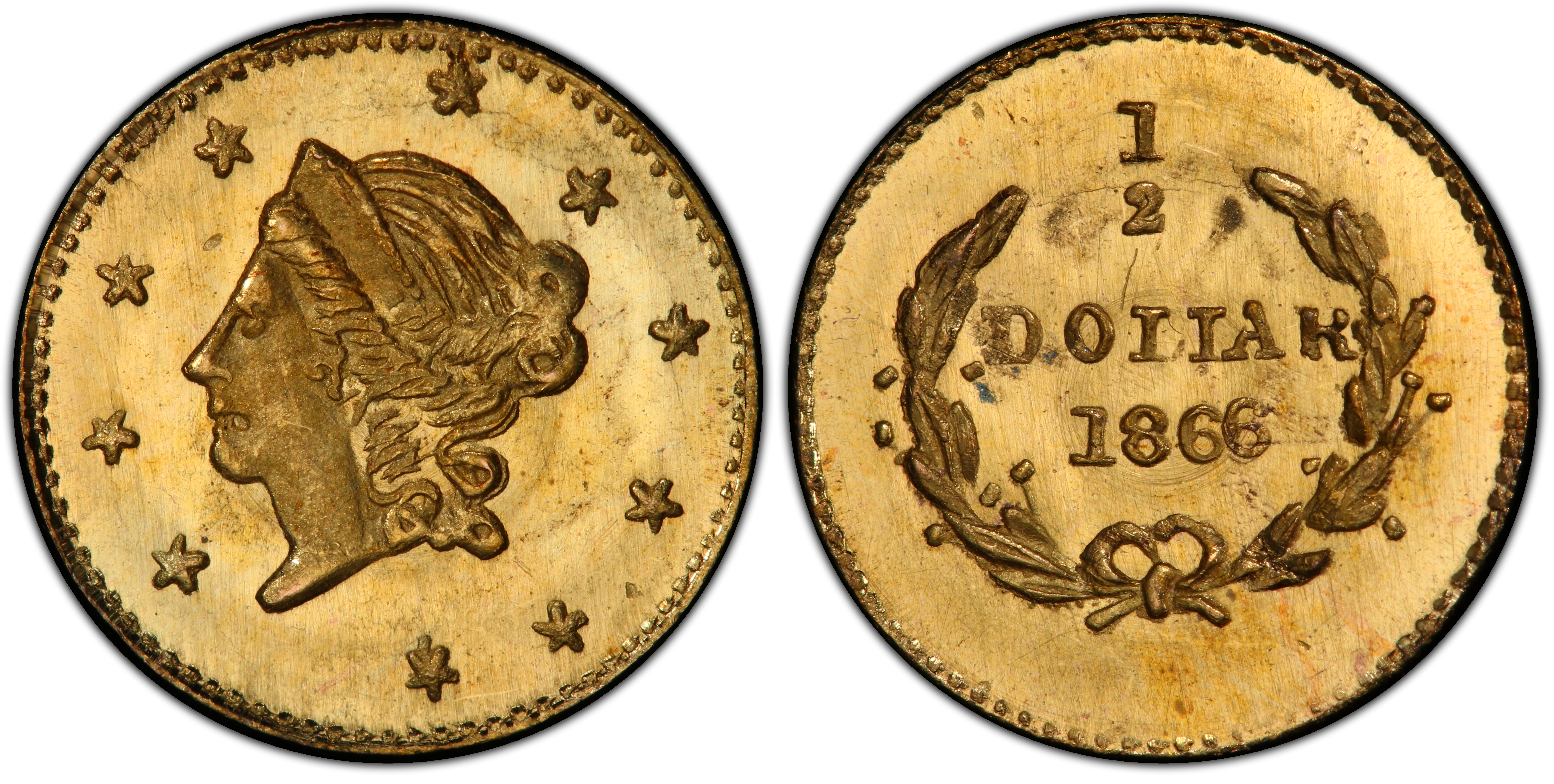
Obverse & Reverse
The 1866 BG-1006 50 Cents is a quintessential example of a 'Period Two' California Fractional Gold piece. By the mid-1860s, the acute shortage of small change that had plagued California during the initial Gold Rush years had largely been resolved by the output of the San Francisco Mint. The impetus for producing these minuscule gold coins shifted from commerce to curiosity. Enterprising jewelers and minting firms, such as Frontier and Company, recognized a burgeoning market for souvenirs and keepsakes that evoked the romance and adventure of the Gold Rush. These 'jeweler's issues,' as they are known, were often produced with less intrinsic gold value than their predecessors and were sold as novelties to tourists and collectors rather than being intended for daily transactions. A crucial characteristic of this period was the common practice of backdating. The Coinage Act of 1864 had made private coinage illegal, but enforcement by the Secret Service was not rigorous until the early 1880s. To circumvent the law and add a veneer of historical legitimacy, producers often used dates from earlier, more permissible years. Authoritative sources, such as the catalog for the Norweb Collection, confirm that although the BG-1006 is dated 1866, it was actually manufactured by Frontier and Company between 1870 and 1871. This places its creation firmly in the souvenir era, a period when the memory of the Gold Rush was a more potent economic force than the dust itself for these small-scale minters. The coin's extreme rarity today (R-7) suggests an exceptionally small original production, likely struck to order or as part of a very limited series for a specific clientele. Its survival is a testament to the collector sentiment that has preserved these tiny, historic echoes of California's foundational economic boom.
Associated EventPost-Gold Rush Economic Expansion & Souvenir Trade
Reason For MintingPrimarily struck as a souvenir or collectible item for the tourist trade, capitalizing on the nostalgia of the California Gold Rush.
Minter HistoryFrontier and Company was a prominent San Francisco jewelry and minting firm active during the 'Period Two' (1859-1882) of California Fractional Gold production. The firm evolved from earlier partnerships involving Pierre Frontier and a Mr. Deviercy. They were prolific producers of these small denomination gold pieces, known for a variety of designs and a business model that successfully transitioned from producing circulating necessity coinage to lucrative souvenir issues. Their work is cataloged extensively in the Breen-Gillio reference, and their pieces are a key component of any comprehensive collection of the series.
Historical SignificanceThe BG-1006 is historically significant not as a circulating coin, but as a tangible artifact of how the California Gold Rush was mythologized and commercialized in the decades that followed. It represents a shift from utilitarian private coinage to a numismatic souvenir market, and its backdating is a direct reflection of the evolving legal landscape surrounding private minting in the United States.
N/A
Denomination50 Cents
Minting Periodc. 1870-1871
Assayer/MinterFrontier and Company
Geographic OriginSan Francisco, California
Obverse DescriptionA medium-sized Liberty Head, facing left, with hair tied in the back. The portrait is surrounded by ten stars, five to the left and five to the right, with the date 1866 below.
Obverse Inscription1866
Reverse DescriptionThe denomination '50 CENTS' is displayed within a simple, open wreath of two branches tied with a bow at the bottom. The wreath is positioned far from the beaded border, creating an open field. The legend 'CALIFORNIA GOLD' appears around the periphery, separated by the top of the wreath, although on some examples the letters can be weakly struck.
Reverse InscriptionCALIFORNIA GOLD 50 CENTS
CompositionGold
Stated Fineness Actual Fineness EdgePlain
Extremely Low
Survival Estimate4-9 pieces known
Rarity ScaleR-7
This coin is a paramount rarity in the California Fractional Gold series. Its appeal lies in its R-7 rating, linking it to the known and respected minter Frontier and Company, and its status as a classic backdated 'Period Two' jeweler's issue. For the advanced specialist, acquiring a BG-1006 is a significant achievement.
Key VarietiesNo major varieties, patterns, or official restrikes of BG-1006 are known. The original issue itself is a special collector striking, being a backdated souvenir produced years after its inscribed date.
Authentication TipsGenuine examples are defined by specific die characteristics. Look for spindly die cracks and stress marks in the peripheral areas on both the obverse and reverse, which are features of the die state. The strike on the reverse can be soft, particularly on some letters of the legend. The obverse features a distinctive medium Liberty head with exactly 10 stars. Any piece with a different star count, design style, or without evidence of the known die markers should be considered highly suspect.
Shopping ConsiderationsGiven its extreme rarity, any opportunity to acquire a BG-1006 is noteworthy. A premium quality example would be one with a balanced, bold strike on the central devices, even if some peripheral lettering is soft. Look for original, undisturbed surfaces, often described as having a 'green-gold' hue. Post-production marks, such as pinscratches on the portrait, are noted on some known examples and should be factored into the price. Due to the high likelihood of counterfeits for such a rare piece, third-party certification by PCGS or NGC is an absolute necessity for any buyer.
A coin's grade is its condition, rated on a 1-70 scale. For rare coins, this is the most critical factor in determining value, as a tiny difference in preservation can mean a huge difference in price.
Relevant Grade TypesOriginal period issues were business strikes, although as jeweler's pieces they were not intended for long-term circulation and are found in Circulated (1-58) and, more commonly for this rarity, Mint State (MS, 60-70) grades. No true Proofs (PR/PF) were struck during the original manufacturing period. Any piece described as 'prooflike' refers to the reflectivity of the fields and not to the method of manufacture.
Mint State CharacteristicsUncirculated examples of BG-1006 are judged on the sharpness of the strike, the quality of the luster, and surface preservation. The strike is often well-balanced on the portrait but can show softness on the reverse legend. Luster is typically bright and satiny, sometimes with prooflike or reflective fields. Due to the tiny size and handling over time, even high-grade examples may show minuscule contact marks or faint hairlines; a truly 'clean' surface commands a significant premium.
Circulated Wear PatternsWear first appears on the highest points of Liberty's hair, cheek, and the leaves of the wreath. On moderately worn examples, the finer hair details will merge, and the inscription '50 CENTS' will show flattening. In lower grades, the stars and legends will begin to fade into the fields.
Key Factors For ValueFor the BG-1006, rarity is the primary value driver. After that, grade and eye appeal are paramount. An example with a sharp strike, minimal distracting marks, and original golden or greenish-gold surfaces will command the highest prices. The presence of known, as-struck die cracks is a positive diagnostic feature, not a flaw. A CAC sticker would provide strong confirmation of quality for the assigned grade and would add a significant premium.
PCGS Price Guide
| Grade | Price | Population |
|---|---|---|
| 55 | $300.00 | 4 |
| 55+ | $310.00 | N/A |
| 58 | $325.00 | 3 |
| 58+ | $335.00 | N/A |
| 60 | $350.00 | 2 |
| 61 | $365.00 | 3 |
| 62 | $400.00 | 7 |
| 62+ | $425.00 | N/A |
| 63 | $525.00 | 9 |
| 63+ | $575.00 | N/A |
| 64 | $650.00 | 9 |
| 64+ | $825.00 | N/A |
| 65 | $1,250.00 | 3 |
| 65+ | $1,350.00 | N/A |
| 66 | $1,500.00 | 1 |
| 66+ | $1,750.00 | 1 |
| 67 | $2,000.00 | N/A |