1852 G50C BG-962 (Regular Strike)
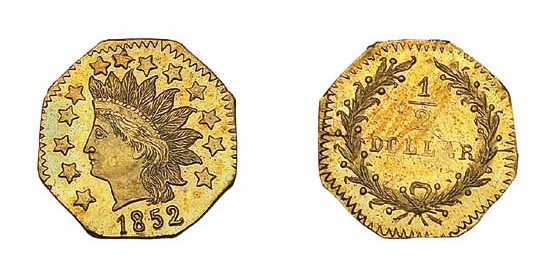
Obverse & Reverse
The California Gold Rush, ignited by the 1848 discovery at Sutter's Mill, triggered a massive influx of over 300,000 people to California, famously known as the 'forty-niners.' This explosive population growth created vibrant but chaotic boomtowns. A severe, chronic shortage of circulating small-denomination coinage plagued daily commerce. Gold dust, the primary medium of exchange, was imprecise and inconvenient for small transactions; a 'pinch' of dust for a drink was a common but highly variable measure. To address this critical need, private jewelers and metallurgists in San Francisco began striking their own coins in 1852, creating the fascinating series known as California Fractional Gold. These pieces, issued in 25C, 50C, and $1 denominations, were not official government coinage but were indispensable for lubricating the wheels of commerce. The BG-962 is a 'Period One' (1852-1857) issue, a designation for pieces believed to have been genuinely intended for circulation, unlike the later 'Period Two' issues (1858-1882) which were primarily made as souvenirs. The production methods were often crude; most were hand-struck using a hammer method, where a top die was struck with a sledgehammer onto a planchet resting on a bottom die. This often resulted in uneven strikes and weakly detailed areas. These fractional gold coins, while containing gold, were technically tokens as their intrinsic value was typically less than their face value. Their legality was ambiguous until the Coinage Act of 1864 expressly forbade private coinage, though enforcement in the West was lax until 1883. The BG-962 is a product of this unregulated, necessity-driven environment. Its octagonal shape and Indian Head motif were likely chosen to inspire confidence and mimic the familiar designs of official U.S. gold coinage. Today, these tiny gold pieces are treasured numismatic artifacts that provide a direct link to the tumultuous and enterprising spirit of the Gold Rush.
Associated EventCalifornia Gold Rush
Reason For MintingTo alleviate a severe shortage of small change for daily commercial transactions in Gold Rush-era California.
Minter HistoryThe specific minter of BG-962 remains unidentified, a common trait for many Period One California Fractional Gold issues. However, stylistic analysis and die links often point towards a small group of French jewelers working in San Francisco. Leading numismatic researchers, such as Walter Breen and Ronald J. Gillio (for whom the 'BG' attribution system is named), have suggested that Antoine Louis Nouizillet was a likely candidate for manufacturing many of these early pieces due to similarities in design elements and manufacturing techniques. These minters operated in a competitive and legally gray area, focusing on utility and profit rather than lasting recognition, hence the frequent anonymity.
Historical SignificanceThe BG-962, as a Period One California Fractional Gold piece, is a tangible relic of the makeshift economy that arose from the California Gold Rush. It represents a private solution to a government failure—the inability to supply adequate coinage to the booming West Coast. These coins facilitated everyday life, allowing for standardized pricing and transactions beyond the barter system of gold dust. They are historically significant not just as coins, but as artifacts of frontier entrepreneurship and the economic chaos that defined one of America's most transformative eras.
K-N/A
DenominationG50C (Gold 50 Cents)
Minting Period1852
Assayer/MinterUnknown, possibly Antoine Louis Nouizillet
Geographic OriginSan Francisco, California
Obverse DescriptionA stylized 'Indian Head' portrait facing left, often referred to as a Liberty Head with an Indian headdress. The portrait is surrounded by thirteen six-pointed stars, representing the original colonies. The design is simple and somewhat crudely engraved, characteristic of the era's private minting techniques.
Obverse Inscription Reverse DescriptionThe central device is the denomination '50 CENTS' arranged in two lines. A decorative element or wreath-like design typically surrounds the denomination. The octagonal shape of the planchet is a key feature of this variety.
Reverse Inscription50 CENTS
CompositionGold
Stated Fineness Actual FinenessVaries, but typically ranges from .500 to .850 fine. Period One issues generally had higher fineness than later souvenir pieces.
EdgePlain
Unknown
Survival EstimateFewer than 15 known
Rarity ScaleR-7- (Low R-7)
This coin is highly sought after for its extreme rarity, its status as a 'Period One' circulating issue, and its direct connection to the California Gold Rush. The octagonal shape and Indian Head design add to its distinctive charm and collector appeal. It represents one of the quintessential types in a highly popular and historically rich collecting field.
Key VarietiesThe primary variety is the Regular Strike, BG-962. A Prooflike (PL) variant, designated BG-962 PL, is also recognized by PCGS and represents examples with unusually reflective surfaces. There are no known official restrikes or patterns associated with this 19th-century private issue. Later 20th-century copies and souvenir 'charms' exist but are not considered numismatic varieties; they are typically undenominated to comply with the law.
Authentication TipsAuthentic examples are die-struck, not cast. Look for sharp, albeit sometimes weak, details and characteristic die flow lines. The lettering and stars should be consistent with known genuine examples. A key diagnostic for BG-962 is the faintness of the 'LL' in 'DOLLAR' on the reverse, a result of metal flow during the strike. Counterfeits are common and may appear soapy or have incorrect details, weight, or specific gravity. The octagonal cuts should be sharp, not rounded. Comparison with high-resolution images from major grading services is essential.
Shopping ConsiderationsFor a premium quality BG-962, a potential buyer should prioritize surface preservation and strike. Look for an example with minimal distracting marks and as much original luster as possible. Flashy, prooflike surfaces command a significant premium. The strike is often weak on the high points of the Indian's portrait and on the reverse lettering due to the hammer-striking process. A well-centered strike is also desirable. Avoid examples that have been harshly cleaned, polished, or show signs of being mounted in jewelry, which was a common fate for these small gold pieces. Original, unadulterated surfaces, even with some honest wear, are far more valuable than cleaned or damaged specimens.
A coin's grade is its condition, rated on a 1-70 scale. For rare coins, this is the most critical factor in determining value, as a tiny difference in preservation can mean a huge difference in price.
Relevant Grade TypesOriginal period issues were business strikes intended for circulation, found in Circulated (1-58) and Mint State (MS, 60-70) grades. No true Proofs were struck during the original minting period. The 'Prooflike' (PL) designation is sometimes applied to business strikes that exhibit exceptionally mirrored surfaces from polished dies, but these are a subset of Mint State coins and not a separate striking method.
Mint State CharacteristicsAn uncirculated BG-962 will show original mint luster, which is often satiny or slightly reflective. Strike quality is a major factor; specimens are often weakly struck on the Indian's headdress and the denomination on the reverse. A premium MS example will be well-centered and show a sharper-than-average strike. Small planchet flaws or adjustment marks made prior to striking are common for this series and are generally accepted by collectors if not overly distracting.
Circulated Wear PatternsWear first appears on the highest points of the design: the cheek and the details of the headdress on the obverse, and the numerals '50' on the reverse. On more heavily worn examples, the stars will begin to merge with the fields and the reverse lettering will become faint, especially the outer wreath elements.
Key Factors For ValueRarity is the primary driver of value for this variety. Beyond that, the specific grade is paramount. A high-grade Mint State example (e.g., MS65 or MS66) can be worth multiples of a lower-grade MS coin. Surface quality is critical; coins with clean, original surfaces and attractive, prooflike fields are prized. The presence of a CAC sticker, indicating premium quality for the grade, adds a significant premium. Conversely, coins that have been cleaned, damaged, or removed from jewelry are heavily penalized in the market.
PCGS Price Guide
| Grade | Price | Population |
|---|---|---|
| 60 | $1,000.00 | N/A |
| 61 | $1,100.00 | N/A |
| 62 | $1,200.00 | 1 |
| 62+ | $1,350.00 | N/A |
| 63 | $1,500.00 | 4 |
| 63+ | $1,675.00 | N/A |
| 64 | $1,900.00 | 1 |
| 64+ | $2,250.00 | N/A |
| 65 | $3,000.00 | 3 |
| 65+ | $3,250.00 | N/A |
| 66 | $3,850.00 | 1 |