1854 G25C BG-105, PL (Regular Strike)
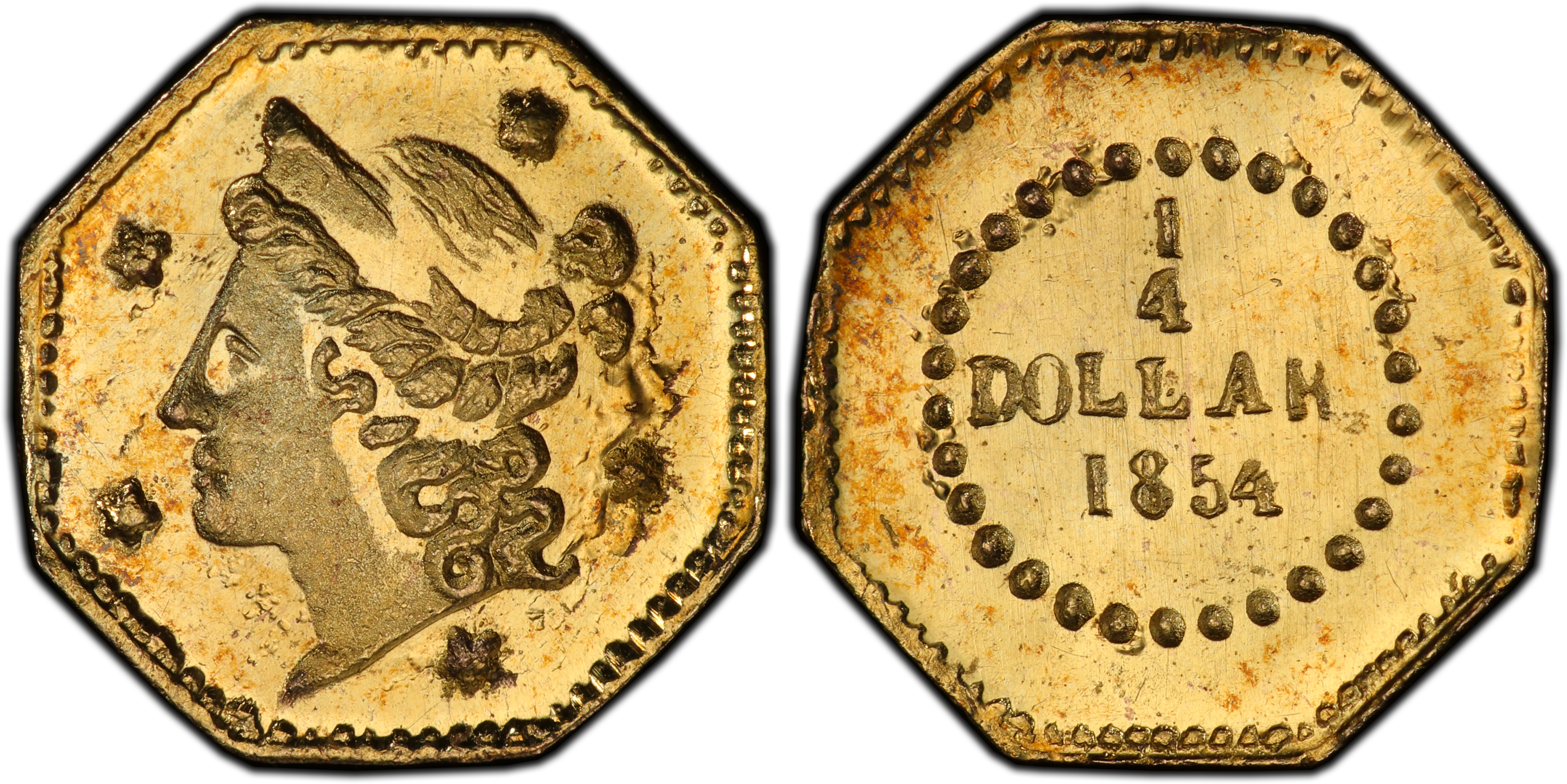
Obverse & Reverse
The California Gold Rush, initiated by the discovery of gold at Sutter's Mill in 1848, precipitated a massive influx of people to the West Coast, creating a booming economy virtually overnight. This rapid expansion, however, was not matched by an adequate supply of federal coinage, leading to a severe, chronic shortage of small change for daily transactions. Commerce was often conducted with pinches of gold dust, a highly imprecise and unsatisfactory method. To fill this critical monetary void, private jewelers and metallurgists in San Francisco began striking their own small-denomination coins from native California gold in 1852. These issues, now known as California Fractional Gold, became an essential, albeit unofficial, part of the region's currency. The 1854 BG-105 25 Cents piece emerged during this initial, fervent phase of private coining, now categorized by numismatists as 'Period One' (1852-1857). Coins from this period are generally considered to have been genuinely intended for circulation, unlike many later 'Period Two' issues which were often underweight and made more as souvenirs. The BG-105, an octagonal coin featuring a Liberty Head design reminiscent of contemporary federal gold dollars, was likely produced by Gaime, Guillemot & Co., a firm of French jewelers active in San Francisco. These tiny coins facilitated everyday purchases, allowing miners and merchants to transact business more efficiently. The primitive minting technology of the time, often a simple sledgehammer striking a die, resulted in coins of varying strike quality. By 1856-1857, the San Francisco Mint was in full operation, producing sufficient federal coinage and rendering these private issues obsolete. The Coinage Act of 1864 officially outlawed private currency, cementing the fate of these fascinating and historically significant pieces. Today, the BG-105 and its contemporaries are prized by collectors as tangible relics of the chaotic and enterprising spirit of the California Gold Rush.
Associated EventCalifornia Gold Rush
Reason For MintingTo alleviate a severe shortage of small-denomination coinage for everyday commercial transactions in Gold Rush-era California.
Minter HistoryWhile not definitively signed, the BG-101 to BG-107 group of fractional gold pieces, including the BG-105, is attributed with high confidence to Gaime, Guillemot & Co. This firm of French jewelers and watchmakers was active in San Francisco during the early 1850s. Like several other French expatriate jewelers, they applied their metallurgical skills to meet the regional demand for coinage, producing some of the earliest and most crudely beautiful examples of California Fractional Gold before the U.S. Branch Mint's output stabilized the local economy.
Historical SignificanceThe BG-105 is a key representative of 'Period One' California Fractional Gold, a series that provides a direct monetary link to the socio-economic conditions of the Gold Rush. These privately issued coins demonstrate the ingenuity and necessity-driven enterprise that characterized the era before the full establishment of federal authority and services in the West.
N/A
Denomination25 Cents
Minting Period1854
Assayer/MinterProbably Gaime, Guillemot & Co.
Geographic OriginSan Francisco, California
Obverse DescriptionA crude but charming Liberty Head, facing left, styled after the U.S. gold dollar. The head is large for the planchet and is surrounded by five, five-pointed stars.
Obverse Inscription[None]
Reverse DescriptionThe reverse is dominated by the date '1854' with the denomination '25 CENTS' below it. The inscription is enclosed within a circle of periods or beads. There is no fraction bar between '25' and 'CENTS'.
Reverse Inscription1854 25 CENTS
CompositionGold
Stated Fineness Actual FinenessTypically around .880 fine, reflecting the natural alloy of unrefined California gold which contained significant amounts of silver.
Weight0.25 grams
Diameter9.50 mm
EdgePlain
Unknown
Survival Estimate201-300
Rarity ScaleR-4 (Per Breen-Gillio)
This coin is highly sought after as an authentic 'Period One' issue, meaning it was made for actual circulation during the peak of the Gold Rush. Its crude, octagonal design, historical importance, and direct connection to the frontier economy make it a classic and desirable piece of Americana.
Key VarietiesThe primary variety is the regular business strike. The 'PL' (Prooflike) designation, as specified in the user's request, is not a separate variety but a desirable surface characteristic found on a minority of well-struck coins from fresh dies, exhibiting reflective fields. No contemporary proofs or patterns are known. Later restrikes by figures like Herman Kroll exist for other Period One issues, but none are specifically cataloged for BG-105. Collectors should be aware of modern replicas and souvenir tokens which are not genuine California Fractional Gold.
Authentication TipsGenuine BG-105 coins have a specific die alignment and crude but consistent details in the Liberty portrait and reverse lettering. The weight should be approximately 0.25 grams. Counterfeits are common; many are cast and will have mushy details and possibly casting bubbles or seams. Others are modern strikes from fantasy dies. Authentication by a major grading service (PCGS or NGC) is strongly recommended, as they have extensive databases of genuine examples for comparison.
Shopping ConsiderationsFor a premium quality BG-105, look for a bold strike, especially on Liberty's hair details and the date. Many examples are weakly struck. Original, lustrous surfaces are paramount; coins with a 'prooflike' (PL) designation command significant premiums due to their reflectivity and eye appeal. The natural gold color should be a slightly pale, reddish-yellow due to the silver content. Avoid examples that have been harshly cleaned, which strips the original surface, or those with scratches, rim bumps, or tooling. A CAC sticker on a certified holder indicates superior quality for the grade and adds value.
A coin's grade is its condition, rated on a 1-70 scale. For rare coins, this is the most critical factor in determining value, as a tiny difference in preservation can mean a huge difference in price.
Relevant Grade TypesOriginal BG-105 issues were business strikes intended for circulation and are found in Circulated (1-58) and Mint State (MS, 60-70) grades. No proofs were struck during the original minting period. The 'PL' or Prooflike designation is applied to business strikes that were made with highly polished dies, resulting in mirror-like fields. These are not a separate issue but are a highly desirable subset of the business strike population.
Mint State CharacteristicsAn uncirculated BG-105 will exhibit full mint luster, which is typically satiny and slightly reflective. Due to the primitive striking methods, even high-grade Mint State examples can show some weakness in the strike, particularly on the highest points of Liberty's hair and the reverse digits. The surfaces are very soft and prone to contact marks; a premium MS example will be relatively free of distracting marks in the primary focal areas. Prooflike examples are rare and highly valued, identified by their mirrored fields and sometimes frosted devices.
Circulated Wear PatternsWear first appears on the high points of Liberty's hair, especially the strands above the ear and at the coronet. The cheek and the eyebrow are also susceptible. On the reverse, the numerals of the date and the letters in 'CENTS' will show the first signs of flattening. In lower grades (VF and below), the stars on the obverse will begin to lose their points and merge with the field.
Key Factors For ValueThe primary value drivers are grade and surface quality. An uncirculated example is worth many times more than a circulated one. Within a grade, coins with original, uncleaned surfaces and strong luster command premiums. The strike is critical; well-centered and sharply struck pieces are more valuable than their softly struck counterparts. Exceptional eye appeal, sometimes enhanced by a hint of reddish toning from the alloy, adds value. Finally, certification by PCGS or NGC is standard, and a CAC sticker for this issue significantly increases its market price by confirming its quality for the assigned grade.
PCGS Price Guide
| Grade | Price | Population |
|---|---|---|
| 63 | $675.00 | N/A |
| 63+ | $725.00 | N/A |
| 64 | $800.00 | N/A |
| 64+ | $900.00 | N/A |
| 65 | $1,050.00 | 1 |
| 65+ | $1,500.00 | N/A |
| 66 | $2,250.00 | 2 |
| 66+ | $3,000.00 | N/A |
| 67 | $4,500.00 | 1 |