1875 G25C BG-846 (Regular Strike)
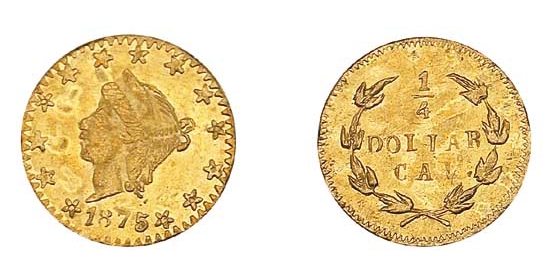
Obverse & Reverse
The 1875 25 Cents, cataloged as Breen-Gillio 846, is a quintessential example of a 'Period Two' California Fractional Gold piece. The story of these diminutive coins is rooted in the chaos and opportunity of the California Gold Rush. Following the discovery of gold in 1848, a massive influx of prospectors and merchants created a vibrant but chaotic economy. While large transactions could be settled in gold dust or with the hefty private slugs being produced, there was a severe, chronic shortage of small denomination coinage for everyday commerce. A pinch of gold dust for a drink was an inexact and wasteful system. To fill this void, private jewelers and metallurgists, primarily in San Francisco, began striking their own small-denomination gold coins in 25-cent, 50-cent, and one-dollar sizes starting in 1852. The earliest 'Period One' (1852-1856) issues were genuinely intended to circulate, though they were often underweight. By the time BG-846 was produced in 1875, the nature of these pieces had evolved. The Coinage Act of 1864 had officially prohibited private coinage, but enforcement was lax until the early 1880s. In this interim 'Period Two' (1859-1882), production continued, but the pieces became lighter and their primary function shifted from circulation to that of souvenirs and novelty items for tourists and locals alike. They were tangible, affordable mementos of the Gold Rush's fading glory. These so-called 'jeweler's issues' often featured crude but charming renditions of federal coinage designs, struck with hand-cut dies and manual presses, resulting in significant variation in quality. The BG-846, with its dated 1875, was produced under this semi-legal ambiguity. Its very existence was an act of commercial defiance and entrepreneurial spirit, catering to a market that desired a tangible piece of California's golden identity long after the initial fever had subsided. Today, these pieces are not just numismatic rarities but artifacts of a unique economic period where private enterprise directly addressed a government failure to provide adequate currency for a booming frontier society.
Associated EventCalifornia Gold Rush
Reason For MintingInitially to alleviate a severe shortage of small change, these later issues served primarily as popular souvenirs and keepsakes.
Minter HistoryThe specific minter or jeweler who produced the BG-846 die pair is unknown, which is characteristic of many 'Period Two' California Fractional Gold issues. These pieces were often made anonymously or with simple initials to avoid scrutiny from federal authorities following the Coinage Act of 1864. The makers were typically skilled jewelers and artisans based in San Francisco who possessed the engraving and striking capabilities to produce these small, intricate pieces for the robust souvenir market.
Historical SignificanceBG-846 is significant as a representative of the later, post-Civil War era of private California gold coinage. It demonstrates the transition of these pieces from utilitarian coins of necessity to commercial souvenir items, reflecting a nostalgia for the Gold Rush era while still existing in a grey area of minting legality. Its rarity underscores the small-scale, almost clandestine, nature of its production.
N/A
Denomination25 Cents
Minting Period1875
Assayer/MinterUnknown Private Minter
Geographic OriginSan Francisco, California
Obverse DescriptionA small Liberty Head facing left, modeled after the contemporary U.S. gold coinage by James B. Longacre. The portrait is typically simple, with hair tied in a bun. Thirteen stars encircle the portrait, representing the original colonies. The date '1875' is below the bust truncation.
Obverse Inscription1875
Reverse DescriptionThe denomination '25 CENTS' is enclosed within a wreath. The wreath is composed of two branches tied with a bow at the bottom. The design is utilitarian and conveys the value clearly.
Reverse Inscription25 CENTS
CompositionGold
Stated Fineness Actual FinenessVariable, but typically lower than federal coinage, often ranging from .500 to .800 fine. Fineness was not a primary concern for these souvenir-era pieces.
Diameter9.00 mm
EdgePlain
Unknown
Survival EstimateFewer than 30 known examples
Rarity ScaleR-6 (13-30 known)
The BG-846 is highly sought after due to its status as a genuine, denominated Gold Rush-era coin. Its high rarity (R-6), charmingly crude design, and direct connection to the romantic history of the California frontier make it a prize for specialists in territorial and private gold.
Key VarietiesThe BG-846 is a specific die marriage and has no major recognized varieties from the period of issue. Unlike federal coinage, there were no proof strikings or patterns produced for commercial sale. Collectors focus on die states, with earlier strikes showing sharper details and later strikes potentially exhibiting minute die cracks or erosion.
Authentication TipsGenuine pieces often exhibit a somewhat weak or uneven strike due to the use of manual presses. The luster can be prooflike or satiny but is often subdued. Look for the characteristic softness and occasional planchet flaws of genuine gold; many contemporary counterfeits and modern replicas are brass-based and have a harder, more uniform appearance. Genuine pieces will have the denomination clearly stated; later tokens often omit the word 'CENTS' or 'DOLLAR'. Any piece that appears too perfectly struck should be viewed with suspicion. Third-party grading is highly recommended.
Shopping ConsiderationsFor a premium quality example, seek out a specimen with a bold strike, particularly on the highest points of Liberty's hair and the leaves of the wreath. Original, uncleaned surfaces are paramount; many of these tiny coins were harshly cleaned or used as jewelry, and finding one with intact original skin commands a significant premium. Look for pleasing, original reddish-gold or deep yellow-gold toning. Avoid examples that are bent, holed, or show evidence of being mounted in jewelry. Even on high-grade pieces, some planchet roughness or adjustment marks can be acceptable and are part of the coin's character.
A coin's grade is its condition, rated on a 1-70 scale. For rare coins, this is the most critical factor in determining value, as a tiny difference in preservation can mean a huge difference in price.
Relevant Grade TypesOriginal BG-846 coins were business strikes intended for commerce or sale as souvenirs, and are found in Circulated (1-58) and Mint State (MS, 60-70) grades. No true Proofs were struck during the original period of issue. The small, protected size of these coins means that a relatively high proportion survive in uncirculated grades compared to larger circulating coinage.
Mint State CharacteristicsAn uncirculated BG-846 is defined by the presence of original mint luster. However, the quality of that luster and the strike can vary dramatically. A typical Mint State example may still show weakness on the stars or the details of the wreath. Premium examples will have a full, sharp strike across all elements and vibrant, often prooflike or satiny luster. Due to the softness of the gold and loose handling, small contact marks (bag marks) are common even on high-grade specimens and are expected; the key is that they are not distracting.
Circulated Wear PatternsWear first appears on the highest points of the design. On the obverse, check the hair above Liberty's eye and ear, her cheek, and the tips of the stars. On the reverse, the high points of the wreath's leaves and the bow will be the first areas to show flatness and loss of detail. On lower grade examples, the legends will begin to soften and merge with the fields.
Key Factors For ValueBeyond the numerical grade, value is driven by three key factors: strike, surface, and eye appeal. A sharply struck coin with minimal distracting marks will always be worth more than a weakly struck coin of the same grade. Original, uncleaned surfaces are essential and command huge premiums. Finally, eye appeal—a combination of attractive original toning and a crisp overall appearance—can make one coin far more desirable than another. A CAC sticker on this issue is highly valued as confirmation of premium quality for the grade.
PCGS Price Guide
| Grade | Price | Population |
|---|---|---|
| 58 | $375.00 | 2 |
| 58+ | $425.00 | N/A |
| 60 | $550.00 | 1 |
| 61 | $650.00 | 4 |
| 62 | $1,000.00 | 6 |
| 62+ | $1,100.00 | N/A |
| 63 | $1,450.00 | 3 |
| 63+ | $1,750.00 | N/A |
| 64 | $2,500.00 | N/A |