1870 G25C BG-807 (Regular Strike)
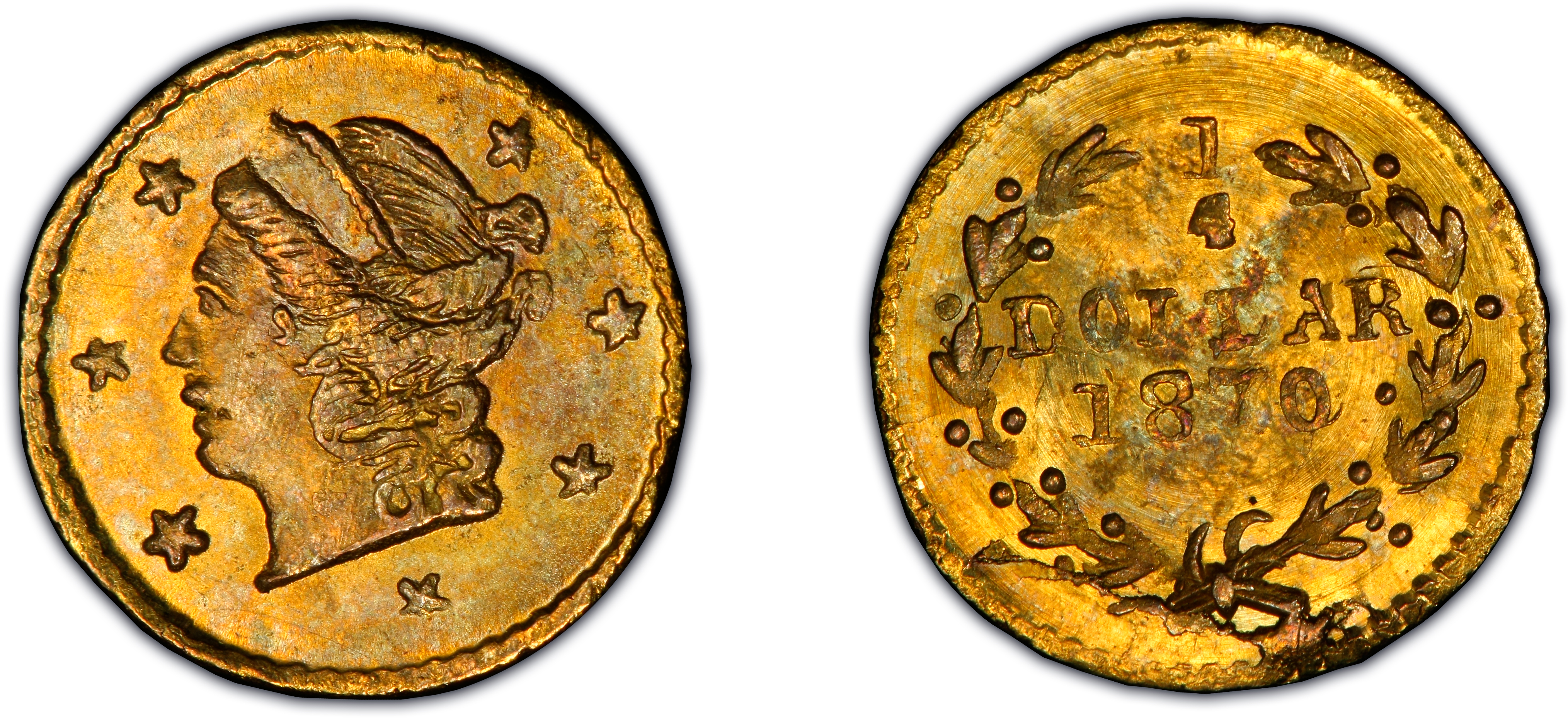
Obverse & Reverse
The 1870 G25C BG-807 is a quintessential example of a 'Period Two' California Fractional Gold piece, also known to numismatists as a 'Suppressed Jeweler's Issue.' By 1870, the chaotic, frontier economy of the initial Gold Rush had matured. The San Francisco Mint, operating since 1854, was producing ample federal coinage for commerce, rendering the initial need for privately minted small-denomination gold obsolete. However, a thriving market had emerged for these diminutive gold pieces as souvenirs and keepsakes. Jewelers in San Francisco, many of whom were of French origin, capitalized on this demand by producing vast numbers of 25-cent, 50-cent, and dollar-denominated pieces. These later issues, struck from 1858 to 1882, were not intended to and did not seriously circulate as money. Their gold content was often significantly less than their face value, and their tiny size made them impractical for daily transactions. The Coinage Act of 1864 had explicitly outlawed private coinage, but enforcement in California was lax until the early 1880s. This legal ambiguity allowed jewelers to continue their production, often backdating coins to pre-1864 dates to feign legality. The 1870 BG-807 was born into this environment—a commercial product designed to capture the romance of the Gold Rush for tourists and those back East. The production methods were often rudimentary, employing hand-operated presses which resulted in coins of varying strike quality. For this specific variety, a prominent die failure in the form of a crack on the reverse die limited its production, contributing to its significant rarity today. The eventual crackdown by the Secret Service in the early 1880s brought an end to the era of these fascinating and historically significant private issues.
Associated EventPost-Gold Rush California Commerce
Reason For MintingPrimarily created as souvenirs and novelties for the jewelry trade, capitalizing on the mystique of the California Gold Rush.
Minter HistoryThe specific maker of the BG-807 variety is unknown, as was common for many Period Two 'jeweler's issues.' San Francisco at the time was home to several jewelers who produced fractional gold, such as Robert B. Gray & Co., but the dies for this variety are not definitively attributed. These minters operated small, private enterprises, creating their own dies and striking pieces on demand for the souvenir market.
Historical SignificanceThe BG-807 represents a transitional phase in private minting, shifting from a necessary component of a specie-starved economy to a commercial enterprise producing numismatic souvenirs. It is a tangible link to 1870s San Francisco, reflecting the city's growing manufacturing base and its identity as a hub of tourism and trade. Its very existence highlights a period of lax federal oversight on private coinage, a practice that would soon be extinguished.
N/A
Denomination25 Cents
Minting Period1870
Assayer/MinterAnonymous
Geographic OriginSan Francisco, California
Obverse DescriptionA head of Liberty facing left, her hair tied in a bun with a coronet inscribed LIBERTY. She is surrounded by thirteen stars, representing the original colonies. The date, 1870, is positioned below the bust.
Obverse InscriptionLIBERTY
Reverse DescriptionThe denomination '25 CENTS' is displayed within a wreath of two olive branches. The wreath is tied at the bottom with a bow. A notable diagnostic is a prominent die break through the lower portion of the wreath.
Reverse Inscription25 CENTS
CompositionGold
Stated Fineness Actual Fineness Weight0.25 grams
Diameter9.80 mm
EdgePlain
Extremely low, likely fewer than 500.
Survival EstimateFewer than 15 known to exist in all grades. Population reports from PCGS and NGC combined show approximately 10-12 examples certified.
Rarity ScaleR-7 (Very Rare)
This coin is highly prized for its extreme rarity and connection to the romanticized post-Gold Rush era. As a Period Two issue, it is a key component for specialists seeking to build a comprehensive set of California Fractional Gold varieties. Its status as the plate coin in the Breen-Gillio reference adds to its desirability.
Key VarietiesThe BG-807 is a singular variety struck in 1870. No major varieties, patterns, or official restrikes are known. All known examples are business strikes from the original period of issue.
Authentication TipsThe primary diagnostic is a prominent, arcing die break on the reverse, running through the lower portion of the wreath. This feature should be sharp and integral to the coin. Counterfeits are common in the Cal Gold series; they often have a soapy appearance, incorrect weight, or mushy details. Authentication by a major grading service (PCGS or NGC) is highly recommended.
Shopping ConsiderationsA premium quality BG-807 will exhibit a sharp strike on the central devices, particularly on Liberty's hair and the leaves of the wreath. High-grade examples display a satiny, apricot-gold luster. Due to the manufacturing process, a slight weakness or sinking in the center of the reverse, opposite the highest point of the obverse portrait, is common and generally accepted. Look for examples free of distracting marks, cleaning, or jewelry mounting, as these pieces were often repurposed. Original, unmolested surfaces are paramount.
A coin's grade is its condition, rated on a 1-70 scale. For rare coins, this is the most critical factor in determining value, as a tiny difference in preservation can mean a huge difference in price.
Relevant Grade TypesAll original 1870 BG-807 coins are business strikes, intended for sale as souvenirs rather than circulation. They are found in both Circulated (1-58) and, more commonly, Mint State (MS, 60-70) grades. No Proofs (PR/PF) of this variety were struck during the original period of issue, and no later-date Proof restrikes are known to exist.
Mint State CharacteristicsAn uncirculated BG-807 typically exhibits a soft, satiny luster rather than a hard, frosty one. The strike can be uneven; complete sharpness across all design elements is rare. Expect some softness on the highest points of Liberty's hair and the reverse wreath. A slight buckling of the planchet or weakness on the central reverse is a common characteristic of the issue and not necessarily a detriment. Small, mint-made planchet flaws are also sometimes seen.
Circulated Wear PatternsOn circulated examples, wear first appears on the high points of Liberty's cheek, coronet, and hair bun. On the reverse, the highest leaves of the wreath and the bow will show initial friction and flattening. In lower grades (VF and below), the word LIBERTY on the coronet and the finer details of the leaves will become faint.
Key Factors For ValueRarity is the primary driver of value. For a given grade, eye appeal is crucial. An example with rich, original golden-orange toning and clean surfaces will command a significant premium over a harshly cleaned or dull specimen. The sharpness of the strike, despite its typical weaknesses, is a key differentiator. Coins that are well-centered and show strong details for the issue are highly sought after. A CAC sticker, indicating premium quality for the grade, adds a substantial premium for this rare variety.
PCGS Price Guide
| Grade | Price | Population |
|---|---|---|
| 58 | $750.00 | 1 |
| 58+ | $780.00 | N/A |
| 60 | $900.00 | 1 |
| 61 | $1,000.00 | N/A |
| 62 | $1,100.00 | 2 |
| 62+ | $1,250.00 | N/A |
| 63 | $1,500.00 | 2 |
| 63+ | $1,650.00 | N/A |
| 64 | $2,000.00 | 8 |
| 64+ | $2,250.00 | N/A |
| 65 | $2,750.00 | 1 |