1854 G50C BG-305, PL (Regular Strike)
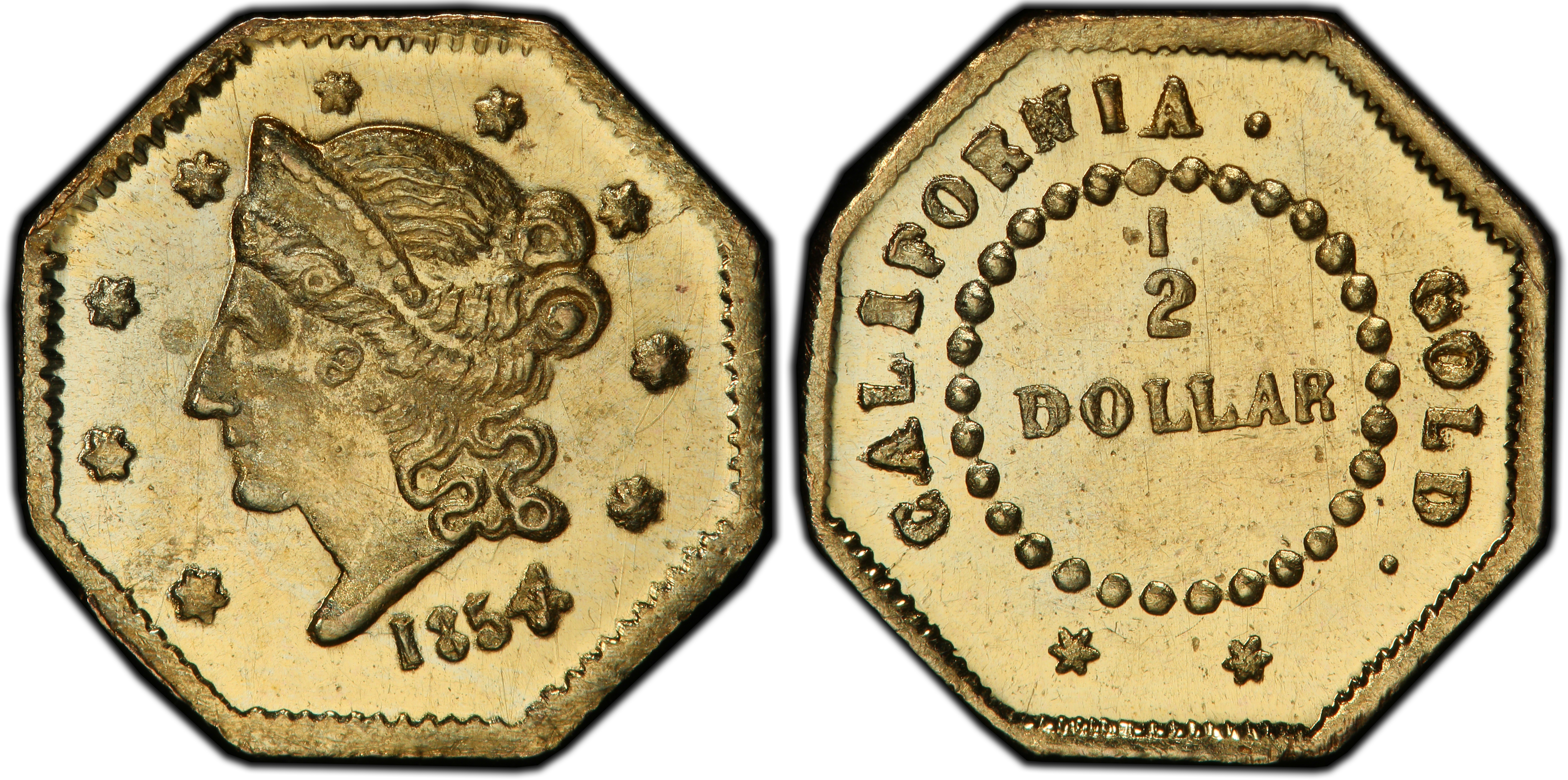
Obverse & Reverse
The 1854 Octagonal Liberty Head 50 Cents, cataloged as Breen-Gillio 305, is a quintessential artifact of the California Gold Rush's 'Period One' (1852-1857) private coinage. The discovery of gold at Sutter's Mill in 1848 triggered a massive influx of population and gold dust into California, but a severe shortage of circulating small-denomination coinage created a chasm in the region's burgeoning economy. Simple transactions were often conducted with pinches of gold dust, an inaccurate and cumbersome method. Federal efforts were slow to respond; the San Francisco Mint would not open until April 1854 and its initial output was insufficient to meet the rampant demand. In this vacuum, private minters, primarily jewelers and assayers in San Francisco with the requisite skills in metallurgy, stepped in to fill the void. These entrepreneurs began striking fractional denominations—25 cents, 50 cents, and one dollar—from native California gold. The BG-305 is a product of this environment of necessity and ingenuity. Struck in 1854, the very year the federal mint opened, it represents a direct competitor and a vital supplement to official coinage. These early issues were genuinely intended for commerce and were accepted, albeit unofficially, in local trade. Their diminutive size, however, soon proved impractical, and many were quickly repurposed as souvenirs and keepsakes to be sent back East, tangible proof of the holder's participation in the great adventure. This dual role as both circulating medium and souvenir is key to understanding their history and survival rates. The Coinage Act of 1864 eventually outlawed all private currency, cementing the status of these Period One issues as a finite and historically encapsulated series.
Associated EventCalifornia Gold Rush
Reason For MintingTo alleviate a severe shortage of small-denomination circulating coinage for daily commerce in Gold Rush California.
Minter HistoryAntoine Louis Nouizillet was a prominent French jeweler and one of the most prolific private minters in Gold Rush San Francisco. Arriving amidst the frenetic economic activity, he applied his metallurgical skills to the pressing need for coinage. He operated his own establishment and also entered into partnerships, such as with M. Deriberpe (D.N.) and F. Routhier (N.R.), creating a wide array of fractional gold pieces. Nouizillet's work is characteristic of the Period One style, often featuring a Liberty Head motif inspired by contemporary federal gold dollars, but with a distinctive, somewhat cruder artisanship that lends them a unique charm. His coins, including the octagonal half dollars, were essential components of the local monetary landscape before federal coinage became ubiquitous. After the initial rush, he, like other jewelers, transitioned to producing souvenir issues before eventually selling his business in the late 1850s.
Historical SignificanceThe BG-305 is historically significant as a tangible example of private enterprise solving a critical failure in the money supply during one of America's most important economic and social upheavals. It represents a fascinating, albeit brief, period when private citizens legally and successfully minted their own currency to facilitate commerce. As a Period One issue, it stands apart from later 'jeweler's issues' which were made primarily as souvenirs, having been created with the genuine intent of serving as a circulating medium of exchange.
N/A
Denomination50 Cents
Minting Period1854
Assayer/MinterAntoine Louis Nouizillet
Geographic OriginSan Francisco, California
Obverse DescriptionA stylized Liberty Head, facing left, with thirteen stars encircling the portrait. The depiction of Liberty is inspired by the federal gold dollars of the era but is of a more primitive, local style. The stars are often unevenly spaced and of varying sharpness.
Obverse Inscription[None, only stars]
Reverse DescriptionThe central device is the denomination '1/2' surrounded by a wreath composed of two branches. The legend 'CALIFORNIA GOLD' is inscribed around the periphery, outside the wreath.
Reverse InscriptionCALIFORNIA GOLD 1/2
CompositionGold
Stated Fineness Actual FinenessTypically .800-.900, derived from native California gold which contained silver.
Weight0.75 grams
Diameter10.80 mm
EdgePlain
Unknown
Survival Estimate150-200 known
Rarity ScaleLow R-4
The BG-305 is highly sought after as a representative of the octagonal 50-cent denomination from Period One. Its appeal lies in its direct connection to the authentic commercial chaos of the Gold Rush, its primitive yet charming design, and its status as a product of a known, prolific private minter. The octagonal shape is particularly emblematic of the era's private gold coinage.
Key VarietiesThe primary variety is the regular business strike. No original proof strikings are known. Collectors should be aware of numerous contemporary counterfeits and later-made souvenir tokens or 'charms' that mimic the design but are typically gold-plated base metal and often lack the word 'CENTS' or 'DOLLAR'. Modern replicas also exist. There are no known official restrikes of this variety.
Authentication TipsGenuine BG-305 coins often exhibit a somewhat crude, soft strike, particularly on the highest points of Liberty's hair and the wreath leaves. The planchets were often unrefined, so look for original, slightly irregular surfaces rather than perfectly smooth, modern-looking fields. The gold color should be consistent with native California alloy, often a bit brassy or light yellow due to the natural silver content. Suspect any piece with a sharp, wire rim, a perfectly uniform strike, or a soapy, cast-like appearance. Weight and diameter should conform closely to the known specifications.
Shopping ConsiderationsA premium quality example for its grade will possess a bold strike for the issue, with clear details on Liberty's hair and the wreath. Original, uncleaned surfaces with some remaining mint luster command a significant premium; many survivors are cleaned or have been used in jewelry. Look for a pleasing, original reddish-gold or mellow yellow-gold patina. Avoid examples with significant rim bumps, scratches, or evidence of tooling or solder from jewelry mounting. A specimen designated 'PL' (Prooflike) is exceptionally rare and desirable, characterized by reflective fields that contrast with frosted devices.
A coin's grade is its condition, rated on a 1-70 scale. For rare coins, this is the most critical factor in determining value, as a tiny difference in preservation can mean a huge difference in price.
Relevant Grade TypesOriginal issues of BG-305 are business strikes, intended for circulation. They are found in Circulated grades (AG-3 to AU-58) and Mint State (MS-60 to MS-70). No proofs were struck during the original minting period. Any piece described as a 'Proof' would be a much later replica or fantasy piece and not a genuine Period One coin.
Mint State CharacteristicsUncirculated examples are rare. A typical Mint State BG-305 will exhibit a soft, satiny luster rather than a hard, frosty one. The strike is almost never perfectly sharp across the entire coin; weakness on the high points of Liberty's hair and the central reverse details is common and should not be overly penalized. Due to the softness of the gold and hurried production, small planchet flaws or contact marks are the norm, even on high-grade specimens. A truly choice MS example is a major rarity.
Circulated Wear PatternsWear first appears on the highest points: Liberty's cheek, the hair just above the ear, and the tips of the wreath leaves on the reverse. On moderately circulated examples (VF-XF), the finer hair details will be flattened, and the individual leaves of the wreath will begin to merge. In lower grades (F and below), Liberty's portrait becomes indistinct, and the reverse legends and wreath become faint.
Key Factors For ValueThe primary drivers of value are grade and surface quality. An example with original, uncleaned 'skin' is immensely more valuable than a harshly cleaned or polished coin of the same technical grade. The sharpness of the strike is critical; a well-struck coin with full details will command a substantial premium over a typically soft or weakly struck example. Eye appeal, encompassing attractive original color and minimal distracting marks, plays a major role. For this series, a CAC sticker indicates a premium quality coin for the grade and will add significantly to its value.
PCGS Price Guide
| Grade | Price | Population |
|---|---|---|
| 61 | $575.00 | N/A |
| 62 | $750.00 | N/A |
| 62+ | $900.00 | N/A |
| 63 | $1,050.00 | N/A |
| 63+ | $1,250.00 | N/A |
| 64 | $1,600.00 | 1 |
| 64+ | $1,850.00 | N/A |
| 65 | $2,500.00 | N/A |
| 65+ | $3,000.00 | N/A |
| 66 | $4,250.00 | 1 |