1878/6 G50C BG-952 (Regular Strike)
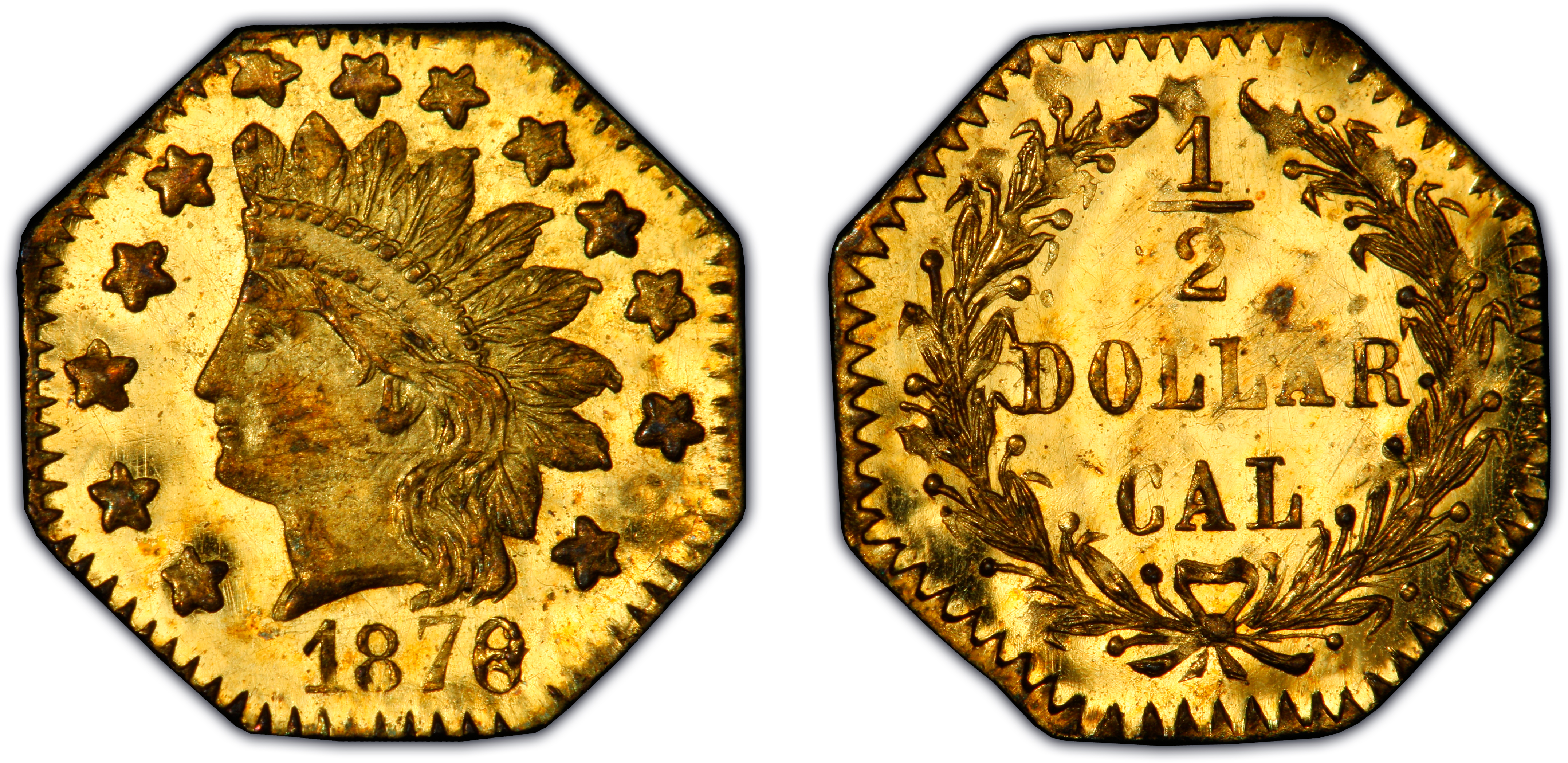
Obverse & Reverse
The 1878/6 G50C BG-952 is a quintessential example of a 'Period Two' California Fractional Gold piece, a fascinating and complex series born from the economic realities of the American West. Following the initial Gold Rush boom, the United States Mint established a branch in San Francisco in 1854, gradually alleviating the acute shortage of small circulating coinage. The earliest fractional gold pieces ('Period One', 1852-1857) were struck out of genuine commercial necessity. By the time the BG-952 was created, this need had largely evaporated. Instead, these later issues, often termed 'jeweler's pieces,' were manufactured primarily as souvenirs and keepsakes, catering to a romanticized Eastern fascination with the Gold Rush. Struck by the firm of Robert B. Gray & Co., a prominent San Francisco jeweler, the BG-952 was not intended to function as money in the same way its predecessors were. The Private Coinage Act of 1864 had made such private issues illegal, but the law was not strictly enforced against these small, low-value tokens until 1883. Minter-jewelers like Gray operated in a legal gray area, producing these miniature gold pieces for a thriving market. The overdate, 1878/6, is a common feature among Period Two issues, resulting from the re-punching of existing dies to update the date, a cost-saving measure typical for these commercial ventures. These pieces were often struck with less care than official coinage, using the 'hammer method' where a top die was struck with a sledgehammer onto a planchet resting on a bottom die, resulting in frequent variations in strike quality. Their gold content was also notoriously variable and typically less than their face value would imply, cementing their status as novelties rather than true circulating coins. Today, the BG-952 is a tangible link to this later, more commercialized phase of the Gold Rush legacy, representing the transition of fractional gold from a vital necessity to a popular memento.
Associated EventPost-Gold Rush Era Commerce
Reason For MintingPrimarily created as a collectible souvenir for tourists and jewelry purposes, rather than to fill a need for circulating currency.
Minter HistoryRobert B. Gray & Co. was a significant producer of 'Period Two' California Fractional Gold in San Francisco. Active from the late 1850s, Gray purchased the business and equipment of another fractional gold maker, Antoine Nouizillet, around 1859-1860. He produced his own distinct issues, often marked with a 'G' as seen on the 'G50C' nomenclature of this coin. Gray's pieces are generally noted for being of higher weight and intrinsic value than many other contemporary jeweler's issues. The firm continued its operations until 1871, when Gray sold his interests to the California Jewelry Co. (the Levison Brothers), another key player in the fractional gold story.
Historical SignificanceThis coin represents the second phase of fractional gold production, where the pieces evolved from necessity-driven currency to commercial souvenirs. It highlights the sustained national interest in the California Gold Rush long after its peak and illustrates a niche market of private manufacturing that persisted despite federal laws against private coinage.
BG-952
Denomination50 Cents
Minting Period1878
Assayer/MinterRobert B. Gray & Co.
Geographic OriginSan Francisco, California
Obverse DescriptionThe obverse features a Native American princess (Indian Head) facing left, adorned with a feathered headdress. A circle of 13 stars surrounds the portrait. The date, 1878, is positioned below the bust. A clear '8' is punched over a '6', a diagnostic for this variety.
Obverse Inscription1878
Reverse DescriptionThe reverse design consists of the denomination '50 CENTS' enclosed within a continuous wreath. The wreath is composed of numerous leaves and berries and is tied with a bow at the bottom. The legend 'CALIFORNIA GOLD' is inscribed outside of the wreath, following the octagonal border at the top of the coin. The 'G' for Gray is typically implied by the catalog number rather than being a prominent design feature on this specific variety's reverse.
Reverse InscriptionCALIFORNIA GOLD 50 CENTS
CompositionGold
Stated Fineness Actual FinenessVariable, often between 14 to 22 karats. Period Two issues are not known for consistent fineness.
Weight0.25 grams
Diameter10.00 mm
EdgePlain
Unknown
Survival Estimate31-75
Rarity ScaleR-5+
The 1878/6 G50C BG-952 is sought after for its distinct overdate, octagonal shape, and connection to the well-documented minter Robert B. Gray & Co. As a 'Period Two' issue, it is more commonly found in high grades than its circulating predecessors, making it an accessible entry point into the fractional gold series for collectors seeking attractive, uncirculated examples.
Key VarietiesThe primary variety is the 1878/6 overdate. No other major varieties, patterns, or restrikes are widely recognized for the BG-952. Collectors should be aware of other Robert B. Gray issues, some of which are mules using different obverse and reverse dies, but BG-952 itself is a specific die marriage.
Authentication TipsAuthentication requires careful comparison to known genuine examples. The overdate is a key diagnostic; the underlying '6' should be visible beneath the '8'. The style of the Indian Head portrait and the wreath details are specific to this die pair. Genuine pieces often exhibit a slightly uneven strike and a characteristic luster from the original planchet preparation. Counterfeits are common and often have a soapy, cast-like appearance, incorrect weight, or design details that do not match the BG-952 dies. Many modern replicas exist; authentic pieces must have a denomination (e.g., 'CENTS'), whereas souvenir tokens often say 'CAL GOLD CHARM' or lack a denomination entirely.
Shopping ConsiderationsA premium quality example for this issue is defined by a sharp, well-centered strike, particularly on the feathers of the headdress and the details of the wreath. Look for examples with vibrant, original prooflike or semi-prooflike surfaces. Due to the hammer-striking process, some softness in the strike is common, but coins with exceptional definition command a significant premium. Avoid examples that have been cleaned, as this disrupts the original skin and luster. Also, be wary of pieces that have been previously mounted in jewelry, checking the edges carefully for any signs of removal or repair. A strong, clear overdate adds to the eye appeal and desirability.
A coin's grade is its condition, rated on a 1-70 scale. For rare coins, this is the most critical factor in determining value, as a tiny difference in preservation can mean a huge difference in price.
Relevant Grade TypesOriginal period issues like BG-952 were business strikes, although produced more as souvenirs than for circulation. They are found in Circulated grades (AU-50 to AU-58, rarely lower) and, more commonly, Mint State grades (MS-60 to MS-67). While some exhibit prooflike (PL) surfaces from polished dies, no true Proofs were struck during the original period of issue. Any coin described as a 'Proof' should be treated as a special striking or a later issue and is distinct from these original pieces.
Mint State CharacteristicsIn uncirculated condition, the BG-952 typically displays a bright, satiny or prooflike luster. The strike can be inconsistent; a fully struck piece will show sharp details on the highest points of the Indian's cheek and the feathers, as well as the bow and leaves on the reverse. Planchet quality can vary, and it is not uncommon to see minor adjustment marks or striations from the manufacturing process. Small, detracting contact marks are common due to the softness of the gold.
Circulated Wear PatternsWear first appears on the high points of the design: the cheekbone and the upper feathers of the headdress on the obverse. On the reverse, the highest points of the wreath's leaves and the bow will show the first signs of friction. In lower circulated grades (VF/XF, though rare for this issue), the finer details of the feathers will merge and the legends will begin to soften.
Key Factors For ValueThe primary value drivers for the BG-952 are grade and surface quality. A high-grade Mint State coin (MS-64 or better) with pristine, prooflike surfaces commands a substantial premium. Eye appeal is paramount; collectors favor sharply struck examples with attractive, original reddish-gold toning over hazy or dull specimens. The clarity and prominence of the 8/6 overdate can also influence value. Certification by a top-tier grading service (PCGS or NGC) is essential for marketability, and a CAC sticker for a coin with superior quality for the grade adds a significant premium.
PCGS Price Guide
| Grade | Price | Population |
|---|---|---|
| 55 | $275.00 | 1 |
| 55+ | $280.00 | N/A |
| 58 | $290.00 | N/A |
| 58+ | $310.00 | N/A |
| 60 | $400.00 | 1 |
| 61 | $425.00 | N/A |
| 62 | $500.00 | 3 |
| 62+ | $575.00 | N/A |
| 63 | $700.00 | 11 |
| 63+ | $800.00 | N/A |
| 64 | $1,200.00 | 10 |
| 64+ | $1,350.00 | N/A |
| 65 | $1,650.00 | 1 |
| 65+ | $1,850.00 | N/A |
| 66 | $2,150.00 | 1 |
| 66+ | $2,750.00 | N/A |
| 67 | $3,750.00 | N/A |