1869 G25C BG-829 (Regular Strike)
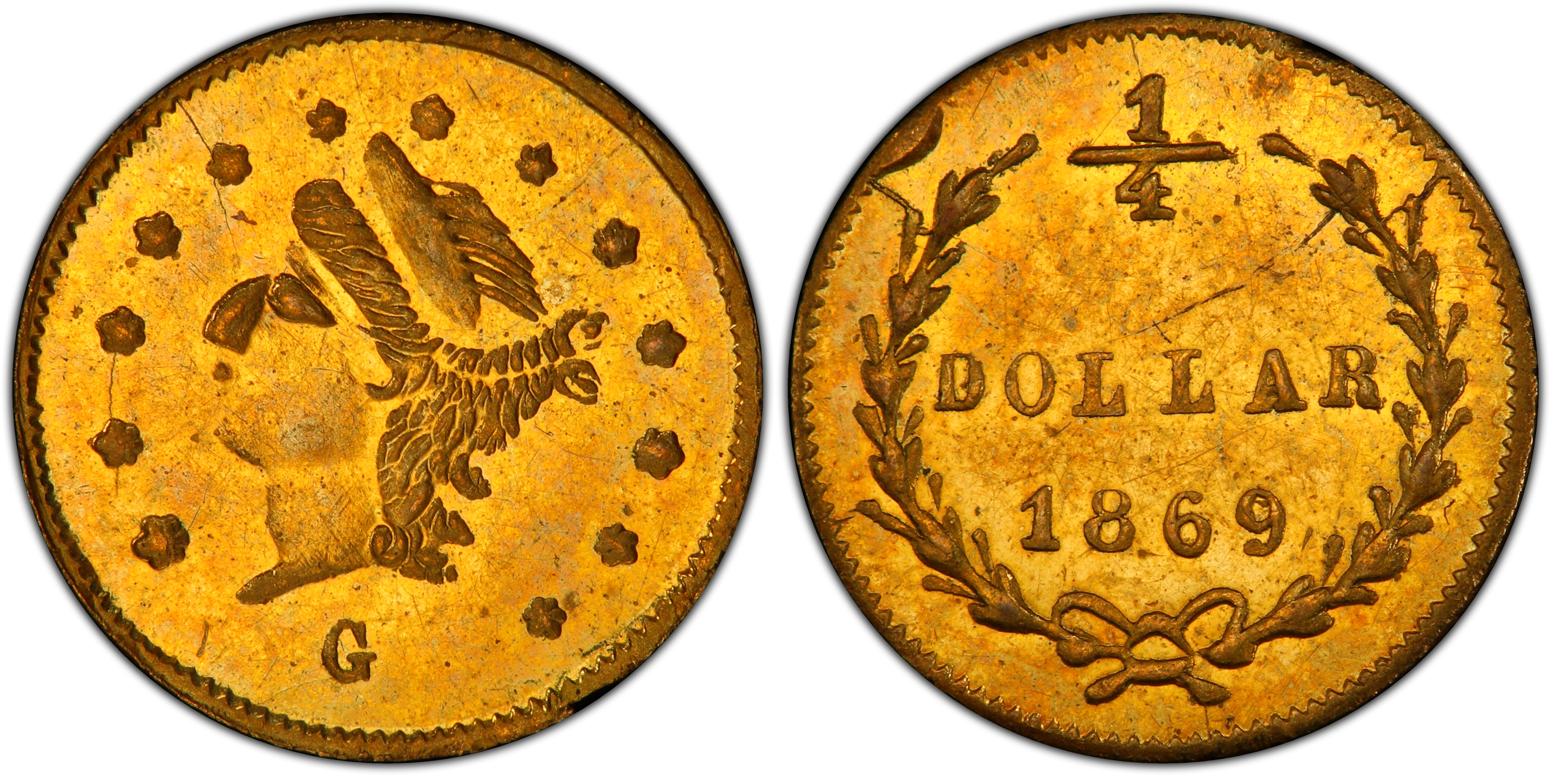
Obverse & Reverse
The 1869 G25C BG-829 is a quintessential example of a 'Period Two' California Fractional Gold piece, a fascinating series born from the unique economic conditions of the American West. Following the initial California Gold Rush, the U.S. Mint's output of small denomination coinage struggled to keep pace with the explosive commercial growth, particularly in remote California. The first wave of fractional gold, 'Period One' (1852-1857), consisted of privately-minted quarter dollars, half dollars, and dollars that were generally of good weight and intended to alleviate this severe shortage of pocket change. However, by the late 1850s, the San Francisco Mint was in full operation and the acute need for these private issues had subsided. This gave rise to the 'Period Two' issues (1858-1882), which served a different purpose. These pieces, often called 'jeweler's issues,' were primarily created as souvenirs, keepsakes, and novelty items for tourists and locals nostalgic for the Gold Rush heyday. The BG-829 falls squarely into this category. It was struck by Robert B. Gray & Co., a prominent San Francisco jeweler who had purchased the business and equipment of an earlier fractional gold pioneer, Antoine Nouizillet, around 1859. Gray continued to produce these small gold tokens, often marking his work with a characteristic 'G' on the obverse, as seen on many of his varieties. These Period Two pieces were not intended to circulate as money in the same way as their predecessors. Their gold content was often less than their face value, and their manufacture was a commercial enterprise aimed at the jewelry and souvenir trade. The Coinage Act of 1864 officially outlawed private coinage, but the law was not strictly enforced against these small tokens until the Secret Service cracked down in 1883. This legal gray area allowed jewelers like Robert Gray to produce a wide variety of designs throughout the 1860s and 1870s, contributing to a rich and complex numismatic series. The BG-829, with its 1869 date, represents a period of peak production for these popular souvenirs, reflecting a prosperous and growing San Francisco that was capitalizing on its romantic Gold Rush past.
Associated EventPost-Gold Rush Economic Expansion
Reason For MintingPrimarily struck as a souvenir or keepsake for the jewelry trade rather than to fulfill a circulating coinage need.
Minter HistoryRobert B. Gray & Co. was a significant San Francisco-based jewelry firm and a prolific producer of Period Two California fractional gold. Around 1859, Gray acquired the business of Antoine Louis Nouizillet, one of the Period One minters, including his dies and equipment. Gray began producing his own distinctive issues, often hallmarked with a 'G' on the obverse. While some early pieces may have used Nouizillet's old dies, Gray quickly introduced his own designs. Breen and Gillio note that Gray's pieces, particularly his quarter dollars, were often heavier and of higher intrinsic value than many other contemporary jeweler's issues. The firm operated until 1871 when Gray sold his interests to the California Jewelry Co. (Levison Brothers).
Historical SignificanceThe BG-829 is historically significant not as a coin that facilitated commerce, but as a tangible artifact of the California Gold Rush's enduring legacy. It represents the commercialization of the Gold Rush mythos and the demand for souvenirs from the romanticized 'Wild West.' As a product of a known and respected jeweler, it exemplifies the private enterprise that characterized San Francisco's economy in the decades following the initial rush.
N/A
Denomination25 Cents
Minting Period1869
Assayer/MinterRobert B. Gray & Co.
Geographic OriginSan Francisco, California
Obverse DescriptionA small head of Liberty facing left, with LIBERTY inscribed on her coronet. The portrait is surrounded by thirteen six-pointed stars. The date 1869 is below the bust. A small letter 'G', the mark of minter Robert B. Gray & Co., is sometimes associated with this minter's issues, though it is not explicitly part of the BG-829 obverse design itself but rather a general identifier for the maker's series.
Obverse InscriptionLIBERTY
Reverse DescriptionThe denomination 25 CENTS is displayed within a wreath composed of two olive branches. The wreath is open at the top and tied with a bow at the bottom. Below the denomination, the abbreviation CAL. is present.
Reverse Inscription25 CENTS CAL.
CompositionGold
Stated Fineness Actual FinenessVariable, typical for Period Two issues (approx. 14-22 Karat)
Weight0.25 grams
Diameter10.00 mm
EdgePlain
Unknown
Survival Estimate31-75
Rarity ScaleR-5
The BG-829 is sought after for its specific date, its attribution to the well-documented minter Robert B. Gray & Co., and its status as a representative 'Period Two' issue. Its R-5 rarity makes it a challenging but achievable acquisition for specialists. Collectors appreciate the historical connection to San Francisco's famous jewelry trade and the souvenir market that flourished after the Gold Rush.
Key VarietiesThe primary variety is the regular business strike BG-829. There are no known major varieties, patterns, or official restrikes for this specific Breen-Gillio number. The broader series of 1869 25-cent pieces includes several other BG numbers (e.g., BG-826, BG-828, BG-830) with subtle differences in die characteristics, making die state analysis crucial for correct attribution.
Authentication TipsAuthentic BG-829 specimens exhibit sharp, albeit sometimes uneven, strike characteristics typical of manual press or hammer striking. Look for crisp details in the stars and wreath leaves. The font style of the date and legends should match known genuine examples. Period Two pieces are frequently counterfeited or replicated; modern fakes are often soapy in appearance, exhibit casting bubbles, or are made of gold-plated brass. Weight and specific gravity tests are critical. Comparison to high-resolution images of certified examples is the best method for identifying die markers and spotting forgeries. A key diagnostic for many Robert Gray issues is the precise shape and placement of the letters and numerals.
Shopping ConsiderationsA premium quality example for its grade will possess a sharp strike, especially on Liberty's hair and the leaves of the wreath. Original, lustrous surfaces are highly desirable and command significant premiums; many surviving examples have been cleaned, polished, or used as jewelry. Look for pieces with minimal distracting contact marks—a challenge given their small size and softness. Attractive, original reddish-gold or orange-peel toning is a significant plus. Avoid examples with evidence of solder, tooling, or harsh cleaning, as these drastically reduce value. Given the prevalence of fakes, purchasing examples certified by PCGS or NGC is strongly recommended.
A coin's grade is its condition, rated on a 1-70 scale. For rare coins, this is the most critical factor in determining value, as a tiny difference in preservation can mean a huge difference in price.
Relevant Grade TypesOriginal 1869 BG-829 issues were struck as business strikes, though primarily for souvenir purposes rather than circulation. They are found in both Circulated (1-58) and Mint State (MS, 60-70) grades, although the majority of survivors are Uncirculated due to their nature as keepsakes. No true Proofs were struck during the original minting period, and there are no known later-date Proof restrikes for this specific variety. Some Mint State examples may exhibit prooflike (PL) surfaces from polished dies, but these are distinct from true Proof strikings.
Mint State CharacteristicsAn uncirculated BG-829 typically displays a soft, satiny luster. The strike can be variable; a well-struck example will show full detail on the word LIBERTY on the coronet and sharp definition in the wreath leaves. Weakness is often seen in the centers. Because these were made by jewelers and not handled with the care of a government mint, even high-grade Mint State examples can show minor planchet flaws or small, scattered contact marks. The overall eye appeal, combining luster, strike, and surface preservation, is paramount.
Circulated Wear PatternsFor examples that did see handling or pocket wear, friction first appears on the highest points: Liberty's cheek, the hair above the ear, and the knot of the bow on the reverse wreath. On lower-grade circulated examples, the word LIBERTY on the coronet will become indistinct, and the finer details of the wreath leaves will merge. The date and peripheral stars are usually more protected and remain legible even in moderately worn grades.
Key Factors For ValueThe primary drivers of value for an 1869 BG-829 are grade and surface quality. An uncirculated piece with original, uncleaned surfaces and strong luster will be worth many times more than a circulated or cleaned example. Strike quality is a key differentiator; a sharply struck coin is always preferred. Eye appeal, including attractive original toning, adds a premium. Certification by a top-tier service like PCGS or NGC is nearly essential for market acceptance and value realization, and a CAC sticker for this issue indicates superior quality for the grade and commands a strong premium.
PCGS Price Guide
| Grade | Price | Population |
|---|---|---|
| 50 | $245.00 | 3 |
| 50+ | $250.00 | N/A |
| 53 | $260.00 | 3 |
| 53+ | $265.00 | N/A |
| 55 | $275.00 | 5 |
| 55+ | $280.00 | N/A |
| 58 | $290.00 | 10 |
| 58+ | $300.00 | N/A |
| 60 | $325.00 | 3 |
| 61 | $375.00 | 5 |
| 62 | $650.00 | 11 |
| 62+ | $750.00 | N/A |
| 63 | $1,000.00 | 6 |
| 63+ | $1,250.00 | N/A |
| 64 | $2,150.00 | 3 |