1856 G50C BG-916 (Regular Strike)
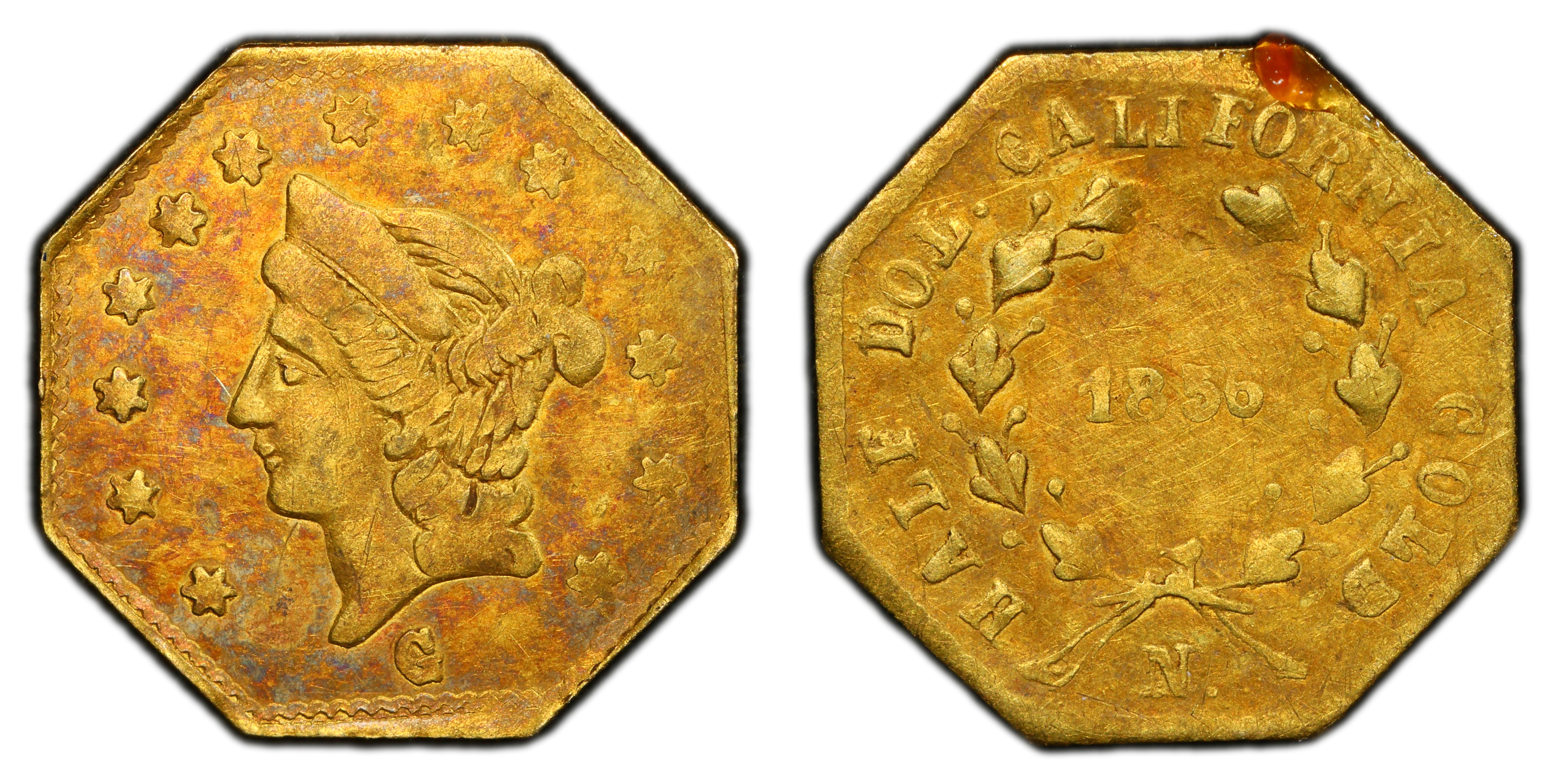
Obverse & Reverse
The 1856 Octagonal Gold Half Dollar, cataloged as Breen-Gillio 916, represents the zenith and conclusion of the initial, utilitarian phase of private California fractional gold coinage, known as 'Period One' (1852-1856). The California Gold Rush, which began in 1848, flooded the region with raw gold but created a severe, paradoxical shortage of small-denomination coinage for daily commerce. Gold dust, a pinch at a time, proved to be an inaccurate and inefficient medium of exchange for minor transactions. While private mints began striking larger denomination coins ($5, $10, $20), the need for pocket change remained acute. In 1852, enterprising San Francisco jewelers and metalworkers began striking their own fractional gold coins in 25-cent, 50-cent, and one-dollar denominations. These tiny coins, often mirroring the federal Liberty Head designs to inspire public confidence, were a direct response to this economic necessity. They were not legal tender but circulated by common consent, filling a crucial void that the distant U.S. Mint and its newly established San Francisco branch (opened in 1854) were slow to fill. By 1856, the production of federal coinage in San Francisco had finally increased to a point where the necessity for these private issues began to wane, effectively ending the era of 'circulation' pieces. The BG-916 was thus one of the final expressions of this fascinating and historically significant solution to a regional economic problem. Unlike the later 'Period Two' issues (1859-1882), which were primarily made as souvenirs for tourists and collectors, the BG-916 was intended for and saw actual use in the bustling economy of Gold Rush California, a fact attested to by the circulated condition of many of the few surviving examples. Their anonymous nature is typical of the period, as many jewelers produced them without specific maker's marks, focusing on utility rather than brand.
Associated EventCalifornia Gold Rush
Reason For MintingTo alleviate a severe shortage of small-denomination coinage for everyday commercial transactions in Gold Rush-era California.
Minter HistoryThe specific minter for BG-916 is unknown, and the coin is attributed as 'Anonymous'. During 'Period One' (1852-1856), numerous San Francisco-based jewelers and artisans, such as Frontier, Deviercy & Co., Antoine Louis Nouizillet, and M. Deriberpe, produced fractional gold. However, many varieties, including BG-916, were issued without any identifying initials or marks, making a definitive attribution to a specific maker impossible based on current research.
Historical SignificanceAs a 'Period One' issue, the BG-916 is a genuine artifact of the California Gold Rush economy, representing one of the last privately-minted fractional gold pieces intended to circulate as money before the San Francisco Mint's output rendered them obsolete. Its extreme rarity today underscores the ephemeral, utilitarian nature of these coins, most of which were lost or melted down over time.
K-Unlisted
DenominationG50C
Minting Period1856
Assayer/MinterAnonymous
Geographic OriginSan Francisco, California
Obverse DescriptionThe obverse features a small, fairly crude rendering of a Liberty Head, facing left. The portrait is loosely styled after the federal gold coins of the era, with hair tied in a bun at the back. The bust is surrounded by thirteen small, five-pointed stars, arranged in an arc around the periphery. The date, 1856, is not present on the obverse.
Obverse Inscription Reverse DescriptionThe reverse is dominated by a wreath composed of two branches tied together by a bow at the bottom. Inside the wreath, the denomination is expressed on two lines as '1/2' above 'DOL.' The date, 1856, is positioned centrally within the wreath, below the denomination. The legend 'CALIFORNIA GOLD' encircles the top periphery of the wreath.
Reverse InscriptionCALIFORNIA GOLD 1/2 DOL. 1856
CompositionGold
Stated Fineness Actual FinenessTypically varied for Period One issues, often ranging from .800 to .900, using native California gold which contained silver and other trace elements.
Weight0.45 grams
Diameter10.00 mm
EdgePlain
Extremely Low
Survival Estimate13-30 coins
Rarity ScaleR-6
The BG-916 is a highly coveted numismatic rarity, prized as a genuine 'Period One' circulating issue from the final year of that era. Its appeal lies in its extreme scarcity, its octagonal shape, and its direct connection to the authentic commerce of the California Gold Rush. For specialists, its status as a high R-6 variety makes any appearance a significant event.
Key VarietiesThere are no known major varieties, patterns, or restrikes of the BG-916 from the original minting period. All known examples are considered regular business strikes. The Breen-Gillio reference does not list any distinct die states or sub-varieties for this specific catalog number.
Authentication TipsAuthentic BG-916 specimens will exhibit a denomination, '1/2 DOL.', and 'CALIFORNIA GOLD'. Fakes and later souvenirs often lack a denomination or use phrases like 'CAL GOLD CHARM'. Look for characteristic crudeness in the strike; genuine pieces were made with rudimentary equipment and often show weakness in some areas, particularly the stars or parts of the wreath. Modern counterfeits are often too sharp and uniform. The surfaces of genuine pieces should have a texture consistent with 19th-century gold, not the glassy or porous fields seen on many cast or modern replicas. Any piece with a bear on the reverse is a 20th-century token and not a genuine fractional gold coin.
Shopping ConsiderationsFor a potential buyer, a premium quality BG-916 is defined first and foremost by its authenticity and problem-free surfaces. Look for examples with minimal marks and original, uncleaned surfaces that may exhibit a deep, reddish-gold or mellow 'old gold' toning. Given the crude manufacturing, strike is a key consideration; an example with a bold Liberty portrait and a fully legible date and denomination commands a significant premium. Weakness is common, but seek a coin with pleasing overall sharpness and eye appeal. Avoid examples that have been holed, bent, heavily cleaned, or show evidence of tooling or repairs, as these issues drastically reduce value for such a rare piece.
A coin's grade is its condition, rated on a 1-70 scale. For rare coins, this is the most critical factor in determining value, as a tiny difference in preservation can mean a huge difference in price.
Relevant Grade TypesAll original BG-916 pieces were struck as business strikes intended for commerce and are found in Circulated (1-58) and, very rarely, in Mint State (MS, 60-70) grades. No Proof (PR/PF) examples were struck during the original period of issue, and there are no known later-date Proof restrikes or special collector strikings for this variety. Any piece described as a 'Proof' should be regarded with extreme skepticism and is likely a later-issue souvenir with prooflike surfaces.
Mint State CharacteristicsAn uncirculated BG-916 is exceedingly rare. Quality is determined by the sharpness of the strike, the quality of the luster, and the presence of marks. The strike is typically somewhat soft, with flatness expected on the highest points of Liberty's hair and the leaves of the wreath. The luster is typically satiny rather than deeply frosty. Due to the softness of the gold and rudimentary handling, even Mint State examples will likely show scattered small contact marks or planchet flaws, but a premium example would have these well away from the central devices.
Circulated Wear PatternsWear first appears on the highest points of the design. On the obverse, friction will first dull the luster and then flatten the details on Liberty's hair, cheek, and the stars. On the reverse, the highest points of the wreath's leaves and the numerals of the date and denomination will show initial wear. In lower grades (VG and below), the stars on the obverse may become faint or merge with the fields, and the finer details of the wreath will be completely worn away.
Key Factors For ValueFor the BG-916, rarity is paramount, so any authenticated, gradable example is valuable. The key value multipliers are surface preservation and strike. An example with original, uncleaned surfaces and attractive toning is highly desirable. Strike quality is critical; a coin with a sharp date, clear denomination, and well-defined Liberty portrait will command a substantial premium over a weakly struck counterpart of the same numerical grade. Given its rarity, a CAC sticker indicating premium quality for the grade would add a significant premium.
PCGS Price Guide
| Grade | Price | Population |
|---|---|---|
| 20 | N/A | 1 |
| 30 | $450.00 | 1 |
| 35 | $485.00 | N/A |
| 40 | $520.00 | N/A |
| 45 | $575.00 | 1 |
| 45+ | $625.00 | N/A |
| 50 | $725.00 | 1 |
| 50+ | $750.00 | N/A |
| 53 | $800.00 | 3 |
| 53+ | $825.00 | N/A |
| 55 | $875.00 | 3 |
| 55+ | $900.00 | N/A |
| 58 | $1,000.00 | 3 |
| 58+ | $1,050.00 | N/A |
| 60 | $1,500.00 | N/A |
| 61 | $2,250.00 | 1 |
| 62 | $3,250.00 | 3 |
| 65 | N/A | N/A |