1868 25C BG-711 (Regular Strike)
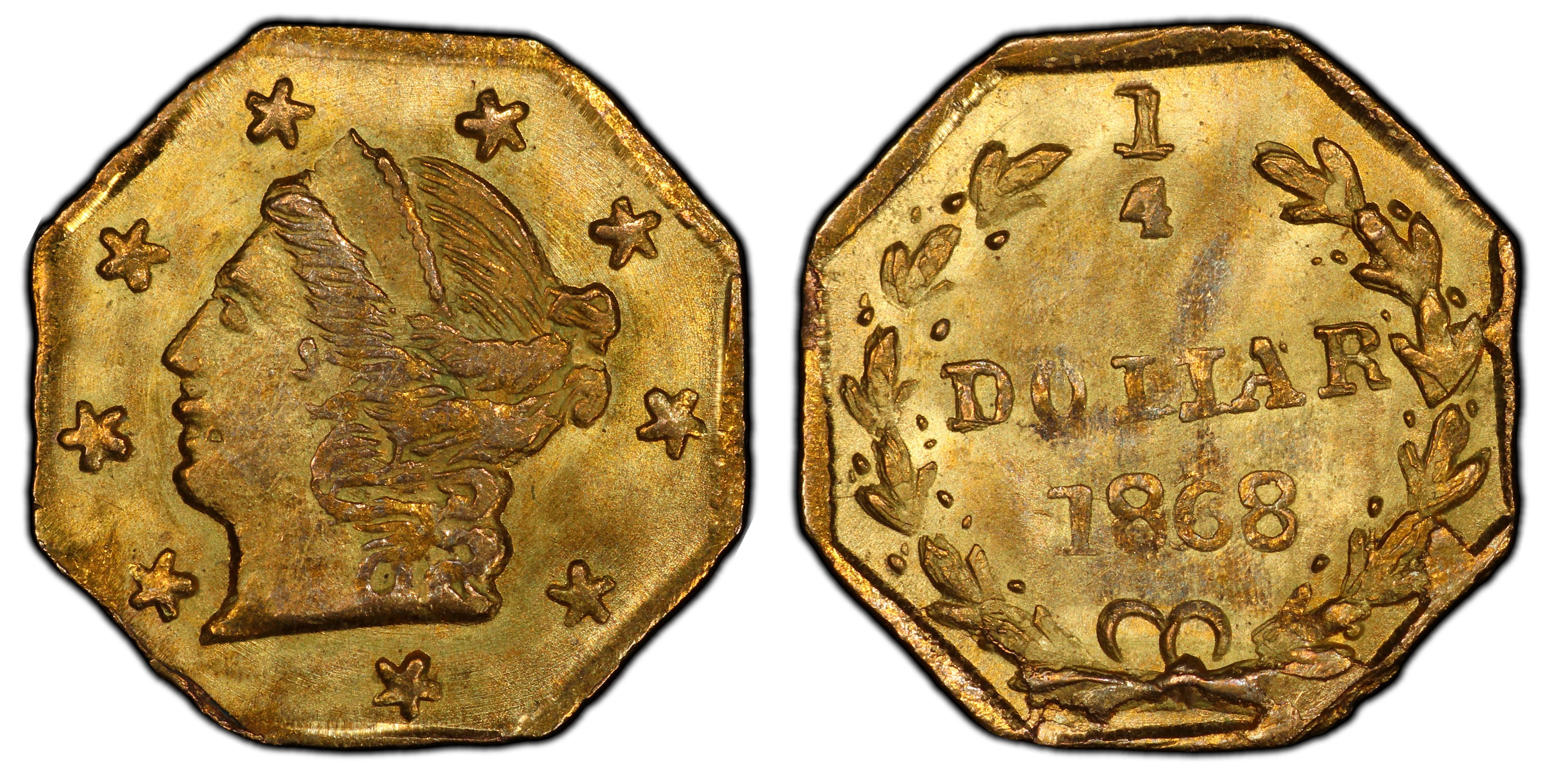
Obverse & Reverse
The 1868 BG-711 25 Cent piece is a quintessential example of a 'Period Two' California Fractional Gold coin, a series born from the unique economic conditions of the American West. The initial California Gold Rush created an immense and immediate need for circulating coinage, particularly in small denominations, a demand the U.S. Mint could not adequately meet in the isolated western territory. This led to the rise of private minters in the early 1850s, whose 'Period One' issues were generally of good weight and intended to alleviate the critical shortage of small change. By 1868, however, the landscape had changed dramatically. The San Francisco Mint, opened in 1854, was in full operation, and federal coinage had become more plentiful, largely eliminating the commercial necessity for private issues. Concurrently, the Coinage Act of 1864 explicitly outlawed private coinage. Despite this, enforcement by the Secret Service was inconsistent until 1883, allowing a cottage industry of 'suppressed jewelers' issues' to flourish. These Period Two pieces, including the BG-711, were not struck to facilitate commerce but to satisfy a burgeoning tourist and souvenir market. San Francisco was no longer just a rugged boomtown; it was a world-famous destination. Visitors and residents alike sought mementos of the great Gold Rush, and these tiny, intricate gold coins were the perfect keepsake. Struck by manufacturing jewelers like Robert B. Gray & Co., these coins were often knowingly made underweight and with variable fineness, maximizing profit while still providing a genuine gold token. The BG-711, with its classic Liberty Head motif, evoked the design of official U.S. gold coinage, lending it a sense of legitimacy and historical connection that made it highly appealing. These pieces were hammered out in small workshops, resulting in inconsistent strike quality and frequent die imperfections, characteristics that are now studied by specialists. Their survival in high grades is a testament to their immediate adoption as collectibles rather than their use in day-to-day transactions.
Associated EventCalifornia Gold Rush Aftermath
Reason For MintingPrimarily produced as a souvenir or charm for the growing tourist trade in San Francisco, capitalizing on the fame of the Gold Rush.
Minter HistoryRobert B. Gray & Co. was a manufacturing jewelry firm active in San Francisco from approximately 1859 to 1871. The firm's history is deeply intertwined with other significant California fractional gold minters. Around 1859-60, Robert B. Gray purchased the business of Antoine Louis Nouizillet, another prominent French jeweler and minter, acquiring his dies, hubs, and punches. Gray continued to use some of Nouizillet's old dies before creating new ones bearing his own hallmark, the letter 'G', which often appears on his issues. Gray's firm became a significant producer of 'Period Two' fractional gold, catering to the souvenir market. His pieces are noted by researchers like Breen and Gillio for often being heavier and more intrinsically valuable than many other contemporary jeweler's issues. In 1871, Robert B. Gray sold his interests to the California Jewelry Co., which was operated by the Levison Brothers, another major name in San Francisco's jewelry and horology trade.
Historical SignificanceThe BG-711 represents the evolution of private coinage from a commercial necessity to a collectible souvenir, reflecting San Francisco's transition from a frontier boomtown to a center of tourism and commerce.
BG-711
Denomination25C
Minting Period1868
Assayer/MinterRobert B. Gray & Co.
Geographic OriginSan Francisco, California
Obverse DescriptionA small, diademed Liberty Head facing left, in the style of James B. Longacre's federal gold dollar design. The head is surrounded by thirteen six-pointed stars arranged in a circle near the octagonal border. The date, 1868, is positioned below the bust.
Obverse Inscription1868
Reverse DescriptionThe central device is the fraction '1/4' surrounded by a decorative wreath of two branches tied together at the bottom with a bow. Outside the wreath is the inscription 'CALIFORNIA GOLD'.
Reverse Inscription1/4 CALIFORNIA GOLD
CompositionGold
Stated Fineness Actual Fineness Weight0.25 grams
Diameter9.50 mm
EdgePlain
Unknown
Survival Estimate76-200
Rarity ScaleR-4
This coin is highly collectible due to its direct connection to the California Gold Rush era, its miniature artistry, and its status as a 'Period Two' jeweler's issue. The octagonal shape is particularly emblematic of pioneer gold. As a dated variety from a known San Francisco jeweler, it offers a tangible piece of Old West history.
Key VarietiesNo major, widely recognized varieties of the BG-711 itself are listed in standard references. California Fractional Gold as a series contains no officially sanctioned patterns or restrikes. All pieces from this era were private issues, and later souvenir pieces made in the 20th century are considered copies or tokens, not restrikes.
Authentication TipsGenuine Period Two fractionals like the BG-711 are denominated, typically reading '1/4', '25 CENTS', or 'DOLLAR'. Many common, modern fakes are unmarked or feature a bear on the reverse. Authentic pieces are typically struck on very thin planchets, often compared to the thickness of a business card; modern replicas are usually thicker and have a more cast or soapy appearance. The strike on genuine pieces can be crude or uneven due to the hammer-striking process, whereas many fakes have a uniform, modern look. Compare strike details, letter and number shapes, and star formations to known genuine examples in references like Breen-Gillio.
Shopping ConsiderationsFor a premium quality example, seek a coin with a sharp, well-centered strike, especially on Liberty's hair details and the numerals of the date. Original, uncleaned surfaces are paramount; many of these tiny pieces were harshly cleaned or used as jewelry, so finding one with intact, satiny luster commands a significant premium. Look for attractive, undisturbed reddish-gold or almond-gold toning. Avoid examples that are bent, holed, or show evidence of being mounted in jewelry. Pay close attention to the sharpness of the octagonal corners, as wear can make them appear rounded. A coin certified by a major grading service (PCGS or NGC) is highly recommended for authentication and liquidity.
A coin's grade is its condition, rated on a 1-70 scale. For rare coins, this is the most critical factor in determining value, as a tiny difference in preservation can mean a huge difference in price.
Relevant Grade TypesOriginal BG-711 issues were business strikes, although intended as souvenirs rather than for circulation. They are found in Circulated (1-58) and, more commonly, Mint State (MS, 60-70) grades due to their collectible nature. No proofs were struck during the original minting period, and there are no known later-date authorized restrikes; any prooflike examples are the result of polished dies used for regular production.
Mint State CharacteristicsUncirculated examples of BG-711 often exhibit a soft, satiny luster characteristic of the gold used. The strike quality varies significantly due to the manual hammering process; some are sharply defined, while others show weakness in the center of the obverse or reverse. Well-struck specimens will show clear details in Liberty's hair curls and the individual leaves of the wreath. Due to their small size and handling as curios, even Mint State examples can have tiny ticks or hairlines. Truly pristine surfaces are rare and highly prized.
Circulated Wear PatternsWear first appears on the highest points of the design. On the obverse, look for flattening on the hair curls above Liberty's eye and ear, the coronet band, and the eyebrow. On the reverse, the leaves of the wreath and the loops of the bow will be the first elements to show smoothness and lose detail. On lower-grade examples, the stars and legends will begin to weaken and merge with the fields.
Key Factors For ValueThe primary value driver is surface preservation. An example with original, lustrous, and uncleaned surfaces will always be worth multiples of a cleaned or damaged coin of the same grade. Strike quality is a close second; a full, sharp strike is highly desirable and commands a premium. Eye appeal, which encompasses toning, luster, and strike, is crucial. Coins with a pleasing, original 'old gold' patina are favored over dipped or bright examples. Certification by PCGS or NGC is essential for market acceptance, and a CAC sticker on a certified coin indicates premium quality for the grade and adds significant value.
PCGS Price Guide
| Grade | Price | Population |
|---|---|---|
| 55 | $250.00 | 1 |
| 55+ | $255.00 | N/A |
| 58 | $275.00 | N/A |
| 58+ | $280.00 | N/A |
| 60 | $300.00 | N/A |
| 61 | $335.00 | 2 |
| 62 | $400.00 | 6 |
| 62+ | $475.00 | N/A |
| 63 | $575.00 | 15 |
| 63+ | $625.00 | N/A |
| 64 | $675.00 | 26 |
| 64+ | $750.00 | N/A |
| 65 | $900.00 | 21 |
| 65+ | $1,050.00 | N/A |
| 66 | $1,375.00 | 6 |
| 66+ | $1,750.00 | N/A |
| 67 | $2,000.00 | 1 |