1858 G50C BG-1323 (Regular Strike)
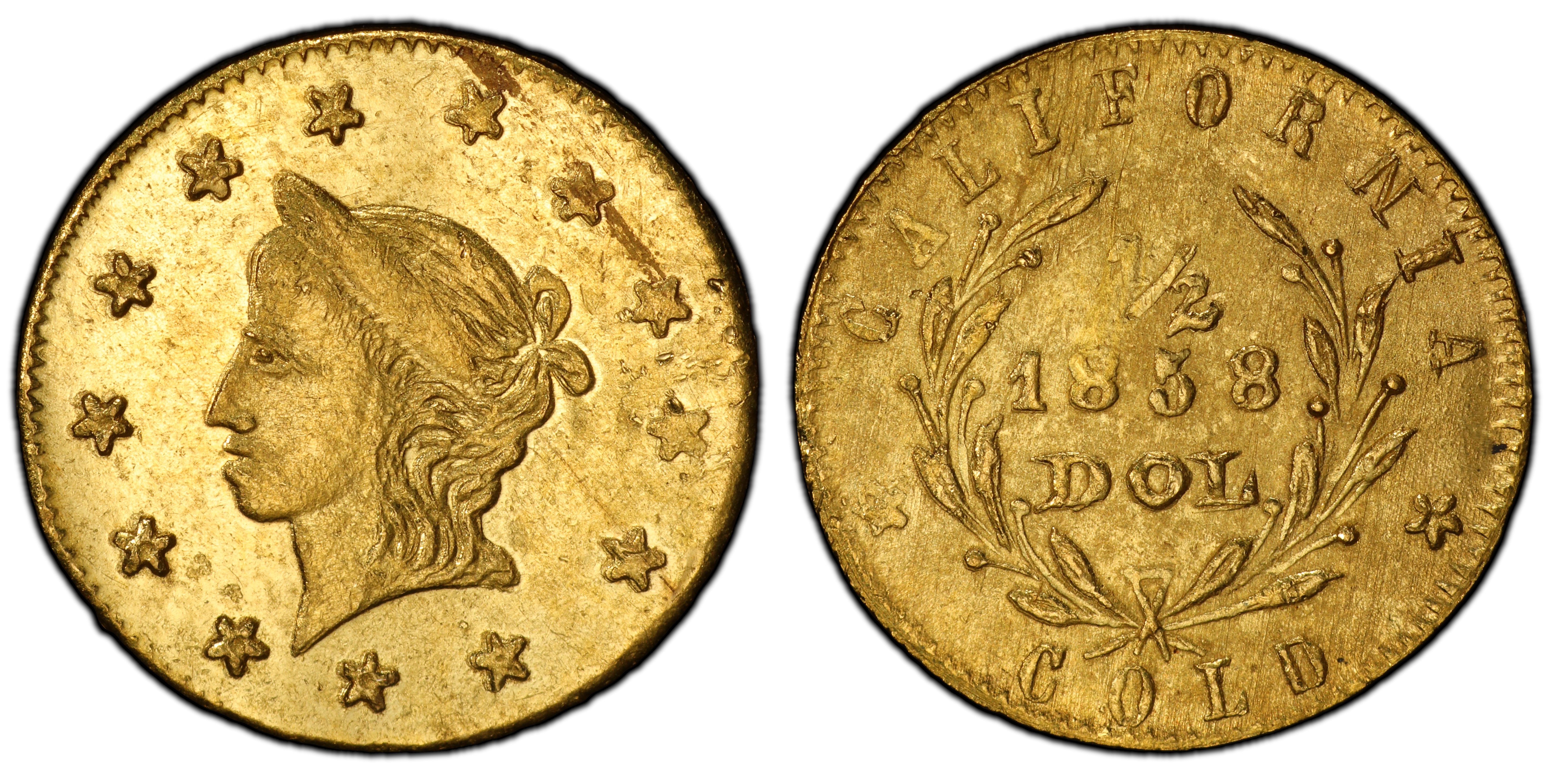
Obverse & Reverse
The 1858 G50C BG-1323 is one of the great rarities in the California Fractional Gold series, but its story diverges significantly from the popular narrative of Gold Rush emergency money. Numismatic scholarship, particularly the Breen-Gillio reference, categorizes these miniature gold pieces into three distinct periods. Period One (1852-1857) consists of pieces made to alleviate a shortage of small change during the peak of the Gold Rush. Period Two (1858-1882) comprises souvenir and jewelry issues made after the initial need had subsided. The BG-1323, however, is classified as a 'Period Three' variety. These were pieces struck after 1882, the year the Secret Service finally suppressed the manufacture of private coinage. To circumvent the law and appeal to a growing collector market, makers of Period Three pieces backdated their creations to the Gold Rush era. The maker of BG-1323 remains anonymous, and auction records suggest the intent was likely to deceive collectors. The coin's date of 1858 places it aesthetically within the souvenir period, but its actual creation was likely decades later. The extreme rarity (R-8, with only 2 or 3 examples known) suggests its production was either a test, an experiment, or a very limited issue intended for a specific purpose, rather than a wide commercial release. The only publicly recorded and graded example appeared in a 2014 auction, where it was noted as the sole specimen certified by either PCGS or NGC at the time. This highlights its status not as a relic of the Gold Rush economy, but as a fascinating and mysterious numismatic artifact from the dawn of coin collecting in America, when nostalgia for the '49ers created a market for such curious and sometimes deceptive mementos.
Associated EventPost-Gold Rush Era / Rise of Numismatic Collecting
Reason For MintingLikely produced post-1882 as a backdated collectible or jeweler's piece intended to deceive or appeal to the nostalgia market.
Minter HistoryThe identity of the minter for BG-1323 is unknown. Period Three issues were often produced clandestinely by jewelers who were well-aware of the illegality of striking private coinage after the Secret Service crackdown in 1882. Their anonymity was a matter of legal necessity. The style of engraving is crude but distinct, suggesting a skilled but perhaps non-professional hand.
Historical SignificanceThe BG-1323 is significant not for its role in commerce, but for what it reveals about the early market for rare coins and historical souvenirs in the United States. It represents a rare category of backdated, possibly deceptive, private strikings created to meet a collector demand for Gold Rush-era items. Its extreme rarity makes it a legendary issue among specialists.
BG-1323
Denomination50 Cents
Minting Period1858 (Dated)
Assayer/MinterUnknown
Geographic OriginSan Francisco, California (presumed)
Obverse DescriptionA crudely rendered Liberty Head faces left, with somewhat bulbous features. The hair is tied in the back with a ribbon. Thirteen stars, also somewhat crudely executed, encircle the portrait. The date, 1858, appears below the truncation of the neck.
Obverse Inscription1858
Reverse DescriptionA simple, open wreath of two branches tied with a bow at the bottom. The denomination '50 CENTS' is inscribed in two lines within the wreath. The legend 'CALIFORNIA GOLD' is inscribed in an arc outside the wreath at the top.
Reverse InscriptionCALIFORNIA GOLD / 50 CENTS
CompositionGold
Stated Fineness Actual FinenessUnknown, but Period Three issues are often of a lower, non-standard fineness.
EdgePlain
Extremely low, likely fewer than a dozen pieces.
Survival Estimate2-3 examples known.
Rarity ScaleR-8
This is a coin of the highest rarity, appealing to advanced specialists of California Fractional Gold. Its allure lies in its mysterious origin as a backdated 'Period Three' issue and the fact that only a few examples have ever been confirmed to exist. Acquiring one would be a landmark event for any collection.
Key VarietiesBG-1323 is a unique die marriage and is not a variety of a more common coin. Its primary distinguishing characteristic is its status as a backdated Period Three issue. There are no known restrikes or special collector issues of this specific variety, as it is itself a later creation.
Authentication TipsAuthentication is paramount. Any example must be compared to the high-quality images of the known certified specimen (PCGS MS62). Key diagnostics include the specific, crude style of the Liberty portrait and the exact positioning of the reverse legends and wreath. Given its R-8 status, any newly discovered example should be considered suspect until professionally authenticated by a top-tier grading service.
Shopping ConsiderationsThe concept of 'shopping' for this coin is largely inapplicable due to its extreme rarity. A potential buyer would likely face a once-in-a-generation auction opportunity or a private treaty sale. The primary consideration would be establishing an unbroken pedigree to one of the known examples. The sole graded example is in Mint State, so quality would be judged by the sharpness of the strike (which is surprisingly decent on the known specimen), the quality of the luster, and the absence of distracting marks or impairments. Eye appeal is strong on the known example, described as having a 'lustrous wheat-gold' appearance.
A coin's grade is its condition, rated on a 1-70 scale. For rare coins, this is the most critical factor in determining value, as a tiny difference in preservation can mean a huge difference in price.
Relevant Grade TypesOriginal issues were business strikes not intended for circulation, but rather for sale to collectors or jewelers. As such, they are typically found in high grades, from About Uncirculated (AU) to Mint State (MS, 60-70). The only publicly known graded example is MS62. No original Proofs were made, and the concept of a later-date restrike does not apply to this already-retrospective issue.
Mint State CharacteristicsAn uncirculated BG-1323 would be defined by the single known high-grade example. It exhibits a lustrous, wheat-gold surface. The strike is relatively sharp, especially for a piece with such crude engraving. The fields may show minor die polishing lines or inherent planchet roughness typical of these private issues. Contact marks, even small ones, will have a significant impact on the grade, as would any impairment to the original luster.
Circulated Wear PatternsNo circulated examples are known to exist. Hypothetically, wear would first appear on the high points of Liberty's cheek, hair, and the leaves of the wreath. Due to the small size and the fact that it was not made for commerce, any circulated examples would likely be impaired from use as jewelry.
Key Factors For ValueWith an R-8 rarity, existence and authenticity are the primary drivers of value. The value is almost entirely numismatic. For a given example, the key factors would be its grade and surface quality. A pristine, well-struck piece with brilliant luster, like the known MS62 coin, sets the standard. Any specimen would command a massive premium. A CAC sticker would be highly desirable, confirming premium quality for the grade, though it is not known if any existing examples have been submitted to CAC.
PCGS Price Guide
| Grade | Price | Population |
|---|---|---|
| 62 | $1,450.00 | 4 |
| 62+ | $1,550.00 | N/A |
| 63 | $1,700.00 | 4 |
| 63+ | $1,800.00 | N/A |
| 64 | $2,100.00 | 1 |