1871 G$1 BG-1104 (Regular Strike)
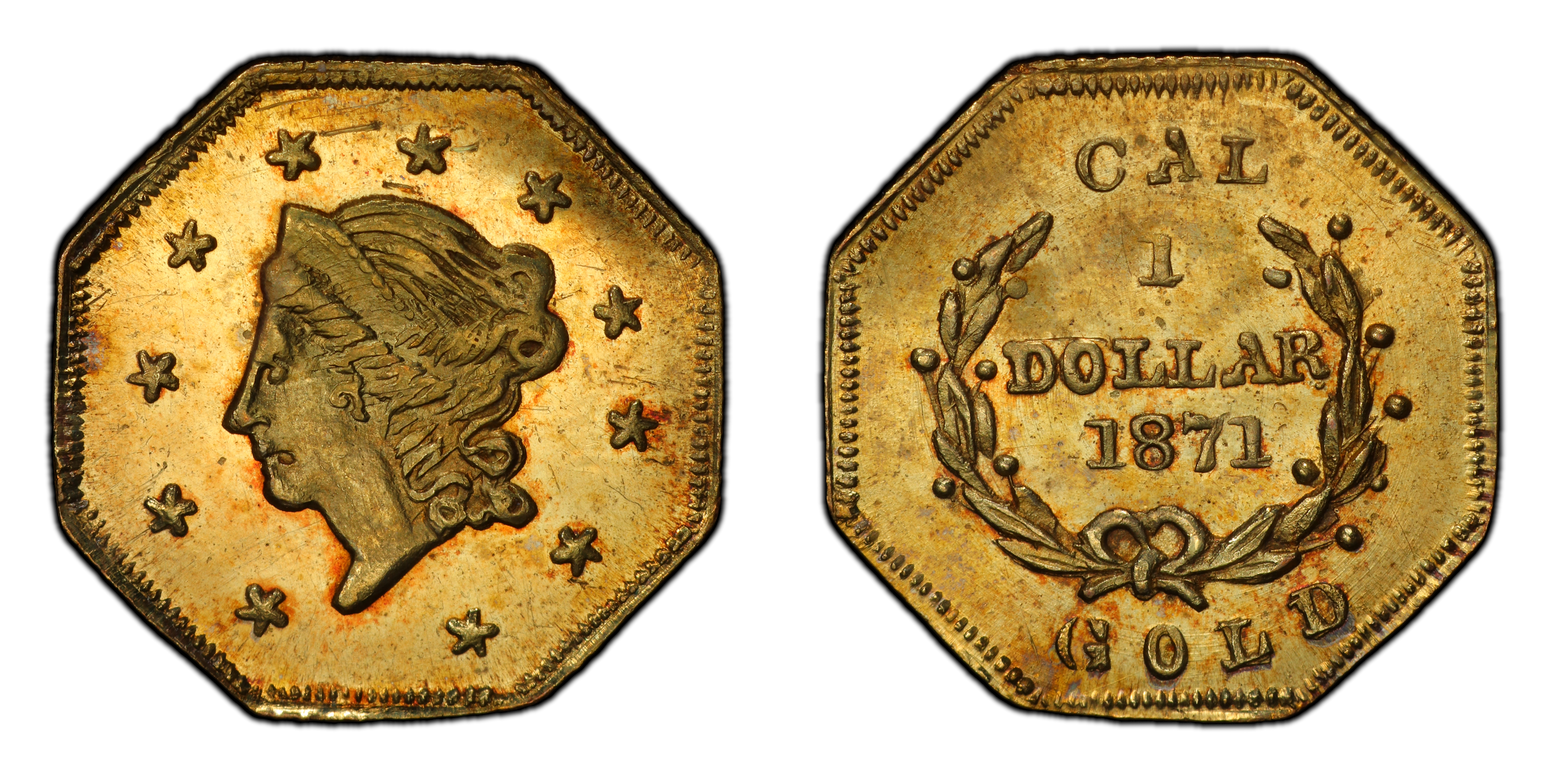
Obverse & Reverse
The 1871 G$1 BG-1104 is a fascinating product of the post-Gold Rush era in California, a period numismatically defined as 'Period Two' (1859-1882) of fractional gold production. By the 1870s, the acute shortage of small circulating coinage that had plagued California in the early 1850s had been largely resolved by the full-scale operations of the San Francisco Mint. The impetus for producing these miniature gold dollars had shifted dramatically from necessity to novelty. The original, heavier 'Period One' issues, which were genuinely intended to facilitate commerce, had ceased production by 1857. The new wave of fractional gold, often termed 'jeweler's issues,' were lighter, often of lower fineness, and catered to a burgeoning tourism industry and a national fascination with the 'Wild West.' San Francisco was no longer a rugged frontier outpost but a sophisticated metropolis, a destination for travelers and a hub of commerce. Jewelers and private minters, many of whom were skilled German or French immigrants, recognized a potent market for Gold Rush souvenirs. These tiny, intricate gold pieces were the perfect memento. The BG-1104 was struck in this environment. Its minter is attributed to the prominent San Francisco firm, Levison Brothers (operating as the California Jewelry Co.), who in 1871 had just acquired the interests of another fractional gold producer, Robert B. Gray & Co. This acquisition likely included dies and equipment, allowing Levison Brothers to enter the lucrative souvenir coin market. While technically illegal under the Private Coinage Act of 1864, production of these pieces flourished due to lax enforcement and high public demand. The federal government's attention was focused on Reconstruction, and the Secret Service did not launch a serious crackdown on these private issues until the early 1880s. Thus, the BG-1104 existed in a legal gray area, sold openly by jewelers as keepsakes, charms, and symbols of California's golden identity, rather than as functional currency for daily transactions.
Associated EventPost-California Gold Rush Economic Expansion
Reason For MintingPrimarily struck to be sold as souvenirs and keepsakes to tourists and collectors, capitalizing on the romanticism of the California Gold Rush.
Minter HistoryLevison Brothers, operating as the California Jewelry Co., was a major San Francisco jewelry manufacturer and importer founded in 1859. By 1871, they had moved into a large, multi-story building at 134 Sutter Street, equipped with modern machinery. In that same year, they acquired the business of Robert B. Gray & Co., a known producer of fractional gold. This strategic purchase likely marked their entry into the souvenir gold coin market. Fractional gold pieces produced by the firm in 1871 are known to bear an 'L' mintmark, directly tying them to the Levison name. The company was a significant player in the luxury goods market of San Francisco, producing high-quality jewelry and importing watches and diamonds, with the fractional gold coins being a profitable sideline.
Historical SignificanceThe BG-1104 is a quintessential example of a 'Period Two' California Fractional Gold piece. Its significance lies not as a circulating coin, but as a cultural and economic artifact. It demonstrates the maturation of the Californian economy and the commercialization of the Gold Rush mythos, representing a transition from utilitarian private coinage to privately struck numismatic souvenirs.
Not Applicable
Denomination$1
Minting Period1871
Assayer/MinterLevison Brothers / California Jewelry Co.
Geographic OriginSan Francisco, California
Obverse DescriptionFeatures a classic Liberty Head design facing left, reminiscent of the U.S. Mint's gold coinage but cruder in execution. The portrait is surrounded by 13 six-pointed stars arranged in a circle. The date, 1871, is positioned at the bottom.
Obverse InscriptionLIBERTY (on coronet)
Reverse DescriptionThe reverse is unique to this variety. It features the abbreviation 'CAL.' at the top periphery and 'GOLD' at the bottom. In the center, within a beaded circle, is the denomination '1' over 'DOLLAR'.
Reverse InscriptionCAL. / 1 / DOLLAR / GOLD
CompositionGold
Stated Fineness Actual FinenessTypically varied for Period Two issues, often between 14k and 22k (.585 to .917 fine).
EdgePlain
Unknown, but very small, consistent with other Period Two issues.
Survival EstimateFewer than 30 believed to exist.
Rarity ScaleR-6 (Very Rare)
The BG-1104 is highly sought after due to its high rarity (R-6), unique reverse design, and its connection to the romantic era of California's post-Gold Rush history. Its octagonal shape adds to its distinctive character. As a one-year type, it appeals to specialists in the extensive California Fractional Gold series.
Key VarietiesThe primary issue is the business strike of 1871. No proof strikings from the original period are known, nor are there any sanctioned restrikes. Any prooflike examples are the result of polished dies used for early impressions and are not true Proofs.
Authentication TipsAuthentic examples often show a somewhat crude, hand-finished quality. Look for sharp, well-defined corners on the octagonal planchet. The lettering and stars, while potentially unevenly struck, should have a particular style consistent with known genuine pieces. Counterfeits are common and may be gold-plated brass or have incorrect weights and mushy details. Diagnostics for the BG-1104 die pair include the specific positioning of 'CAL.' and 'GOLD' and the style of the numeral '1' on the reverse. Comparison with high-resolution images of certified examples is crucial.
Shopping ConsiderationsA premium quality example for this issue is defined by a sharp, relatively central strike. Many specimens are weakly struck on the stars or the date, so examples with full details command a significant premium. Look for original, undisturbed surfaces with some remaining luster; many have been cleaned or polished over the years due to their use in jewelry. The color of the gold can vary, with attractive reddish or olive-gold toning being highly desirable. Avoid pieces with significant rim bumps, scratches, or evidence of having been mounted in jewelry, as this severely impacts value.
A coin's grade is its condition, rated on a 1-70 scale. For rare coins, this is the most critical factor in determining value, as a tiny difference in preservation can mean a huge difference in price.
Relevant Grade TypesAll original examples of BG-1104 were struck as business strikes for commercial sale, not for circulation. They are found in Circulated (AU-58 and lower, often from handling or jewelry use) and Mint State (MS, 60-70) grades. No true Proof (PR/PF) examples were struck during the original period of issue. Examples with reflective, mirror-like surfaces are designated as 'Prooflike' (PL) but are a subset of the Mint State business strikes, not a separate type of striking.
Mint State CharacteristicsUncirculated examples of BG-1104 are characterized by their luster, which can range from satiny to semi-prooflike. The strike is a key determinant of quality; examples are often unevenly struck, with weakness common on the stars opposite the highest point of Liberty's portrait. Planchet quality can be inconsistent, with minor natural imperfections. Contact marks are common due to the softness of the gold and the way these small pieces were handled in bulk by their makers.
Circulated Wear PatternsWear first appears on the highest points of the design: Liberty's coronet, eyebrow, and cheek. On the reverse, the numeral '1' and the letters in 'DOLLAR' will show initial friction. On heavily worn examples, the stars on the obverse will begin to merge with the fields, and the peripheral lettering on both sides will become faint.
Key Factors For ValueFor the BG-1104, value is driven primarily by rarity and grade. Surface quality is paramount; an example with original, uncleaned 'skin' is far more valuable than a harshly cleaned one of the same grade. Strike sharpness is the next critical factor; a bold, well-centered strike can double the value over a weakly struck counterpart. Eye appeal, including attractive original toning and a lack of distracting marks, plays a major role. A CAC sticker, verifying the quality for the assigned grade, adds a significant premium for this rare and coveted issue.
PCGS Price Guide
| Grade | Price | Population |
|---|---|---|
| 50 | $650.00 | 1 |
| 50+ | $660.00 | N/A |
| 53 | $675.00 | 3 |
| 53+ | $700.00 | N/A |
| 55 | $725.00 | 2 |
| 55+ | $765.00 | N/A |
| 58 | $850.00 | 3 |
| 58+ | $900.00 | N/A |
| 60 | $1,000.00 | N/A |
| 61 | $1,100.00 | 5 |
| 62 | $1,250.00 | 13 |
| 62+ | $1,375.00 | N/A |
| 63 | $1,500.00 | 13 |
| 63+ | $1,850.00 | N/A |
| 64 | $2,850.00 | 9 |
| 64+ | $3,500.00 | N/A |
| 65 | $5,250.00 | 2 |
| 65+ | $6,000.00 | N/A |
| 66 | $8,500.00 | 1 |