1851 G50C BG-1318 (Regular Strike)
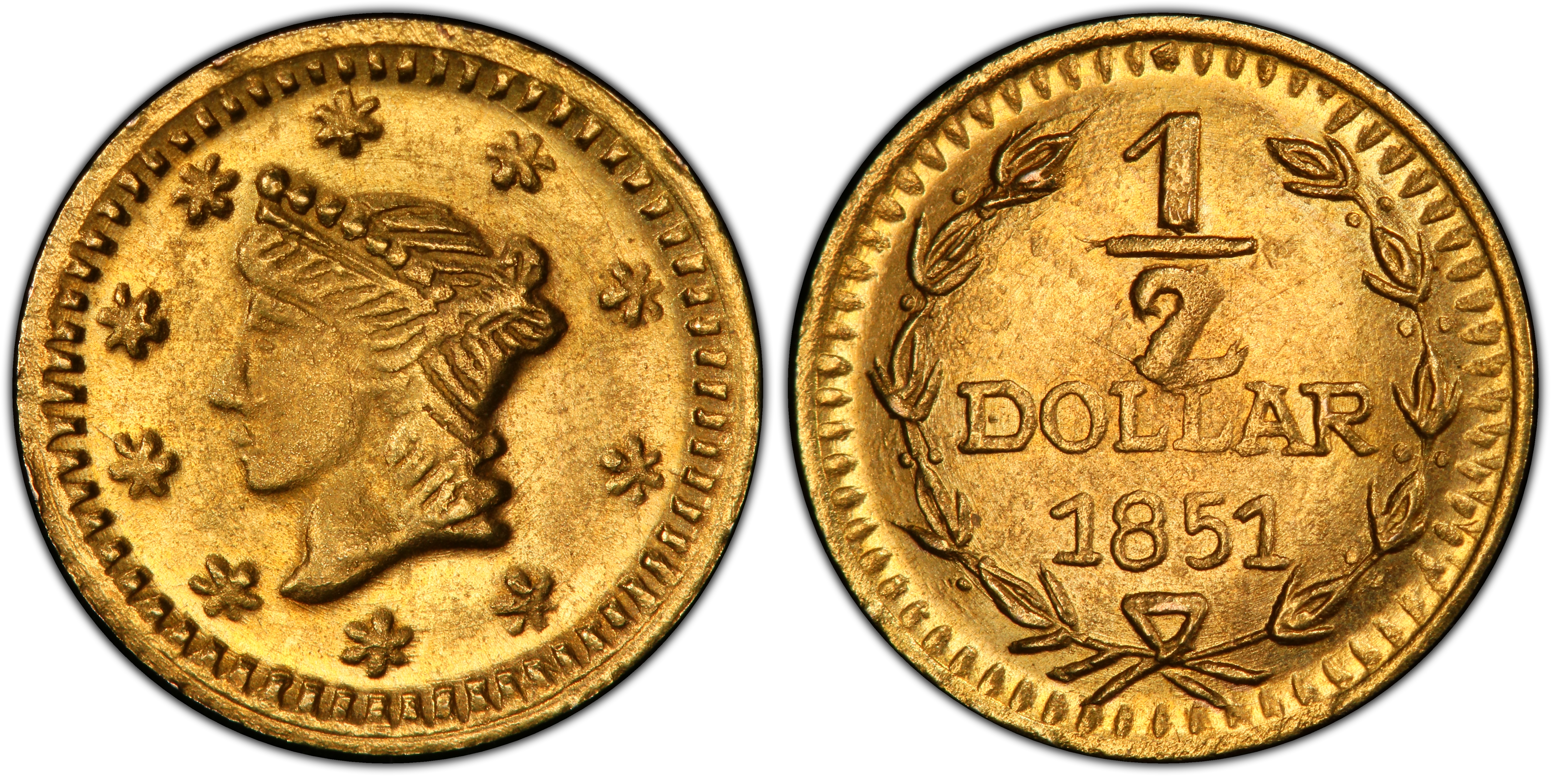
Obverse & Reverse
The 1851 G50C BG-1318 is a numismatic enigma, a representative of the third and final phase of 'California Fractional Gold' production, a period now understood to consist largely of spurious tokens and souvenir charms created long after the Gold Rush heyday. The initial 'Period One' (1852-1857) issues were born of necessity, struck by private jewelers and assayers in San Francisco to alleviate a severe shortage of small denomination coinage for daily commerce. These tiny gold coins, though often underweight, served a genuine economic purpose. As the San Francisco Mint ramped up production of federal coinage, the need for these private issues waned, giving rise to 'Period Two' (1859-1882), where fractional gold pieces transitioned into souvenir items, often of debased gold, made for tourists and for use in jewelry. The Coinage Act of 1864 made private coinage illegal, though it was not strictly enforced until the early 1880s. The BG-1318 falls into the subsequent 'Period Three' (post-1882). These pieces were not products of the California Gold Rush. Instead, they were typically manufactured by jewelers in Eastern cities, most notably Herman M. Kroll of New York, who produced a wide variety of such charms. To circumvent anti-counterfeiting laws and to imbue their products with historical allure, these makers intentionally backdated their creations to the Gold Rush era; in this case, '1851,' a date that predates the first legitimate fractional issues. These items were never intended for circulation as money but were sold as novelties, keepsakes, and patriotic charms. The BG-1318, by its very nature as a Period Three token, is shrouded in anonymity. Its inclusion in the Breen-Gillio catalog under a high number separates it from the legitimate pioneer issues, placing it among a class of coins whose history is one of commercial nostalgia rather than frontier economics. Its significance lies not in its use in the Gold Rush, but as a fascinating artifact of how that era was remembered and commercialized at the turn of the 20th century.
Associated EventPost-Gold Rush Nostalgia & Souvenir Trade
Reason For MintingTo be sold as a souvenir or charm, capitalizing on nostalgia for the California Gold Rush.
Minter HistoryThe specific minter for BG-1318 is unknown, a common trait for Period Three tokens. The primary suspect for many such issues is Herman M. Kroll, a New York City jeweler active in the late 19th and early 20th centuries. Kroll and others in the trade produced a vast array of small, denominated gold tokens, often backdated, to sell to the public as historical curiosities. These operations were commercial ventures, not private mints in the territorial sense.
Historical SignificanceBG-1318 and other Period Three tokens are significant not as currency, but as evidence of a burgeoning market for historical souvenirs in the late 19th and early 20th centuries. They demonstrate the enduring legacy of the Gold Rush in the American imagination and represent a distinct class of exonumia that is often confused with genuine territorial coinage. Their study highlights the importance of careful attribution in the complex field of private and territorial gold.
N/A
Denomination50 Cents (G50C)
Minting Periodc. 1883-1915 (Spurious backdate of '1851')
Assayer/MinterUnknown, likely a New York or Eastern jeweler (e.g., Herman M. Kroll)
Geographic OriginLikely New York, NY (Spuriously attributed to California)
Obverse DescriptionSpecific details for the BG-1318 variety are not readily available in numismatic literature. Typically, Period Three tokens of this type feature a crude Liberty Head or Indian Head design, stylistically different from the earlier, more functional issues. The design is often simplified, with less refined engraving.
Obverse InscriptionLikely includes a spurious date '1851' and stars, though the exact arrangement is unrecorded in major references.
Reverse DescriptionThe reverse design is unrecorded in major references. It would likely feature a wreath or similar device enclosing the denomination.
Reverse InscriptionTypically includes the denomination, such as '1/2' or '50 CENTS', and may include 'CALIFORNIA GOLD' or a similar phrase.
CompositionGold
Stated Fineness Actual FinenessTypically low, often ranging from 9 to 14 Karat (.375 to .585 fine), significantly below the standard for circulating coinage.
EdgePlain
Unknown
Survival EstimateUnknown, but likely very few.
Rarity ScaleR-7 (4-12 known) or higher; extreme rarity is a hallmark of many minor Period Three varieties.
The appeal of BG-1318 is highly specialized. It is sought by completists of the Breen-Gillio catalog and by specialists in Period Three tokens. Its allure comes from its obscurity and rarity, representing a challenging piece of the broader California Fractional Gold puzzle, rather than from direct ties to the Gold Rush.
Key VarietiesAs a Period Three token, the BG-1318 is itself a 'variety' distinct from the legitimate circulating issues. No major variations of BG-1318 itself are known. There are no known patterns, trial pieces, or restrikes in the traditional sense, as the original items were essentially fantasy pieces to begin with.
Authentication TipsAuthenticity for Period Three tokens is complex. The primary concern is distinguishing them from modern, worthless gold-plated replicas. Genuine Period Three pieces are solid gold, albeit of low fineness. Key diagnostics include a 'mushy' or soft strike, crude design elements, and a weight and specific gravity inconsistent with official coinage but consistent with other known jeweler's tokens. Comparison with authenticated examples in the Breen-Gillio reference is essential, though images of BG-1318 are not widely published. Any piece with a bear on the reverse or lacking a denomination is a token, not a coin, but BG-1318 is a denominated token.
Shopping ConsiderationsA potential buyer must prioritize authentication above all else. Given its extreme rarity, any offered example should be certified by a major grading service (PCGS or NGC) that specifically recognizes the BG-1318 attribution. 'Premium quality' for such a piece is defined by a lack of jewelry mounting, cleaning, or other damage. The strike is almost universally weak on these types, so a relatively sharp example would command a premium. Eye appeal is subjective but favors pieces with smooth, undisturbed surfaces and an attractive, aged-gold patina.
A coin's grade is its condition, rated on a 1-70 scale. For rare coins, this is the most critical factor in determining value, as a tiny difference in preservation can mean a huge difference in price.
Relevant Grade TypesOriginal strikings of BG-1318 were effectively business strikes, though not intended for circulation. They are found in Circulated (1-58) grades if they were handled or used as pocket pieces, and Mint State (MS, 60-70) grades if preserved. No Proof (PR/PF) examples were ever created. Given their nature as novelties, many survivors may be found in higher grades but are often impaired from having been mounted as jewelry.
Mint State CharacteristicsAn uncirculated BG-1318 would likely exhibit a soft, somewhat prooflike or satiny luster, characteristic of later jeweler's issues. The strike would almost certainly be weak in areas, particularly in the center of the design on both obverse and reverse. Planchet quality is often poor on these tokens, so expect some inherent roughness or adjustment marks. Contact marks may be present but should be minimal for a high Mint State grade.
Circulated Wear PatternsWear would first appear on the highest points of the Liberty/Indian portrait, such as the cheek and hair details. On the reverse, the high points of the wreath would show initial friction. As these pieces were not heavily circulated, extensive, even wear is uncommon; more often, damage such as scratches, rim bumps, or evidence of solder removal from jewelry mounting is the primary condition issue.
Key Factors For ValueFor BG-1318, the two paramount factors are authenticity and problem-free surfaces. A certified, numerically graded example (as opposed to 'details' graded) is vastly more desirable. Beyond that, a stronger-than-average strike and original, uncleaned surfaces would command a significant premium. The sheer rarity of the variety means that any confirmed, gradable example is of significant value to the specialist collector.
PCGS Price Guide
| Grade | Price | Population |
|---|---|---|
| 65 | N/A | 1 |