1859 G$1 BG-1101 (Regular Strike)
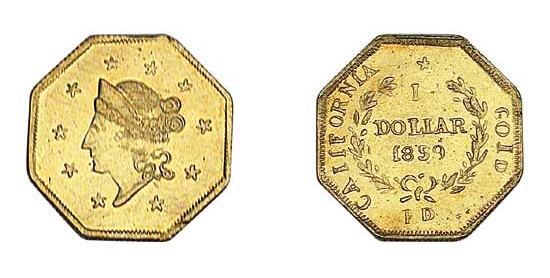
Obverse & Reverse
The 1859 G$1 BG-1101 emerges from the dynamic and chaotic economic environment of post-Gold Rush California. By the late 1850s, the initial frenzy had subsided, but California's economy was still grappling with a chronic shortage of circulating small-denomination coinage. The immense influx of gold dust was impractical for everyday transactions, and the supply of federal silver and copper coins from the distant Philadelphia Mint and the newly established San Francisco Mint was woefully inadequate to meet the demands of a booming population. This void created a fertile ground for private enterprise. Jewelers, assayers, and metallurgists began striking their own small-denomination gold coins, tokens, and charms to facilitate commerce. These 'California Fractional Gold' pieces, struck in denominations of 25 Cents, 50 Cents, and $1, were not legal tender but were widely accepted due to necessity. The period from 1852 to 1882 saw dozens of different manufacturers produce hundreds of varieties. The BG-1101 is a product of this mature phase of fractional gold production. Unlike the earlier, cruder issues, this 1859 dollar exhibits a more refined design, featuring a Liberty Head often described as an 'Indian Head' due to the feathered headdress, a motif popularized by James B. Longacre's federal Indian Head cent introduced that same year. The minter of BG-1101 remains anonymous, but numismatic research, particularly by Breen and Gillio, groups it with other pieces sharing similar design elements and punch-link characteristics, often referred to as the 'DERI' or 'Frontier' group. These pieces were vital lubricants for local trade, used to pay for everything from a meal to a stagecoach fare. Their existence was eventually curtailed by the Act of June 8, 1864, which prohibited private coinage, although production continued surreptitiously for years, evolving into souvenirs for the tourist trade. Today, the BG-1101 is a tangible link to this fascinating and unique chapter of American monetary history, representing the ingenuity and necessity that defined the California frontier.
Associated EventCalifornia Gold Rush Aftermath
Reason For MintingTo alleviate a severe shortage of small-denomination coinage for daily commercial transactions in California.
Minter HistoryThe specific minter of BG-1101 is unknown. However, based on die characteristics and style, it is attributed to a group of producers active in San Francisco in the late 1850s and early 1860s. This group is responsible for a family of related issues (including BG-1102, BG-1103, and others) characterized by a similar 'Indian' portrait and distinctive wreath design. These minters were likely jewelers or skilled artisans who saw a commercial opportunity in the region's currency shortage. They operated in a grey area of the law, producing coins that were technically tokens but functioned as money out of sheer public necessity.
Historical SignificanceThe BG-1101 is a prime example of privately issued coinage filling a crucial role in a developing economy where official currency was scarce. It reflects the adaptation of popular national design motifs (the Indian Head) to local, utilitarian coinage and serves as a significant artifact of California's unique monetary system during a pivotal period of its growth.
BG-1101
DenominationG$1
Minting Period1859
Assayer/MinterUnknown private minter, attributed stylistically to the 'DERI' group of producers.
Geographic OriginSan Francisco, California
Obverse DescriptionA female head facing left, wearing a feathered headdress. The headdress has 13 feathers. Thirteen stars encircle the portrait along the denticled rim. The date '1859' is below the bust truncation.
Obverse Inscription13 stars encircling portrait, with '1859' below.
Reverse DescriptionThe denomination '1' is centrally located within a wreath composed of two branches tied together by a bow at the bottom. The legend 'GOLD' is inscribed above the wreath, and 'DOL.' is below it.
Reverse InscriptionGOLD / 1 / DOL.
CompositionGold
Stated Fineness Actual FinenessVaries by specimen, but generally lower than federal standards, often around .750 to .850.
Weight0.97 grams
Diameter13.00 mm
EdgePlain
Unknown
Survival Estimate75-125
Rarity ScaleR-5
The BG-1101 is highly popular due to its classic 'Indian Princess' design, octagonal shape, and its status as a genuine circulating artifact from the California Gold Rush era. It is one of the more collectible and recognizable of the dollar-denominated fractional gold pieces.
Key VarietiesThe primary variety is the regular business strike (BG-1101). There are no known major die varieties from the original minting period for this specific catalog number. No known patterns, trial pieces, or official later-date restrikes exist. Collectors should be aware of contemporary counterfeits and modern replicas, which are not considered numismatic varieties.
Authentication TipsAuthentic BG-1101 specimens have specific die characteristics. Look for a sharp, well-defined feather design and clear, evenly spaced stars. A key diagnostic is the position of the date relative to the bust; the '1' of the date is slightly to the right of the tip of the bust. On the reverse, the wreath details should be distinct. Many contemporary counterfeits are cast, showing a porous or soft surface texture, and may have incorrect weight or a soapy feel to the details. Modern replicas are often marked with 'COPY' or have a brassy, unnatural color.
Shopping ConsiderationsA premium quality example for its grade will possess a bold strike, particularly on the highest points of the design: the feathers in the headdress and the details of the wreath. Original, uncleaned surfaces are paramount; look for a pleasing, slightly subdued luster rather than brilliant, prooflike fields, which might indicate cleaning or polishing. The natural color should be a rich, reddish-gold. Avoid examples with significant rim bumps, scratches, or evidence of tooling or smoothing in the fields. Given the small size, a clean, problem-free surface commands a significant premium, even in lower circulated grades.
A coin's grade is its condition, rated on a 1-70 scale. For rare coins, this is the most critical factor in determining value, as a tiny difference in preservation can mean a huge difference in price.
Relevant Grade TypesOriginal period issues of BG-1101 were business strikes intended for circulation and are found in Circulated (1-58) and Mint State (MS, 60-70) grades. No Proofs were struck during the original period of issue. The concept of Proof strikings for this type of private coinage is anachronistic; they were made for utility, not for collectors. Any piece described as a 'Proof' is almost certainly a modern copy or fantasy piece.
Mint State CharacteristicsUncirculated examples of BG-1101 typically exhibit a soft, satiny luster rather than a hard, frosty one. The strike is often somewhat weak in the absolute center of both the obverse and reverse, though better-struck examples with sharp central details command premiums. Small planchet flaws, such as minor striations or adjustment marks made prior to striking, are not uncommon and are generally accepted by specialists. Due to the softness of the gold alloy, even high-grade Mint State examples will often show minuscule contact marks from brief handling or storage with other pieces.
Circulated Wear PatternsWear first appears on the highest points of the design. On the obverse, this includes the cheek of the portrait and the tips of the feathers in the headdress. On the reverse, the high points of the wreath's leaves and the numeral '1' will show the first signs of friction. In lower grades (VG and below), the individual feathers will merge, the stars will become faint, and the legends on the reverse will start to weaken significantly, particularly 'GOLD' and 'DOL.'.
Key Factors For ValueBeyond the numerical grade, the primary value drivers are surface quality and eye appeal. An example with original, uncleaned 'skin' and attractive, honest wear is far more desirable than a higher-grade piece that has been harshly cleaned, polished, or otherwise impaired. The sharpness of the strike is critical; a well-struck coin with full feather detail is worth a substantial premium over a weakly struck coin of the same grade. Finally, certification by a top-tier grading service (PCGS or NGC) is essential for market acceptance, and a CAC sticker, indicating premium quality for the grade, adds a significant layer of value and liquidity for this popular issue.
PCGS Price Guide
| Grade | Price | Population |
|---|---|---|
| 55 | $5,000.00 | N/A |
| 55+ | $6,000.00 | N/A |
| 58 | $7,500.00 | 2 |
| 58+ | $9,000.00 | N/A |
| 60 | $12,500.00 | N/A |
| 61 | $15,750.00 | 1 |
| 62 | $18,500.00 | 1 |