1860 G$1 BG-1103 (Regular Strike)
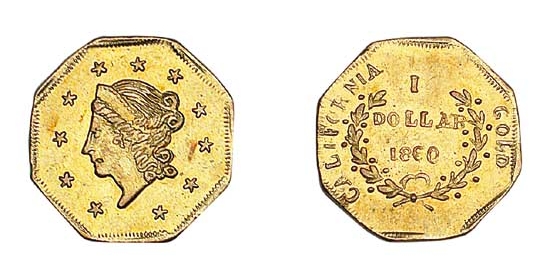
Obverse & Reverse
The 1860 G$1 BG-1103 is a product of what numismatists classify as 'Period Two' (1859-1882) of California Fractional Gold production. Unlike the 'Period One' issues, which were struck out of a genuine commercial necessity to alleviate a severe shortage of small change during the initial Gold Rush years, the Period Two pieces were created under different circumstances. By 1860, the San Francisco Mint was in full operation, and the acute need for circulating small-denomination gold had subsided. Instead, these later issues were primarily manufactured by jewelers as souvenirs, keepsakes, and novelty items to sell to tourists and locals captivated by the romance of the Gold Rush. These pieces were often deliberately underweight and made of a lower fineness gold than their stated face value would imply. The firm of Frontier, Deviercy & Co., a prominent San Francisco jeweler, is credited with producing this and similar varieties. Their work is characterized by a somewhat cruder, more stylized engraving compared to the earlier, more functional issues. The socio-economic context had shifted from necessity to nostalgia. The Private Coinage Act of 1864 would eventually make such private issues illegal, but the law was not strictly enforced for many years, allowing jewelers to continue production into the early 1880s. The BG-1103, being dated 1860, represents an early example of this souvenir-driven phase. Its extreme rarity today suggests a very small original production, likely intended for a limited clientele. These pieces did not circulate in the traditional sense but were treasured as mementos of California's golden era, a tangible link to the transformative event that reshaped the American West.
Associated EventCalifornia Gold Rush Aftermath
Reason For MintingPrimarily created as a souvenir or novelty item for tourists and collectors, rather than to fill a circulating coinage need.
Minter HistoryFrontier, Deviercy & Co. was a well-known San Francisco-based partnership of manufacturing jewelers active during the mid-19th century. Comprised of Pierre Frontier and Eugene Deviercy, the firm was a prolific producer of Period Two California Fractional Gold pieces. Their issues are often identified by the characteristic style of their dies, which, while sometimes crude, are distinct. They produced a variety of denominations and designs, capitalizing on the public's fascination with gold and the California Gold Rush. The firm's operations continued until around 1864, after which it underwent several reorganizations.
Historical SignificanceThe BG-1103 is significant not as a circulating coin, but as a numismatic artifact representing the commercial transition of private gold from a necessity to a souvenir. It reflects the maturation of the Californian economy and the popular romanticism of the Gold Rush that persisted long after the initial frenzy. Its rarity underscores the small-scale, bespoke nature of these jewelers' issues.
BG-1103
Denomination$1
Minting Period1860
Assayer/MinterFrontier, Deviercy & Co.
Geographic OriginSan Francisco, California
Obverse DescriptionOctagonal planchet. The central device is a crude, stylized bust of Liberty facing left. She wears a simple coronet that is blank, without the inscription 'LIBERTY'. The portrait is surrounded by thirteen poorly defined, six-pointed stars along the border.
Obverse Inscription Reverse DescriptionAn open-ended wreath of laurel, tied at the bottom with a simple bow, encircles the denomination and date. The inscription 'CALIFORNIA GOLD' is split, with 'CALIFORNIA' arching along the upper-left inside the wreath and 'GOLD' along the upper-right. The denomination '1 DOLLAR' and the date '1860' are in the center.
Reverse InscriptionCALIFORNIA GOLD 1 DOLLAR 1860
CompositionGold
Stated Fineness Actual FinenessTypically lower than monetary issues of the era, often debased.
EdgePlain
Extremely low, exact figures unknown.
Survival EstimateFewer than 5 known. The combined PCGS and NGC population is just 3.
Rarity ScaleR-8 (Unique or Nearly Unique)
The BG-1103 is a trophy coin for the advanced specialist in California Fractional Gold. Its appeal lies in its absolute rarity, positioning it as one of the ultimate condition-rarities in the series. Being a Period Two dollar, it tells the story of the shift to souvenir production. The combination of its 1860 date, octagonal shape, and near-unobtainable status makes it a landmark piece.
Key VarietiesNo major varieties of the BG-1103 are known, as the issue itself is a unique die marriage. No known patterns, trial pieces, or special restrikes exist.
Authentication TipsAuthentication requires comparison with the few known genuine examples. Pay close attention to the die characteristics: the specific shape and placement of the crude stars, the style of the lettering and date punches, and the details of the wreath. The overall fabric should be consistent with privately produced gold of the era, often exhibiting a slightly soft, somewhat uneven strike. Counterfeits may appear too sharp, have incorrect lettering fonts, or be cast instead of struck. Given its rarity, certification by a top-tier grading service (PCGS or NGC) is essential for any transaction.
Shopping ConsiderationsAcquiring a BG-1103 is an event that may only occur once in a generation. A potential buyer should expect the coin to appear only in a major, named-collection auction. A premium quality example for this issue would be one that is well-centered, free of significant planchet flaws, and retains some measure of original luster. The strike is expected to be weak in areas, particularly on Liberty's hair and the central reverse details. Avoid any specimen with signs of tooling, harsh cleaning, or evidence of having been mounted in jewelry, as originality is paramount for a rarity of this magnitude. Due to its extreme rarity, any example, regardless of grade, is a significant numismatic treasure.
A coin's grade is its condition, rated on a 1-70 scale. For rare coins, this is the most critical factor in determining value, as a tiny difference in preservation can mean a huge difference in price.
Relevant Grade TypesOriginal issues were business strikes, although likely sold directly to collectors and tourists rather than being intended for circulation. They are found in both Circulated (1-58) and Mint State (MS, 60-70) grades. Due to their status as souvenir items, Mint State examples are more likely to exist relative to the total population than for circulating coinage. No Proofs were struck during the original period of issue, and no later-date restrikes are known to exist.
Mint State CharacteristicsAn uncirculated BG-1103 would be judged on the quality of its strike and surfaces. The strike is characteristically weak, especially on the date and the lower curls of Liberty's hair. Luster is typically soft and satiny rather than bright and flashy. Surfaces are often plagued by mint-made imperfections, such as planchet roughness or minor adjustment marks, which are common for jeweler-produced pieces. The highest quality specimens would show minimal contact marks and pleasing original skin.
Circulated Wear PatternsWhile not intended for heavy circulation, any wear would first appear on the highest points of the design. On the obverse, this would be Liberty's cheek, coronet, and the hair above her ear. On the reverse, the high points of the wreath's leaves and the numerals of the date would show initial friction. In lower grades (VF and below), the stars would begin to lose their definition and the reverse lettering would become soft.
Key Factors For ValueFor the BG-1103, rarity is the dominant factor, meaning any example is extremely valuable. However, among the few known specimens, value is determined by surface preservation and eye appeal. An example with original, uncleaned surfaces and minimal distracting marks will command a significant premium. The sharpness of the strike, while inherently weak, is also a consideration; a coin with a comparatively bolder strike on the central motifs is more desirable. Given its rarity, a CAC sticker would provide significant validation of quality for the grade and would be highly sought after.
PCGS Price Guide
| Grade | Price | Population |
|---|---|---|
| 55 | $2,750.00 | 1 |
| 55+ | $3,000.00 | N/A |
| 58 | $3,250.00 | N/A |
| 58+ | $3,600.00 | N/A |
| 60 | $4,000.00 | N/A |
| 61 | $4,250.00 | N/A |
| 62 | $4,500.00 | N/A |
| 62+ | $5,000.00 | N/A |
| 63 | $6,000.00 | 1 |